因子回帰モデル

統計的 因子分析において因子回帰モデル[ 1]またはハイブリッド因子モデル[2]は、次のような形式を持つ 特殊な多変量 モデルである。

y n × n + B z n + c + e n {\displaystyle \mathbf {y} _{n}=\mathbf {A} \mathbf {x} _{n}+\mathbf {B} \mathbf {z} _{n}+\mathbf {c} +\mathbf {e} _{n}}

どこ、

y n {\displaystyle \mathbf {y} _{n}} は- 番目の(既知の)観測値です n {\displaystyle n} G × 1 {\displaystyle G\times 1}
× n {\displaystyle \mathbf {x} _{n}} は、 - 番目のサンプル(不明) の隠れた因子です。 n {\displaystyle n} L × {\displaystyle L_{x}}
{\displaystyle \mathbf {A} } 隠れた因子の(未知の)負荷行列です。
z n {\displaystyle \mathbf {z} _{n}} は、番目のサンプル(既知の)設計係数です。 n {\displaystyle n} L z {\displaystyle L_{z}}
B {\displaystyle \mathbf {B} } 設計要因の(未知の)回帰係数です。
c {\displaystyle \mathbf {c} } は(未知の)定数項または切片のベクトルです
e n {\displaystyle \mathbf {e} _{n}} は(未知の)エラーのベクトルであり、多くの場合白色ガウスノイズです。

因子回帰モデル、因子モデルと回帰モデルの関係

因子回帰モデルは、因子分析モデル()と回帰モデル)の組み合わせとして考えることができます。 y n × n + c + e n {\displaystyle \mathbf {y} _{n}=\mathbf {A} \mathbf {x} _{n}+\mathbf {c} +\mathbf {e} _{n}} y n B z n + c + e n {\displaystyle \mathbf {y} _{n}=\mathbf {B} \mathbf {z} _{n}+\mathbf {c} +\mathbf {e} _{n}}

あるいは、このモデルは、ハイブリッド因子モデルと呼ばれる特殊な因子モデルとして捉えることもできる[2]。
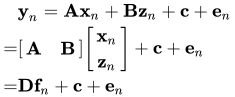
y n × n + B z n + c + e n [ B ] [ × n z n ] + c + e n D f n + c + e n {\displaystyle {\begin{aligned}&\mathbf {y} _{n}=\mathbf {A} \mathbf {x} _{n}+\mathbf {B} \mathbf {z} _{n}+\mathbf {c} +\mathbf {e} _{n}\\=&{\begin{bmatrix}\mathbf {A} &\mathbf {B} \end{bmatrix}}{\begin{bmatrix}\mathbf {x} _{n}\\\mathbf {z} _{n}\end{bmatrix}}+\mathbf {c} +\mathbf {e} _{n}\\=&\mathbf {D} \mathbf {f} _{n}+\mathbf {c} +\mathbf {e} _{n}\end{aligned}}}

ここで、はハイブリッド因子モデルの負荷行列であり、は既知の因子と未知の因子を含む因子です。 D [ B ] {\displaystyle \mathbf {D} ={\begin{bmatrix}\mathbf {A} &\mathbf {B} \end{bmatrix}}} f n [ × n z n ] {\displaystyle \mathbf {f} _{n}={\begin{bmatrix}\mathbf {x} _{n}\\\mathbf {z} _{n}\end{bmatrix}}}

ソフトウェア

因子回帰を実行するためのオープンソースソフトウェアが利用可能です。

参考文献

  1. ^ Carvalho, Carlos M. (2008年12月1日). 「高次元スパース因子モデリング:遺伝子発現ゲノミクスへの応用」. Journal of the American Statistical Association . 103 (484): 1438– 1456. doi :10.1198/016214508000000869. PMC 3017385.  PMID 21218139  .
  2. ^ ab Meng, J. (2011). 「非負性ハイブリッド因子モデルを用いたグリオーブラストーマにおけるマイクロRNAと転写因子による協調的遺伝子制御の解明」.国際音響・音声・信号処理会議. 2011年11月23日時点のオリジナルよりアーカイブ。
「https://en.wikipedia.org/w/index.php?title=Factor_regression_model&oldid=1078447889」より取得

