確率論において、ジョセフ・L・ドゥーブとユージン・ディンキンにちなんで名付けられたドゥーブ・ディンキンの補題(因数分解補題とも呼ばれる)は、ある確率変数が別の確率変数の関数である状況を、それらの確率変数によって生成される-代数を包含することによって特徴付ける。この補題の通常の記述は、一方の確率変数が他方の確率変数によって生成される -代数 に関して可測であるという形で定式化される。

この補題は確率論の条件付き期待値において重要な役割を果たし、ランダム変数の条件付けを、ランダム変数によって生成される-代数の条件付けに置き換えることを可能にします。
注釈と序論
以下の補題において、は上のボレル集合の -代数である。が可測空間である場合 、
![{\displaystyle {\mathcal {B}}[0,1]}](https://wikimedia.org/api/rest_v1/media/math/render/svg/951a86226f30db5a16eeca67219d4456a20660f4)
![{\displaystyle [0,1].}](https://wikimedia.org/api/rest_v1/media/math/render/svg/8786b5ef9daedb24adb59e7825c4096d99a99648)



は、 - 測定可能であるような、上の最小の - 代数です。


補題の記述
を関数とし、を可測空間とする。関数が-可測であるためには、ある-可測な[1]に対して


![{\displaystyle f\colon \Omega \rightarrow [0,1]}](https://wikimedia.org/api/rest_v1/media/math/render/svg/ea827480043fe435c6d11e71a9b726e91fce9c41)
![{\displaystyle \sigma (T)/{\mathcal {B}}[0,1]}](https://wikimedia.org/api/rest_v1/media/math/render/svg/5fbdb61984278d62a732d7d2d830b813b146b018)

![{\displaystyle {\mathcal {A}}'/{\mathcal {B}}[0,1]}](https://wikimedia.org/api/rest_v1/media/math/render/svg/f6a1fa75cfb75c5f6e062890e752aa7b6a450ee4)
![{\displaystyle g\colon \Omega '\to [0,1].}](https://wikimedia.org/api/rest_v1/media/math/render/svg/97c4ced72e26f107a15f78220b7f9f71cf98496e)
注:「もし」の部分は、2つの測定可能な関数の合成が測定可能であることを単に述べています。「その場合のみ」の部分は以下で証明されます。
| 証拠。 |
|
を -測定可能とします。 まず、を の下での -測定可能な集合の逆像の集合として定義することにより、 であればとなるような が存在することがわかります。 ここで、 が何らかの集合 の指示子であると仮定する。となるような関数を同定すれば、関数 は要件を満たす。また、 であるため、そのような集合は常に存在する。線型性により、この主張は任意の単純な測定可能な関数に拡張される。 は測定可能だが必ずしも単純ではないとする。単純関数に関する記事で説明したように、は単調非減少な単純関数列の各点極限である。前のステップにより、ある測定可能な関数に対して、その上限が全体に存在し、測定可能であることが保証される。(測定可能関数に関する記事では、測定可能関数列の上限が測定可能である理由を説明)。任意の関数列に対して、その列は非減少なので、次のことがわかる。 |







注意:空間を に置き換えた場合でも補題は有効であり、はと一対一であり、一対一は両方向に測定可能です。
![{\displaystyle ([0,1],{\mathcal {B}}[0,1])}](https://wikimedia.org/api/rest_v1/media/math/render/svg/2d4de48f2a5904741d0b1401fb5b1397c4276b33)

![{\displaystyle S\subseteq [-\infty ,\infty ],}](https://wikimedia.org/api/rest_v1/media/math/render/svg/a447a5118b17071ba913a405d853dc1c9ebb3c5c)

![{\displaystyle [0,1],}](https://wikimedia.org/api/rest_v1/media/math/render/svg/971caee396752d8bf56711f55d2c3b1207d4a236)
定義により、 の測定可能性は、すべてのボレル集合に対して であることを意味します。したがって、補題は次のように言い換えることができます。
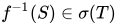
![{\displaystyle S\subseteq [0,1].}](https://wikimedia.org/api/rest_v1/media/math/render/svg/8f58574cd0e18efc38c4ae7117f47feb44347bc5)
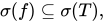
補題。と を可測空間とする。すると、に対して-可測となるのは、 かつ と同値である。

![{\displaystyle f\colon \Omega \rightarrow [0,1],}](https://wikimedia.org/api/rest_v1/media/math/render/svg/b94662753bf08122e20dbf8540ad1183a58a6a39)
![{\displaystyle g\colon \Omega '\to [0,1],}](https://wikimedia.org/api/rest_v1/media/math/render/svg/b8140696be3ec0fc81061896c962a4b89dd4e45a)

参照
参考文献
- ^ カレンバーグ、オラフ(1997). 『現代確率論の基礎』シュプリンガー. p. 7. ISBN 0-387-94957-7。
- A.ボブロウスキー:確率過程と確率過程の機能解析入門、ケンブリッジ大学出版局(2005年)、ISBN 0-521-83166-0
- MM Rao, RJ Swift:確率論とその応用, 数学とその応用, 第582巻, Springer-Verlag (2006), ISBN 0-387-27730-7 doi :10.1007/0-387-27731-5
