フラマントソリューション

先端に2つの力が加わった弾性くさび

連続体力学においてフラマン解は、先端に点荷重が加わった線形弾性くさびの応力と変位を表す式を与える。この解は、1892年[1]にアルフレッド=エメ・フラマン[fr]によって、ジョセフヴァレンタンブシネスク線形弾性に関する 三次元改良して開発された

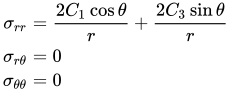
フラマン解によって予測される応力は(極座標で)

σ r r = 2 C 1 cos θ r + 2 C 3 sin θ r σ r θ = 0 σ θ θ = 0 {\displaystyle {\begin{aligned}\sigma _{rr}&={\frac {2C_{1}\cos \theta }{r}}+{\frac {2C_{3}\sin \theta }{r}}\\\sigma _{r\theta }&=0\\\sigma _{\theta \theta }&=0\end{aligned}}}

ここで、は境界条件とくさびの形状(すなわち、角度)から決定される定数であり、 C 1 , C 3 {\displaystyle C_{1},C_{3}} α , β {\displaystyle \alpha ,\beta }

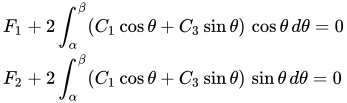
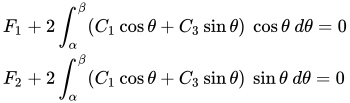
F 1 + 2 α β ( C 1 cos θ + C 3 sin θ ) cos θ d θ = 0 F 2 + 2 α β ( C 1 cos θ + C 3 sin θ ) sin θ d θ = 0 {\displaystyle {\begin{aligned}F_{1}&+2\int _{\alpha }^{\beta }(C_{1}\cos \theta +C_{3}\sin \theta )\,\cos \theta \,d\theta =0\\F_{2}&+2\int _{\alpha }^{\beta }(C_{1}\cos \theta +C_{3}\sin \theta )\,\sin \theta \,d\theta =0\end{aligned}}}

適用される力は どこにありますか。 F 1 , F 2 {\displaystyle F_{1},F_{2}}

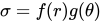
くさび問題は自己相似であり、固有の長さスケールを持たない。また、すべての量は分離変数形式で表すことができる。応力は のように変化する σ = f ( r ) g ( θ ) {\displaystyle \sigma =f(r)g(\theta )} ( 1 / r ) {\displaystyle (1/r)}

半平面に作用する力

2 点の力によって荷重がかかった弾性半平面。

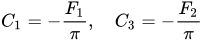
,の特殊なケースではくさびは法線力と接線力を持つ半平面に変換されます。その場合、 α = π {\displaystyle \alpha =-\pi } β = 0 {\displaystyle \beta =0}

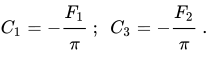
C 1 = F 1 π , C 3 = F 2 π {\displaystyle C_{1}=-{\frac {F_{1}}{\pi }},\quad C_{3}=-{\frac {F_{2}}{\pi }}}

したがって、ストレスは

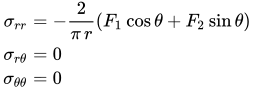
σ r r = 2 π r ( F 1 cos θ + F 2 sin θ ) σ r θ = 0 σ θ θ = 0 {\displaystyle {\begin{aligned}\sigma _{rr}&=-{\frac {2}{\pi \,r}}(F_{1}\cos \theta +F_{2}\sin \theta )\\\sigma _{r\theta }&=0\\\sigma _{\theta \theta }&=0\end{aligned}}}

そして変位は(ミッシェルの解を用いると)

u r = 1 4 π μ [ F 1 { ( κ 1 ) θ sin θ cos θ + ( κ + 1 ) ln r cos θ } + F 2 { ( κ 1 ) θ cos θ + sin θ ( κ + 1 ) ln r sin θ } ] u θ = 1 4 π μ [ F 1 { ( κ 1 ) θ cos θ sin θ ( κ + 1 ) ln r sin θ } F 2 { ( κ 1 ) θ sin θ + cos θ + ( κ + 1 ) ln r cos θ } ] {\displaystyle {\begin{aligned}u_{r}&=-{\cfrac {1}{4\pi \mu }}\left[F_{1}\{(\kappa -1)\theta \sin \theta -\cos \theta +(\kappa +1)\ln r\cos \theta \}+\right.\\&\qquad \qquad \left.F_{2}\{(\kappa -1)\theta \cos \theta +\sin \theta -(\kappa +1)\ln r\sin \theta \}\right]\\u_{\theta }&=-{\cfrac {1}{4\pi \mu }}\left[F_{1}\{(\kappa -1)\theta \cos \theta -\sin \theta -(\kappa +1)\ln r\sin \theta \}-\right.\\&\qquad \qquad \left.F_{2}\{(\kappa -1)\theta \sin \theta +\cos \theta +(\kappa +1)\ln r\cos \theta \}\right]\end{aligned}}}

変位の依存性は、力の作用点から遠ざかるほど変位が大きくなる(そして無限大では無限大になる)ことを示唆している。フラマン解のこの特徴は混乱を招き、非物理的に見える。[2] ln r {\displaystyle \ln r}

半平面の表面における変位

半平面の表面における方向 の変位は次のように与えられる。 x 1 , x 2 {\displaystyle x_{1},x_{2}}

u 1 = F 1 ( κ + 1 ) ln | x 1 | 4 π μ + F 2 ( κ 1 ) sign ( x 1 ) 8 μ u 2 = F 2 ( κ + 1 ) ln | x 1 | 4 π μ + F 1 ( κ 1 ) sign ( x 1 ) 8 μ {\displaystyle {\begin{aligned}u_{1}&={\frac {F_{1}(\kappa +1)\ln |x_{1}|}{4\pi \mu }}+{\frac {F_{2}(\kappa -1){\text{sign}}(x_{1})}{8\mu }}\\u_{2}&={\frac {F_{2}(\kappa +1)\ln |x_{1}|}{4\pi \mu }}+{\frac {F_{1}(\kappa -1){\text{sign}}(x_{1})}{8\mu }}\end{aligned}}}

どこ

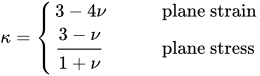
κ = { 3 4 ν plane strain 3 ν 1 + ν plane stress {\displaystyle \kappa ={\begin{cases}3-4\nu &\qquad {\text{plane strain}}\\{\cfrac {3-\nu }{1+\nu }}&\qquad {\text{plane stress}}\end{cases}}}

ν {\displaystyle \nu } ポアソン比せん断弾性率 μ {\displaystyle \mu }

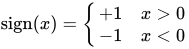
sign ( x ) = { + 1 x > 0 1 x < 0 {\displaystyle {\text{sign}}(x)={\begin{cases}+1&x>0\\-1&x<0\end{cases}}}

導出

応力が のように変化すると仮定すると、ミッチェルの解から応力に含まれる項を取り出すことができる。すると、エアリー応力関数は次のように表される。 ( 1 / r ) {\displaystyle (1/r)} 1 / r {\displaystyle 1/r}

φ = C 1 r θ sin θ + C 2 r ln r cos θ + C 3 r θ cos θ + C 4 r ln r sin θ {\displaystyle \varphi =C_{1}r\theta \sin \theta +C_{2}r\ln r\cos \theta +C_{3}r\theta \cos \theta +C_{4}r\ln r\sin \theta }

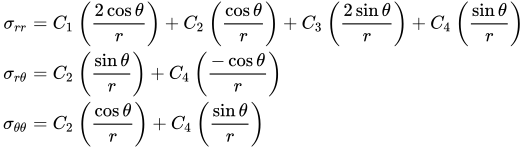
したがって、ミッシェルの解の表から

σ r r = C 1 ( 2 cos θ r ) + C 2 ( cos θ r ) + C 3 ( 2 sin θ r ) + C 4 ( sin θ r ) σ r θ = C 2 ( sin θ r ) + C 4 ( cos θ r ) σ θ θ = C 2 ( cos θ r ) + C 4 ( sin θ r ) {\displaystyle {\begin{aligned}\sigma _{rr}&=C_{1}\left({\frac {2\cos \theta }{r}}\right)+C_{2}\left({\frac {\cos \theta }{r}}\right)+C_{3}\left({\frac {2\sin \theta }{r}}\right)+C_{4}\left({\frac {\sin \theta }{r}}\right)\\\sigma _{r\theta }&=C_{2}\left({\frac {\sin \theta }{r}}\right)+C_{4}\left({\frac {-\cos \theta }{r}}\right)\\\sigma _{\theta \theta }&=C_{2}\left({\frac {\cos \theta }{r}}\right)+C_{4}\left({\frac {\sin \theta }{r}}\right)\end{aligned}}}

原理的には、定数はくさびの形状と適用された境界条件から決定できます。 C 1 , C 2 , C 3 , C 4 {\displaystyle C_{1},C_{2},C_{3},C_{4}}

しかし、頂点の集中荷重は、牽引 境界条件で表現することが難しい

  1. 頂点における単位外向き法線は定義されていない
  2. 力は(面積がゼロの)点に加えられるため、その点における牽引力は無限大になります。
力とモーメントの平衡を保つための境界付き弾性くさび。

この問題を回避するために、くさびの境界領域を考え、その境界領域におけるくさびの平衡状態を考える。[3] [4]境界領域におけるくさびに、2つのトラクションフリー面と、半径 の円弧状の3つ目の面があるとする。円弧に沿って、単位外向き法線は であり、基底ベクトルは である。円弧上のトラクションは a {\displaystyle a\,} n = e r {\displaystyle \mathbf {n} =\mathbf {e} _{r}} ( e r , e θ ) {\displaystyle (\mathbf {e} _{r},\mathbf {e} _{\theta })}

t = σ n t r = σ r r ,   t θ = σ r θ   . {\displaystyle \mathbf {t} ={\boldsymbol {\sigma }}\cdot \mathbf {n} \quad \implies t_{r}=\sigma _{rr},~t_{\theta }=\sigma _{r\theta }~.}

次に、境界付きくさびにおける力とモーメントの釣り合いを調べ、

f 1 = F 1 + α β [ σ r r ( a , θ )   cos θ σ r θ ( a , θ )   sin θ ]   a   d θ = 0 f 2 = F 2 + α β [ σ r r ( a , θ )   sin θ + σ r θ ( a , θ )   cos θ ]   a   d θ = 0 m 3 = α β [ a   σ r θ ( a , θ ) ]   a   d θ = 0 {\displaystyle {\begin{aligned}\sum f_{1}&=F_{1}+\int _{\alpha }^{\beta }\left[\sigma _{rr}(a,\theta )~\cos \theta -\sigma _{r\theta }(a,\theta )~\sin \theta \right]~a~d\theta =0\\\sum f_{2}&=F_{2}+\int _{\alpha }^{\beta }\left[\sigma _{rr}(a,\theta )~\sin \theta +\sigma _{r\theta }(a,\theta )~\cos \theta \right]~a~d\theta =0\\\sum m_{3}&=\int _{\alpha }^{\beta }\left[a~\sigma _{r\theta }(a,\theta )\right]~a~d\theta =0\end{aligned}}}

これらの方程式は のすべての値に対して満たされ、それによって境界条件を満たす必要があります。 a {\displaystyle a\,}

エッジ上のトラクションフリー境界条件 θ = α {\displaystyle \theta =\alpha } θ = β {\displaystyle \theta =\beta }

σ r θ = σ θ θ = 0 at     θ = α , θ = β {\displaystyle \sigma _{r\theta }=\sigma _{\theta \theta }=0\qquad {\text{at}}~~\theta =\alpha ,\theta =\beta }

ただし、その点を除きます r = 0 {\displaystyle r=0}

どこでもそうであると仮定すると、トラクションフリー条件とモーメント平衡方程式が満たされ、次の式が残ります。 σ r θ = 0 {\displaystyle \sigma _{r\theta }=0}

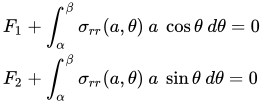
F 1 + α β σ r r ( a , θ )   a   cos θ   d θ = 0 F 2 + α β σ r r ( a , θ )   a   sin θ   d θ = 0 {\displaystyle {\begin{aligned}F_{1}&+\int _{\alpha }^{\beta }\sigma _{rr}(a,\theta )~a~\cos \theta ~d\theta =0\\F_{2}&+\int _{\alpha }^{\beta }\sigma _{rr}(a,\theta )~a~\sin \theta ~d\theta =0\end{aligned}}}

点 を除いて に沿っています。しかし、場はどこでも力の釣り合い方程式も満たします。したがって、これが解であるはずです。また、この仮定はを意味します σ θ θ = 0 {\displaystyle \sigma _{\theta \theta }=0} θ = α , θ = β {\displaystyle \theta =\alpha ,\theta =\beta } r = 0 {\displaystyle r=0} σ θ θ = 0 {\displaystyle \sigma _{\theta \theta }=0} σ r θ = 0 {\displaystyle \sigma _{r\theta }=0} C 2 = C 4 = 0 {\displaystyle C_{2}=C_{4}=0}

したがって、

σ r r = 2 C 1 cos θ r + 2 C 3 sin θ r   ;     σ r θ = 0   ;     σ θ θ = 0 {\displaystyle \sigma _{rr}={\frac {2C_{1}\cos \theta }{r}}+{\frac {2C_{3}\sin \theta }{r}}~;~~\sigma _{r\theta }=0~;~~\sigma _{\theta \theta }=0}

の特定の解を見つけるには、の式を力の平衡方程式に代入して、について解く必要がある 2 つの方程式のシステムを取得する必要があります σ r r {\displaystyle \sigma _{rr}} σ r r {\displaystyle \sigma _{rr}} C 1 , C 3 {\displaystyle C_{1},C_{3}}

F 1 + 2 α β ( C 1 cos θ + C 3 sin θ )   cos θ   d θ = 0 F 2 + 2 α β ( C 1 cos θ + C 3 sin θ )   sin θ   d θ = 0 {\displaystyle {\begin{aligned}F_{1}&+2\int _{\alpha }^{\beta }(C_{1}\cos \theta +C_{3}\sin \theta )~\cos \theta ~d\theta =0\\F_{2}&+2\int _{\alpha }^{\beta }(C_{1}\cos \theta +C_{3}\sin \theta )~\sin \theta ~d\theta =0\end{aligned}}}

半平面に作用する力

とをとると問題は半平面に 垂直力と接線力が作用する問題に変換されます。その場合、力の釣り合い方程式は次のようになります。 α = π {\displaystyle \alpha =-\pi } β = 0 {\displaystyle \beta =0} F 2 {\displaystyle F_{2}} F 1 {\displaystyle F_{1}}

F 1 + 2 π 0 ( C 1 cos θ + C 3 sin θ )   cos θ   d θ = 0 F 1 + C 1 π = 0 F 2 + 2 π 0 ( C 1 cos θ + C 3 sin θ )   sin θ   d θ = 0 F 2 + C 3 π = 0 {\displaystyle {\begin{aligned}F_{1}&+2\int _{-\pi }^{0}(C_{1}\cos \theta +C_{3}\sin \theta )~\cos \theta ~d\theta =0\qquad \implies F_{1}+C_{1}\pi =0\\F_{2}&+2\int _{-\pi }^{0}(C_{1}\cos \theta +C_{3}\sin \theta )~\sin \theta ~d\theta =0\qquad \implies F_{2}+C_{3}\pi =0\end{aligned}}}

したがって

C 1 = F 1 π   ;     C 3 = F 2 π   . {\displaystyle C_{1}=-{\cfrac {F_{1}}{\pi }}~;~~C_{3}=-{\cfrac {F_{2}}{\pi }}~.}

この状況のストレスは

σ r r = 2 π r ( F 1 cos θ + F 2 sin θ )   ;     σ r θ = 0   ;     σ θ θ = 0 {\displaystyle \sigma _{rr}=-{\frac {2}{\pi r}}(F_{1}\cos \theta +F_{2}\sin \theta )~;~~\sigma _{r\theta }=0~;~~\sigma _{\theta \theta }=0}

ミッシェル解の変位表を用いると、この場合の変位は次のように与えられる。

u r = 1 4 π μ [ F 1 { ( κ 1 ) θ sin θ cos θ + ( κ + 1 ) ln r cos θ } + F 2 { ( κ 1 ) θ cos θ + sin θ ( κ + 1 ) ln r sin θ } ] u θ = 1 4 π μ [ F 1 { ( κ 1 ) θ cos θ sin θ ( κ + 1 ) ln r sin θ } F 2 { ( κ 1 ) θ sin θ + cos θ + ( κ + 1 ) ln r cos θ } ] {\displaystyle {\begin{aligned}u_{r}&=-{\cfrac {1}{4\pi \mu }}\left[F_{1}\{(\kappa -1)\theta \sin \theta -\cos \theta +(\kappa +1)\ln r\cos \theta \}+\right.\\&\qquad \qquad \left.F_{2}\{(\kappa -1)\theta \cos \theta +\sin \theta -(\kappa +1)\ln r\sin \theta \}\right]\\u_{\theta }&=-{\cfrac {1}{4\pi \mu }}\left[F_{1}\{(\kappa -1)\theta \cos \theta -\sin \theta -(\kappa +1)\ln r\sin \theta \}-\right.\\&\qquad \qquad \left.F_{2}\{(\kappa -1)\theta \sin \theta +\cos \theta +(\kappa +1)\ln r\cos \theta \}\right]\end{aligned}}}

半平面の表面における変位

半平面の表面での変位を表す式を求めるには、まずこれらの位置に沿った正の変位( ) と負の変位( )を求めます x 1 {\displaystyle x_{1}} θ = 0 {\displaystyle \theta =0} x 1 {\displaystyle x_{1}} θ = π {\displaystyle \theta =\pi } r = | x 1 | {\displaystyle r=|x_{1}|}

なぜなら私たちは θ = 0 {\displaystyle \theta =0}

u r = u 1 = F 1 4 π μ [ 1 ( κ + 1 ) ln | x 1 | ] u θ = u 2 = F 2 4 π μ [ 1 + ( κ + 1 ) ln | x 1 | ] {\displaystyle {\begin{aligned}u_{r}=u_{1}&={\cfrac {F_{1}}{4\pi \mu }}\left[1-(\kappa +1)\ln |x_{1}|\right]\\u_{\theta }=u_{2}&={\cfrac {F_{2}}{4\pi \mu }}\left[1+(\kappa +1)\ln |x_{1}|\right]\end{aligned}}}

なぜなら私たちは θ = π {\displaystyle \theta =\pi }

u r = u 1 = F 1 4 π μ [ 1 ( κ + 1 ) ln | x 1 | ] + F 2 4 μ ( κ 1 ) u θ = u 2 = F 1 4 μ ( κ 1 ) F 2 4 π μ [ 1 + ( κ + 1 ) ln | x 1 | ] {\displaystyle {\begin{aligned}u_{r}=-u_{1}&=-{\cfrac {F_{1}}{4\pi \mu }}\left[1-(\kappa +1)\ln |x_{1}|\right]+{\cfrac {F_{2}}{4\mu }}(\kappa -1)\\u_{\theta }=-u_{2}&={\cfrac {F_{1}}{4\mu }}(\kappa -1)-{\cfrac {F_{2}}{4\pi \mu }}\left[1+(\kappa +1)\ln |x_{1}|\right]\end{aligned}}}

剛体変位を加えることで、力の作用点を中心に変位を対称にすることができます(応力には影響しません)。

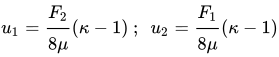
u 1 = F 2 8 μ ( κ 1 )   ;     u 2 = F 1 8 μ ( κ 1 ) {\displaystyle u_{1}={\cfrac {F_{2}}{8\mu }}(\kappa -1)~;~~u_{2}={\cfrac {F_{1}}{8\mu }}(\kappa -1)}

冗長な剛体変位を除去する

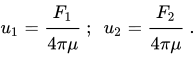
u 1 = F 1 4 π μ   ;     u 2 = F 2 4 π μ   . {\displaystyle u_{1}={\cfrac {F_{1}}{4\pi \mu }}~;~~u_{2}={\cfrac {F_{2}}{4\pi \mu }}~.}

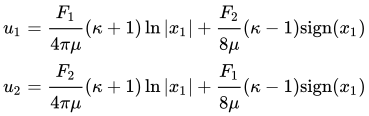
そして表面の変位は結合されて次の形をとる。

u 1 = F 1 4 π μ ( κ + 1 ) ln | x 1 | + F 2 8 μ ( κ 1 ) sign ( x 1 ) u 2 = F 2 4 π μ ( κ + 1 ) ln | x 1 | + F 1 8 μ ( κ 1 ) sign ( x 1 ) {\displaystyle {\begin{aligned}u_{1}&={\cfrac {F_{1}}{4\pi \mu }}(\kappa +1)\ln |x_{1}|+{\cfrac {F_{2}}{8\mu }}(\kappa -1){\text{sign}}(x_{1})\\u_{2}&={\cfrac {F_{2}}{4\pi \mu }}(\kappa +1)\ln |x_{1}|+{\cfrac {F_{1}}{8\mu }}(\kappa -1){\text{sign}}(x_{1})\end{aligned}}}

どこ

sign ( x ) = { + 1 x > 0 1 x < 0 {\displaystyle {\text{sign}}(x)={\begin{cases}+1&x>0\\-1&x<0\end{cases}}}

参考文献

  1. ^ A. フラマント。 (1892年)。長方形の横断面での分割の分割。コンプします。レンドゥ。アカド。科学。パリ、vol. 114、p. 1465年。
  2. ^ 「平面弾性問題」iMechanica . 2024年11月18日閲覧
  3. ^ Slaughter, WS (2002).線形弾性理論. Birkhauser, Boston, p. 294.
  4. ^ JR Barber、2002年、「Elasticity: 2nd Edition」、Kluwer Academic Publishers。

Retrieved from "https://en.wikipedia.org/w/index.php?title=Flamant_solution&oldid=1282761131"