ランク・ヌル定理 階数零定理は 線形代数 の定理であり、次のことを主張する。
したがって、等しい有限次元のベクトル空間 の線形変換の場合、単射性 または全射性のいずれかが 全単射性を 意味することになります。
定理を述べる
を2つのベクトル空間間の線型変換とします。ここで、の定義域は有限次元です。ここで、 は(その像 の次元 ) の階数であり、は(その 核 の次元)の零性 です。言い換えれば、 この定理は分割補題 によって、次元だけでなく空間の同型性 に関する命題へと洗練することができます。明示的に、は からへの同型性を誘導するので、 の任意の基底を拡張する の基底の存在は、分割補題によって、 が成り立つことを意味します。次元をとると、階数零性定理が成り立ちます。 T : V → W {\displaystyle T:V\to W} T {\displaystyle T} V {\displaystyle V} ランク ( T ) + 無効 ( T ) = 薄暗い V 、 {\displaystyle \operatorname {rank} (T)~+~\operatorname {nullity} (T)~=~\dim V,} ランク ( T ) {\textstyle \operatorname {ランク} (T)} T {\displaystyle T} 無効 ( T ) {\displaystyle \operatorname {nullity} (T)} T {\displaystyle T} 薄暗い ( 私は T ) + 薄暗い ( カー T ) = 薄暗い ( ドメイン ( T ) ) 。 {\displaystyle \dim(\operatorname {Im} T)+\dim(\operatorname {Ker} T)=\dim(\operatorname {Domain} (T)).} T {\displaystyle T} V / カー ( T ) {\displaystyle V/\オペレータ名 {Ker} (T)} 私は ( T ) 、 {\displaystyle \operatorname {Im} (T),} V {\displaystyle V} カー ( T ) {\displaystyle \operatorname {Ker} (T)} 私は ( T ) ⊕ カー ( T ) ≅ V 。 {\displaystyle \operatorname {Im} (T)\oplus \operatorname {Ker} (T)\cong V.}
行列 線型写像は行列 で表現できる。より正確には、行列Mは 線型写像を表す。ここで、は基礎体である。 [ 5 ] 、 M の列数はnであり、行列M の階数零定理は メートル × n {\displaystyle m\times n} f : F n → F メートル 、 {\displaystyle f:F^{n}\to F^{m},} F {\displaystyle F} f {\displaystyle f} メートル × n {\displaystyle m\times n} ランク ( M ) + 無効 ( M ) = n 。 {\displaystyle \operatorname {rank} (M)+\operatorname {nullity} (M)=n.}
証明 ここでは2つの証明を示す。最初の証明[ 2 ] [ 6 ] は、階数 を持つ同次系aを扱い、 aの零空間を張る線型独立な 解の集合が存在することを明示的に示す。 あ × = 0 、 {\displaystyle \mathbf {Ax} =\mathbf {0} ,} あ {\displaystyle \mathbf {A} } メートル × n {\displaystyle m\times n} r 、 {\displaystyle r,} n − r {\displaystyle nr} あ {\displaystyle \mathbf {A} }
定理は線型写像の領域が有限次元であることを前提としているが、余領域 にはそのような仮定はない。これは、定理が適用される行列で与えられない線型写像が存在することを意味する。しかしながら、最初の証明は実際には2番目の証明よりも一般性が高いわけではない。線型写像の像は有限次元であるため、その領域からその像への写像を行列で表し、その行列に対して定理を証明し、像を余領域全体に含めて合成することができる。
最初の証明 をある体上のベクトル空間とし、の定理の記述で と定義します。 V 、 W {\displaystyle V,W} F 、 {\displaystyle F,} T {\displaystyle T} 薄暗い V = n {\displaystyle \dim V=n}
が部分空間 であるので、その基底が存在します。 を仮定し、 を そのような基底とします。 Ker T ⊂ V {\displaystyle \operatorname {Ker} T\subset V} dim Ker T = k {\displaystyle \dim \operatorname {Ker} T=k} K := { v 1 , … , v k } ⊂ Ker ( T ) {\displaystyle {\mathcal {K}}:=\{v_{1},\ldots ,v_{k}\}\subset \operatorname {Ker} (T)}
ここで、シュタイニッツの交換補題 により、線形独立ベクトルを使用して拡張し、 の完全な基底を形成できます。 K {\displaystyle {\mathcal {K}}} n − k {\displaystyle n-k} w 1 , … , w n − k {\displaystyle w_{1},\ldots ,w_{n-k}} V {\displaystyle V}
が の基底であるとする 。このことから、 S := { w 1 , … , w n − k } ⊂ V ∖ Ker ( T ) {\displaystyle {\mathcal {S}}:=\{w_{1},\ldots ,w_{n-k}\}\subset V\setminus \operatorname {Ker} (T)} B := K ∪ S = { v 1 , … , v k , w 1 , … , w n − k } ⊂ V {\displaystyle {\mathcal {B}}:={\mathcal {K}}\cup {\mathcal {S}}=\{v_{1},\ldots ,v_{k},w_{1},\ldots ,w_{n-k}\}\subset V} V {\displaystyle V} Im T = Span T ( B ) = Span { T ( v 1 ) , … , T ( v k ) , T ( w 1 ) , … , T ( w n − k ) } {\displaystyle \operatorname {Im} T=\operatorname {Span} T({\mathcal {B}})=\operatorname {Span} \{T(v_{1}),\ldots ,T(v_{k}),T(w_{1}),\ldots ,T(w_{n-k})\}}
= Span { T ( w 1 ) , … , T ( w n − k ) } = Span T ( S ) . {\displaystyle =\operatorname {Span} \{T(w_{1}),\ldots ,T(w_{n-k})\}=\operatorname {Span} T({\mathcal {S}}).} ここで、 が の基底であると主張します。上記の等式は、が の生成集合であることを既に示しています。 が基底であると結論付けるには、 が線形独立であることも示す必要があります。 T ( S ) {\displaystyle T({\mathcal {S}})} Im T {\displaystyle \operatorname {Im} T} T ( S ) {\displaystyle T({\mathcal {S}})} Im T {\displaystyle \operatorname {Im} T}
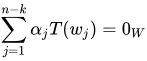
が線形独立ではないと仮定し、 ある について とします。 T ( S ) {\displaystyle T({\mathcal {S}})} ∑ j = 1 n − k α j T ( w j ) = 0 W {\displaystyle \sum _{j=1}^{n-k}\alpha _{j}T(w_{j})=0_{W}} α j ∈ F {\displaystyle \alpha _{j}\in F}
したがって、 の線形性により、 が成り立つ。 これは、すべてがゼロでない限り、 が基底であること と矛盾する。これは、 が線形独立であること、より具体的には の基底であることを示す。 T {\displaystyle T} T ( ∑ j = 1 n − k α j w j ) = 0 W ⟹ ( ∑ j = 1 n − k α j w j ) ∈ Ker T = Span K ⊂ V . {\displaystyle T\left(\sum _{j=1}^{n-k}\alpha _{j}w_{j}\right)=0_{W}\implies \left(\sum _{j=1}^{n-k}\alpha _{j}w_{j}\right)\in \operatorname {Ker} T=\operatorname {Span} {\mathcal {K}}\subset V.} B {\displaystyle {\mathcal {B}}} α j {\displaystyle \alpha _{j}} T ( S ) {\displaystyle T({\mathcal {S}})} Im T {\displaystyle \operatorname {Im} T}
まとめると、 の基底は、の基底はとなります。 K {\displaystyle {\mathcal {K}}} Ker T {\displaystyle \operatorname {Ker} T} T ( S ) {\displaystyle T({\mathcal {S}})} Im T {\displaystyle \operatorname {Im} T}
最後に、 Rank ( T ) + Nullity ( T ) = dim Im T + dim Ker T {\displaystyle \operatorname {Rank} (T)+\operatorname {Nullity} (T)=\dim \operatorname {Im} T+\dim \operatorname {Ker} T}
= | T ( S ) | + | K | = ( n − k ) + k = n = dim V . {\displaystyle =|T({\mathcal {S}})|+|{\mathcal {K}}|=(n-k)+k=n=\dim V.} これで証明は終わりです。
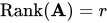
第二校正 を線形独立な 列(すなわち)を持つ行列とします。以下を示します。 A {\displaystyle \mathbf {A} } m × n {\displaystyle m\times n} r {\displaystyle r} Rank ( A ) = r {\displaystyle \operatorname {Rank} (\mathbf {A} )=r}
同次システムには線形独立な解の集合が存在する。n − r {\displaystyle n-r} A x = 0 {\displaystyle \mathbf {Ax} =\mathbf {0} } 他のすべてのソリューションはこれらのソリューションの線形結合であるということです。n − r {\displaystyle n-r} これを実行するには、列が のヌル空間の基底 を形成する行列を作成します。 n × ( n − r ) {\displaystyle n\times (n-r)} X {\displaystyle \mathbf {X} } A {\displaystyle \mathbf {A} }
一般性を失うことなく 、 の最初の列が線形独立であると仮定する。したがって 、 r {\displaystyle r} A {\displaystyle \mathbf {A} } A = ( A 1 A 2 ) , {\displaystyle \mathbf {A} ={\begin{pmatrix}\mathbf {A} _{1}&\mathbf {A} _{2}\end{pmatrix}},}
A 1 {\displaystyle \mathbf {A} _{1}} m × r {\displaystyle m\times r} r {\displaystyle r} A 2 {\displaystyle \mathbf {A} _{2}} m × ( n − r ) {\displaystyle m\times (n-r)} n − r {\displaystyle n-r} A 1 {\displaystyle \mathbf {A} _{1}} これは、ある行列(ランク分解を 参照)に対して、したがって、 A 2 = A 1 B {\displaystyle \mathbf {A} _{2}=\mathbf {A} _{1}\mathbf {B} } r × ( n − r ) {\displaystyle r\times (n-r)} B {\displaystyle \mathbf {B} } A = ( A 1 A 1 B ) . {\displaystyle \mathbf {A} ={\begin{pmatrix}\mathbf {A} _{1}&\mathbf {A} _{1}\mathbf {B} \end{pmatrix}}.}
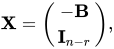
を単位行列 とする 。したがって 、を次の行列 とする。X = ( − B I n − r ) , {\displaystyle \mathbf {X} ={\begin{pmatrix}-\mathbf {B} \\\mathbf {I} _{n-r}\end{pmatrix}},} I n − r {\displaystyle \mathbf {I} _{n-r}} ( n − r ) × ( n − r ) {\displaystyle (n-r)\times (n-r)} X {\displaystyle \mathbf {X} } n × ( n − r ) {\displaystyle n\times (n-r)} A X = ( A 1 A 1 B ) ( − B I n − r ) = − A 1 B + A 1 B = 0 m × ( n − r ) . {\displaystyle \mathbf {A} \mathbf {X} ={\begin{pmatrix}\mathbf {A} _{1}&\mathbf {A} _{1}\mathbf {B} \end{pmatrix}}{\begin{pmatrix}-\mathbf {B} \\\mathbf {I} _{n-r}\end{pmatrix}}=-\mathbf {A} _{1}\mathbf {B} +\mathbf {A} _{1}\mathbf {B} =\mathbf {0} _{m\times (n-r)}.}
したがって、 の各列はの特殊解です。 n − r {\displaystyle n-r} X {\displaystyle \mathbf {X} } A x = 0 F m {\displaystyle \mathbf {Ax} ={0}_{{F}^{m}}}
さらに、の列は線形独立 です。なぜなら、に対してが成り立つからです。 したがって、 の列ベクトルは、に対して線形独立な解の集合を構成します。 n − r {\displaystyle n-r} X {\displaystyle \mathbf {X} } X u = 0 F n {\displaystyle \mathbf {Xu} =\mathbf {0} _{{F}^{n}}} u = 0 F n − r {\displaystyle \mathbf {u} =\mathbf {0} _{{F}^{n-r}}} u ∈ F n − r {\displaystyle \mathbf {u} \in {F}^{n-r}} X u = 0 F n ⟹ ( − B I n − r ) u = 0 F n ⟹ ( − B u u ) = ( 0 F r 0 F n − r ) ⟹ u = 0 F n − r . {\displaystyle \mathbf {X} \mathbf {u} =\mathbf {0} _{{F}^{n}}\implies {\begin{pmatrix}-\mathbf {B} \\\mathbf {I} _{n-r}\end{pmatrix}}\mathbf {u} =\mathbf {0} _{{F}^{n}}\implies {\begin{pmatrix}-\mathbf {B} \mathbf {u} \\\mathbf {u} \end{pmatrix}}={\begin{pmatrix}\mathbf {0} _{{F}^{r}}\\\mathbf {0} _{{F}^{n-r}}\end{pmatrix}}\implies \mathbf {u} =\mathbf {0} _{{F}^{n-r}}.} X {\displaystyle \mathbf {X} } n − r {\displaystyle n-r} A x = 0 F m {\displaystyle \mathbf {Ax} =\mathbf {0} _{\mathbb {F} ^{m}}}
次に、の任意 の解はの列の線形結合 でなければならないことを証明します。 A x = 0 F m {\displaystyle \mathbf {Ax} =\mathbf {0} _{{F}^{m}}} X {\displaystyle \mathbf {X} }
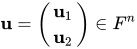
これについては、 u = ( u 1 u 2 ) ∈ F n {\displaystyle \mathbf {u} ={\begin{pmatrix}\mathbf {u} _{1}\\\mathbf {u} _{2}\end{pmatrix}}\in {F}^{n}}
となる任意のベクトルとする。 の列は線形独立なので、となる。 A u = 0 F m {\displaystyle \mathbf {Au} =\mathbf {0} _{{F}^{m}}} A 1 {\displaystyle \mathbf {A} _{1}} A 1 x = 0 F m {\displaystyle \mathbf {A} _{1}\mathbf {x} =\mathbf {0} _{{F}^{m}}} x = 0 F r {\displaystyle \mathbf {x} =\mathbf {0} _{{F}^{r}}}
したがって、 A u = 0 F m ⟹ ( A 1 A 1 B ) ( u 1 u 2 ) = A 1 u 1 + A 1 B u 2 = A 1 ( u 1 + B u 2 ) = 0 F m ⟹ u 1 + B u 2 = 0 F r ⟹ u 1 = − B u 2 {\displaystyle {\begin{array}{rcl}\mathbf {A} \mathbf {u} &=&\mathbf {0} _{{F}^{m}}\\\implies {\begin{pmatrix}\mathbf {A} _{1}&\mathbf {A} _{1}\mathbf {B} \end{pmatrix}}{\begin{pmatrix}\mathbf {u} _{1}\\\mathbf {u} _{2}\end{pmatrix}}&=&\mathbf {A} _{1}\mathbf {u} _{1}+\mathbf {A} _{1}\mathbf {B} \mathbf {u} _{2}&=&\mathbf {A} _{1}(\mathbf {u} _{1}+\mathbf {B} \mathbf {u} _{2})&=&\mathbf {0} _{\mathbb {F} ^{m}}\\\implies \mathbf {u} _{1}+\mathbf {B} \mathbf {u} _{2}&=&\mathbf {0} _{{F}^{r}}\\\implies \mathbf {u} _{1}&=&-\mathbf {B} \mathbf {u} _{2}\end{array}}} ⟹ u = ( u 1 u 2 ) = ( − B I n − r ) u 2 = X u 2 . {\displaystyle \implies \mathbf {u} ={\begin{pmatrix}\mathbf {u} _{1}\\\mathbf {u} _{2}\end{pmatrix}}={\begin{pmatrix}-\mathbf {B} \\\mathbf {I} _{n-r}\end{pmatrix}}\mathbf {u} _{2}=\mathbf {X} \mathbf {u} _{2}.}
これは、 の解である任意のベクトルは、の列によって与えられる特殊解の線形結合でなければならないことを証明しています。また、 の列は線形独立であることは既に述べました。したがって、 の列はの零空間 の基底を構成します。したがって、の零空間性は です。は の階数に等しいので、 が成り立ちます。これで証明は終わりです。 u {\displaystyle \mathbf {u} } A x = 0 {\displaystyle \mathbf {Ax} =\mathbf {0} } n − r {\displaystyle n-r} X {\displaystyle \mathbf {X} } X {\displaystyle \mathbf {X} } X {\displaystyle \mathbf {X} } A {\displaystyle \mathbf {A} } A {\displaystyle \mathbf {A} } n − r {\displaystyle n-r} r {\displaystyle r} A {\displaystyle \mathbf {A} } Rank ( A ) + Nullity ( A ) = n {\displaystyle \operatorname {Rank} (\mathbf {A} )+\operatorname {Nullity} (\mathbf {A} )=n}
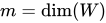
3番目の基本部分空間 が2つの有限次元部分空間の間の線型変換であり、かつ (したがって は行列 で表すことができる)であるとき、階数零定理は、が階数を持つ場合、は の零空間 の次元であり、これはの核 を表すことを主張する。テキストによっては、 に関連付けられた3つ目の基本部分空間がその像と核と並んで考慮される。の余核は 商空間 であり 、その次元は である。この次元の公式( と表現されることもある)は、階数零定理とともに、線型代数の基本定理 と呼ばれることがある。[ 7 ] [ 8 ] T : V → W {\displaystyle T:V\to W} n = dim ( V ) {\displaystyle n=\dim(V)} m = dim ( W ) {\displaystyle m=\dim(W)} m × n {\displaystyle m\times n} M {\displaystyle M} T {\displaystyle T} r {\displaystyle r} n − r {\displaystyle n-r} M {\displaystyle M} T {\displaystyle T} T {\displaystyle T} T {\displaystyle T} W / Im ( T ) {\displaystyle W/\operatorname {Im} (T)} m − r {\displaystyle m-r} dim Im ( T ) + dim Coker ( T ) = dim ( W ) {\displaystyle \dim \operatorname {Im} (T)+\dim \operatorname {Coker} (T)=\dim(W)}
この定理は、ベクトル空間の場合の代数学の最初の同型定理 の記述であり、分割補題 に一般化されます。
より現代的な言葉で言えば、この定理はベクトル空間の短完全列はそれぞれ分解する、とも表現できる。明示的には、 ベクトル空間の短完全列 が与えられれ ば、 となり、 したがって となる。 ここではの役割を果たしており、は である。すなわち 0 → U → V → T R → 0 {\displaystyle 0\rightarrow U\rightarrow V\mathbin {\overset {T}{\rightarrow }} R\rightarrow 0} U ⊕ R ≅ V {\displaystyle U\oplus R\cong V} dim ( U ) + dim ( R ) = dim ( V ) . {\displaystyle \dim(U)+\dim(R)=\dim(V).} R {\displaystyle R} Im T {\displaystyle \operatorname {Im} T} U {\displaystyle U} Ker T {\displaystyle \operatorname {Ker} T} 0 → ker T ↪ V → T im T → 0 {\displaystyle 0\rightarrow \ker T\mathbin {\hookrightarrow } V\mathbin {\overset {T}{\rightarrow }} \operatorname {im} T\rightarrow 0}
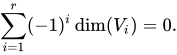
有限次元の場合、この定式化は一般化できる。 すなわち、 が有限次元ベクトル空間の正確な列 であるとき、 [ 9 ] 添字 を用いて定式化することもできる。と が有限次元である とき、線型写像の添字は次のように定義される。0 → V 1 → V 2 → ⋯ → V r → 0 {\displaystyle 0\rightarrow V_{1}\rightarrow V_{2}\rightarrow \cdots \rightarrow V_{r}\rightarrow 0} ∑ i = 1 r ( − 1 ) i dim ( V i ) = 0. {\displaystyle \sum _{i=1}^{r}(-1)^{i}\dim(V_{i})=0.} T ∈ Hom ( V , W ) {\displaystyle T\in \operatorname {Hom} (V,W)} V {\displaystyle V} W {\displaystyle W} index T = dim Ker ( T ) − dim Coker T . {\displaystyle \operatorname {index} T=\dim \operatorname {Ker} (T)-\dim \operatorname {Coker} T.}
直感的に、は方程式 の独立解の数であり、 は方程式 を解けるようにするために課される独立制約の数である。有限次元ベクトル空間の階数零定理は、以下の命題と同値である。 dim Ker T {\displaystyle \dim \operatorname {Ker} T} v {\displaystyle v} T v = 0 {\displaystyle Tv=0} dim Coker T {\displaystyle \dim \operatorname {Coker} T} w {\displaystyle w} T v = w {\displaystyle Tv=w} index T = dim V − dim W . {\displaystyle \operatorname {index} T=\dim V-\dim W.}
線型写像の添え字は、詳細な解析を必要とせずに、関係する空間から容易に読み取ることができることがわかります。この効果は、より深い結果にも現れます。アティヤ・シンガーの添え字定理は、 特定の微分作用素の添え字は、関係する空間の幾何学から読み取ることができると述べています。 T {\displaystyle T} T {\displaystyle T}
引用 ^ アクラー(2015) 63頁、§3.22^ a b Friedberg, Insel & Spence (2014) p. 70, §2.1, 定理2.3^ カッツネルソン&カッツネルソン (2008) p. 52、§2.5.1^ ヴァレンツァ(1993) p.71、§4.3^ Friedberg, Insel & Spence (2014) pp. 103-104, §2.4, 定理2.20^ Banerjee, Sudipto; Roy, Anindya (2014),統計のための線形代数と行列分析 、統計科学テキスト(第1版)、Chapman and Hall/CRC、ISBN 978-1420095388 ^ *ストラング、ギルバート著 『線形代数とその応用 』第3版、オーランド:サンダース、1988年。 ^ Strang, Gilbert (1993)、 「線形代数の基本定理」 (PDF) 、 American Mathematical Monthly 、 100 (9): 848– 855、 CiteSeerX 10.1.1.384.2309 、 doi : 10.2307/2324660 、 JSTOR 2324660 ^ Zaman, Ragib. 「正確な数列におけるベクトル空間の次元」 Mathematics Stack Exchange . 2015年 10月27日 閲覧 。
参考文献 アクラー、シェルドン (2015年)『線形代数の正しい使い方 』『学部生向け数学テキスト (第3版)』Springer社 、ISBN 978-3-319-11079-0 Banerjee, Sudipto; Roy, Anindya (2014), Linear Algebra and Matrix Analysis for Statistics , Texts in Statistical Science (第1版), Chapman and Hall/CRC, ISBN 978-1420095388 Friedberg, Stephen H.; Insel, Arnold J.; Spence, Lawrence E. (2014).線形代数 (第4版). Pearson Education . ISBN 978-0130084514 マイヤー、カール D. (2000)、『行列解析と応用線形代数』 SIAM 、ISBN 978-0-89871-454-8 Katznelson, イツハク ;カッツネルソン、ヨナタン R. (2008)。線形代数の (簡潔な) 入門 。アメリカ数学協会 。ISBN 978-0-8218-4419-9 ヴァレンツァ、ロバート・J. (1993) [1951].線形代数:抽象数学入門 .学部生向け数学テキスト (第3版).シュプリンガー . ISBN 3-540-94099-5
外部リンク