Kerr–Newman metric
| General relativity |
|---|
 |



The Kerr–Newman metric describes the spacetime geometry around a mass that is electrically charged and rotating. It is a vacuum solution that generalizes the Kerr metric (which describes an uncharged, rotating mass) by additionally taking into account the energy of an electromagnetic field, making it the most general asymptotically flat and stationary solution of the Einstein–Maxwell equations in general relativity. As an electrovacuum solution, it only includes those charges associated with the magnetic field; it does not include any free electric charges.
The Kerr–Newman metric is primarily of theoretical interest. Astronomical objects have axes for rotation and for magnetic fields, but the metric is only valid for co-aligned axes. The model lacks description of infalling baryonic matter, light (null dusts) or dark matter, and thus provides an incomplete description of stellar mass black holes and active galactic nuclei. The solution however is of mathematical interest and provides a fairly simple cornerstone for further exploration.
History
In December of 1963, Roy Kerr and Alfred Schild found the Kerr–Schild metrics that gave all Einstein spaces that are exact linear perturbations of Minkowski space. In early 1964, Kerr looked for all Einstein–Maxwell spaces with this same property. By February of 1964, the special case where the Kerr–Schild spaces were charged (including the Kerr–Newman solution) was known but the general case where the special directions were not geodesics of the underlying Minkowski space proved very difficult. The problem was given to George Debney to try to solve but was given up by March 1964. About this time Ezra T. Newman found the solution for charged Kerr by guesswork. In 1965, Ezra "Ted" Newman found the axisymmetric solution of Einstein's field equation for a black hole which is both rotating and electrically charged.[1][2] This formula for the metric tensor is called the Kerr–Newman metric. It is a generalisation of the Kerr metric for an uncharged spinning point-mass, which had been discovered by Roy Kerr two years earlier.[3]
Overview of the solution

Newman's result represents the simplest stationary, axisymmetric, asymptotically flat solution of Einstein's equations in the presence of an electromagnetic field in four dimensions. It is sometimes referred to as an "electrovacuum" solution of Einstein's equations.
The solution contains a singularity in the shape of a ring. The multipole structure of the solution suggests that the solution represents the field of a ring of charge rotating about its axis of symmetry. Similarly the Kerr solution represents the field of a ring of mass. However, for this simple view to be mathematically correct, charge (or mass in the Kerr case) needs to be distributed around the singular ring of the solution to break the multivalued behavior.[1]
Any Kerr–Newman source has its rotation axis aligned with its magnetic axis.[4] Thus, a Kerr–Newman source is different from commonly observed astronomical bodies, for which there is a substantial angle between the rotation axis and the magnetic moment.[5] Specifically, neither the Sun, nor any of the planets in the Solar System has its magnetic field dipole aligned with its spin axis. Thus, while the Kerr solution describes the gravitational field of the Sun and planets, the magnetic fields necessarily arise by a different process.
Limiting cases
The Kerr–Newman metric can be seen to reduce to other exact solutions in general relativity in limiting cases. It reduces to[6]: 61
- the Kerr metric as the charge Q goes to zero;
- the Reissner–Nordström metric as the angular momentum J (or a = J/M) goes to zero;
- the Schwarzschild metric as both the charge Q and the angular momentum J (or a) are taken to zero; and
- Minkowski space if the mass M, the charge Q, and the rotational parameter a are all zero.
The four related solutions may be summarized by the following table:
Non-rotating (J = 0) Rotating (any J) Uncharged (Q = 0) Schwarzschild Kerr Charged (any Q) Reissner–Nordström Kerr–Newman
where Q is the body's electric charge and J is its spin angular momentum.
Taking the gravitational constant G to be zero in the Kerr–Newman solution gives an electromagnetic field from a rotating charged disk with a boundary in a Minkowski space.[7][8] The Kerr–Newman solution itself is a special case of more general exact solutions of the Einstein–Maxwell equations. The more general solutions include a cosmological constant, a Newman, Unti, Tamburino (NUT) parameter, and a magnetic charge.[9]: 324
Metric field
The Kerr–Newman metric describes the geometry of spacetime for a rotating charged black hole with mass M, charge Q and angular momentum J. The formula for this metric depends upon what coordinates or coordinate conditions are selected. Two forms are given below: Boyer–Lindquist coordinates, and Kerr–Schild coordinates. The gravitational metric alone is not sufficient to determine a solution to the Einstein field equations; the electromagnetic stress tensor must be given as well. Both are provided in each section.
Boyer–Lindquist coordinates
One way to express this metric is by writing down its line element in a particular set of spherical coordinates,[10] also called Boyer–Lindquist coordinates:

where (r, θ, ϕ) are standard spherical coordinates, and the length scales:



have been introduced for brevity. Here rs is the Schwarzschild radius of the massive body, which is related to its total mass-equivalent M by

where G is the gravitational constant, and rQ is a length scale corresponding to the electric chargeQ of the mass
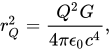
where ε0 is the vacuum permittivity.
Electromagnetic field tensor in Boyer–Lindquist form
The electromagnetic potential in Boyer–Lindquist coordinates is[11][12]
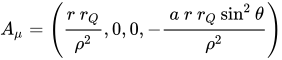
while the Maxwell tensor is defined by

In combination with the Christoffel symbols the second order equations of motion can be derived with

where is the charge-to-mass ratio of the test particle.

Kerr–Schild coordinates
The Kerr–Newman metric can be expressed in the Kerr–Schild form, using a particular set of Cartesian coordinates, proposed by Kerr and Schild in 1965. The metric is as follows.[13][14][15]

![{\displaystyle f={\frac {Gr^{2}}{r^{4}+a^{2}z^{2}}}\left[2Mr-Q^{2}\right]}](https://wikimedia.org/api/rest_v1/media/math/render/svg/a04a917784bc997d802807c0daa7236ddb674cdf)


Here, k is a unit vector. Here M is the constant mass of the spinning object, Q is the constant charge of the spinning object, η is the Minkowski metric, and a = J/M is a constant rotational parameter of the spinning object. It is understood that the vector is directed along the positive z-axis, i.e. . The quantity r is not the radius, but rather is implicitly defined by the relation


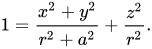
The quantity r becomes the usual radius R
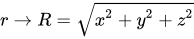
when the rotational parameter a approaches zero. In this form of solution, units are selected so that the speed of light is unity (c = 1). In order to provide a complete solution of the Einstein–Maxwell equations, the Kerr–Newman solution not only includes a formula for the metric tensor, but also a formula for the electromagnetic potential:[13][16]
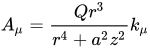
At large distances from the source (R ≫ a), these equations reduce to the Reissner–Nordström metric with:

In the Kerr–Schild form of the Kerr–Newman metric, the determinant of the metric tensor is everywhere equal to negative one, even near the source.[9]
Electromagnetic fields in Kerr–Schild form
The electric and magnetic fields can be obtained in the usual way by differentiating the four-potential to obtain the electromagnetic field strength tensor. It will be convenient to switch over to three-dimensional vector notation.

The static electric and magnetic fields are derived from the vector potential and the scalar potential like this:


Using the Kerr–Newman formula for the four-potential in the Kerr–Schild form, in the limit of the mass going to zero, yields the following concise complex formula for the fields:[17]

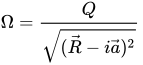
The quantity omega (Ω) in this last equation is similar to the Coulomb potential, except that the radius vector is shifted by an imaginary amount. This complex potential was discussed as early as the nineteenth century, by the French mathematician Paul Émile Appell.[18]
Irreducible mass
The total mass-equivalent M, which contains the electric field-energy and the rotational energy, and the irreducible mass Mirr are related by[19][20]

which can be solved to obtain
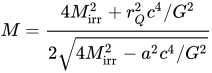
In order to electrically charge and/or spin a neutral and static body, energy has to be applied to the system. Due to the mass–energy equivalence, this energy also has a mass-equivalent; therefore M is always higher than Mirr. If for example the rotational energy of a black hole is extracted via the Penrose processes,[21][22] the remaining mass–energy will always stay greater than or equal to Mirr.
Important surfaces

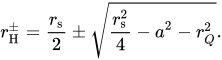
Setting to 0 and solving for gives the inner and outer event horizon, which is located at the Boyer–Lindquist coordinate


Repeating this step with gives the inner and outer ergosurface

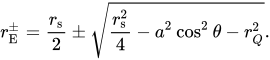
The region between the event horizon and the ergosurface is called the ergosphere. Within the ergosphere all local light cones are tilted in the direction of rotation.[8]: 18

Equations of motion
For brevity, we further use nondimensionalized quantities normalized against , , and , where reduces to and to , and the equations of motion for a test particle of charge become[23][24]


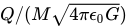


with for the total energy and for the axial angular momentum. is the Carter constant:



where is the poloidial component of the test particle's angular momentum, and the orbital inclination angle.



and

with and for particles are also conserved quantities.


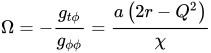
is the frame dragging induced angular velocity. The shorthand term is defined by


The relation between the coordinate derivatives and the local 3-velocity is


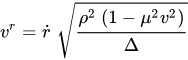
for the radial,
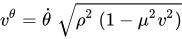
for the poloidial,

for the axial and
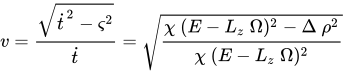
for the total local velocity, where

is the axial radius of gyration (local circumference divided by 2π), and
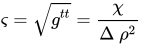
the gravitational time dilation component. The local radial escape velocity for a neutral particle is therefore
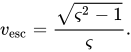
Extremal solutions and naked singularity
For the set of parameters the solution is called "extremal"; in the super-extremal regime, , there is no event horizon and the interior singularity is observable as a naked singularity. That is, the Kerr–Newman metric defines a black hole with an event horizon only when the combined charge and angular momentum are sufficiently small compared to the mass.[8]


An electron's rotational parameter a and charge length scale rQ both far exceed its Schwarzschild radius rs, which implies that there is no event horizon, so a "black hole electron" would necessarily be a naked spinning ring singularity.[25] Such a metric has several seemingly unphysical properties, such as the ring's violation of the cosmic censorship hypothesis and appearance of causality-violating closed timelike curves in the immediate vicinity of the ring.[11]
Dirac–Kerr–Newman electron model
In an analysis of the Kerr–Newman solution for a rotating charged body, Brandon Carter remarked that the solutions predict a gyromagnetic ratio equal to that predicted by the relativistic quantum-mechanical Dirac equation that approximately matches experimental evidence for the electron.[11]: 1562 This led to the application of the Kerr–Newman metric to create non-quantum models of the electron based on general relativity. The electron and all similar particles have large charge-to-mass ratios, which have Kerr–Newman parameters in the regime where there is no event horizon but there is a naked singularity.[26][27]: 2442 For example, for the electron the charge-to-mass ratio 2rQ / rs ≈ 1021 and the spin effects are both orders of magnitude larger than this limit.[28]
If the Kerr–Newman potential is considered as a classical model for an electron (an electron black hole), it predicts an electron having not only a magnetic dipole moment, but also other multipole moments, such as an electric quadrupole moment.[8] However, no experimental measurements of such a quadrupole moment have been reported.[28]
References
- ^ abNewman, Ezra; Janis, Allen (1965). "Note on the Kerr Spinning-Particle Metric". Journal of Mathematical Physics. 6 (6): 915–917. Bibcode:1965JMP.....6..915N. doi:10.1063/1.1704350.
- ^Newman, Ezra; Couch, E.; Chinnapared, K.; Exton, A.; Prakash, A.; Torrence, R. (1965). "Metric of a Rotating, Charged Mass". Journal of Mathematical Physics. 6 (6): 918–919. Bibcode:1965JMP.....6..918N. doi:10.1063/1.1704351.
- ^Kerr, RP (1963). "Gravitational field of a spinning mass as an example of algebraically special metrics". Physical Review Letters. 11 (5): 237–238. Bibcode:1963PhRvL..11..237K. doi:10.1103/PhysRevLett.11.237.
- ^Punsly, Brian (10 May 1998). "High-energy gamma-ray emission from galactic Kerr–Newman black holes. I. The central engine". The Astrophysical Journal. 498 (2): 646. Bibcode:1998ApJ...498..640P. doi:10.1086/305561.
All Kerr–Newman black holes have their rotation axis and magnetic axis aligned; they cannot pulse.
- ^Lang, Kenneth (2003). The Cambridge Guide to the Solar System. Cambridge University Press. p. 96. ISBN 978-0-521-81306-8 – via Internet Archive.
magnetic dipole moment and axis and the sun.
- ^Meinel, Reinhard (29 October 2015). "A Physical Derivation of the Kerr–Newman Black Hole Solution". In Nicolini P.; Kaminski M.; Mureika J.; Bleicher M. (eds.). 1st Karl Schwarzschild Meeting on Gravitational Physics. Springer Proceedings in Physics. Vol. 170. pp. 53–61. arXiv:1310.0640. doi:10.1007/978-3-319-20046-0_6. ISBN 978-3-319-20045-3. S2CID 119200468.
- ^Lynden-Bell, D. (November 29, 2004). "Electromagnetic magic: The relativistically rotating disk". Physical Review D. 70 (10). arXiv:gr-qc/0410109. doi:10.1103/PhysRevD.70.105017. ISSN 1550-7998.
- ^ abcdNewman, Ezra (Ted); Adamo, Tim (October 23, 2014). "Kerr–Newman metric". Scholarpedia. 9 (10) 31791. arXiv:1410.6626. Bibcode:2014SchpJ...931791N. doi:10.4249/scholarpedia.31791. ISSN 1941-6016.
- ^ abStephani, Hans; Kramer, Dietrich; MacCallum, Malcolm; Hoenselaers, Cornelius; Herlt, Eduard (2009-09-24). Exact Solutions of Einstein's Field Equations. Cambridge University Press. p. 485. ISBN 978-1-139-43502-4. See page 485 regarding determinant of metric tensor. See page 325 regarding generalizations.
- ^Hájíček, P.; Meyer, Frank; Metzger, Jan (2008). An introduction to the relativistic theory of gravitation. Lecture notes in physics. Berlin: Springer. p. 243. ISBN 978-3-540-78658-0. OCLC 221218012.
- ^ abcCarter, Brandon (1968-10-25). "Global Structure of the Kerr Family of Gravitational Fields"(PDF). Physical Review. 174 (5): 1559–1571. Bibcode:1968PhRv..174.1559C. doi:10.1103/PhysRev.174.1559.
- ^Luongo, Orlando; Quevedo, Hernando (2014). "Characterizing repulsive gravity with curvature eigenvalues". Physical Review D. 90 (8) 084032. arXiv:1407.1530. Bibcode:2014PhRvD..90h4032L. doi:10.1103/PhysRevD.90.084032. S2CID 118457584.
- ^ abDebney, G. C.; Kerr, R. P.; Schild, A. (1969). "Solutions of the Einstein and Einstein–Maxwell Equations". Journal of Mathematical Physics. 10 (10): 1842–1854. Bibcode:1969JMP....10.1842D. doi:10.1063/1.1664769. See equations (7.10), (7.11) and (7.14).
- ^Balasin, Herbert; Nachbagauer, Herbert (1994). "Distributional energy–momentum tensor of the Kerr–Newman spacetime family". Classical and Quantum Gravity. 1 1 (6): 1453–1461. arXiv:gr-qc/9312028. Bibcode:1994CQGra..11.1453B. doi:10.1088/0264-9381/11/6/010. S2CID 6041750.
- ^Samuel Berman, Marcelo; et al. (2006). Kreitler, Paul V. (ed.). Trends in black hole research. New York: Nova Science Publishers. p. 149. ISBN 978-1-59454-475-0. OCLC 60671837.
- ^Nieuwenhuizen, Theo M.; Philipp, Walter; Špička, Václav; Mehmani, Bahar; Aghdami, Maryam J.; Khrennikov, Andrei, eds. (2007). Beyond the quantum: proceedings of the Lorentz Workshop "Beyond the Quantum", Lorentz Center Leiden, The Netherlands, 29 May – 2 June 2006. New Jersey NJ: World Scientific. p. 321. ISBN 978-981-277-117-9.
The formula for the vector potential of Burinskii differs from that of Debney et al. merely by a gradient which does not affect the fields.
- ^Gair, Jonathan. "Boundstates in a Massless Kerr–Newman Potential"Archived 2011-09-26 at the Wayback Machine
- ^Appell, Math. Ann. xxx (1887) pp. 155–156. Discussed by Whittaker, Edmund and Watson, George.A Course of Modern Analysis, p. 400 (Cambridge University Press 1927).
- ^Thibault Damour: Black Holes: Energetics and Thermodynamics, p. 11
- ^Eq. 57 in Pradhan, Parthapratim (2014). "Black hole interior mass formula". The European Physical Journal C. 74 (5) 2887. arXiv:1310.7126. Bibcode:2014EPJC...74.2887P. doi:10.1140/epjc/s10052-014-2887-2. S2CID 46448376.
- ^Misner, Charles W.; Thorne, Kip S.; Wheeler, John Archibald; Kaiser, David (2017). Gravitation(PDF). Princeton, N.J: Princeton University Press. p. 877, 908. ISBN 978-0-691-17779-3. OCLC 1006427790.
- ^Bhat, Manjiri; Dhurandhar, Sanjeev; Dadhich, Naresh (1985). "Energetics of the Kerr–Newman black hole by the penrose process". Journal of Astrophysics and Astronomy. 6 (2): 85–100. Bibcode:1985JApA....6...85B. doi:10.1007/BF02715080. S2CID 53513572.
- ^Cebeci, Hakan; et al. "Motion of the charged test particles in Kerr–Newman–Taub–NUT spacetime and analytical solutions".
- ^Hackmann, Eva; Xu, Hongxiao (2013). "Charged particle motion in Kerr–Newmann space–times". Physical Review D. 87 (12): 4. arXiv:1304.2142. Bibcode:2013PhRvD..87l4030H. doi:10.1103/PhysRevD.87.124030. S2CID 118576540.
- ^Burinskii, Alexander (2008). "The Dirac–Kerr electron". Gravitation and Cosmology. 14: 109–122. arXiv:hep-th/0507109. doi:10.1134/S0202289308020011. S2CID 119084073.
- ^Burinskii, Alexander (April 2008). "The Dirac–Kerr–Newman electron". Gravitation and Cosmology. 14 (2): 109–122. arXiv:hep-th/0507109. Bibcode:2008GrCo...14..109B. doi:10.1134/S0202289308020011. S2CID 119084073.
- ^Arcos, H. I.; Pereira, J. G. (November 2004). "Kerr–Newman Solution as a Dirac Particle". General Relativity and Gravitation. 36 (11): 2441–2464. arXiv:hep-th/0210103. doi:10.1023/B:GERG.0000046832.71368.a5. ISSN 0001-7701.
- ^ abRosquist, Kjell (2006). "Gravitationally induced electromagnetism at the Compton scale". Classical and Quantum Gravity. 23 (9): 3111–3122. arXiv:gr-qc/0412064. Bibcode:2006CQGra..23.3111R. doi:10.1088/0264-9381/23/9/021. S2CID 15285753.
Bibliography
- Wald, Robert M. (1984). General Relativity. Chicago: The University of Chicago Press. pp. 312–324. ISBN 978-0-226-87032-8.
External links
- Adamo, Tim; Newman, Ezra (2014). "Kerr–Newman metric". Scholarpedia. 9 (10) 31791. arXiv:1410.6626. Bibcode:2014SchpJ...931791N. doi:10.4249/scholarpedia.31791. co-authored by Ezra T. Newman
- SR Made Easy, chapter 11: Charged and Rotating Black Holes and Their Thermodynamics
