Löschian number
| Named after | August Lösch |
|---|---|
| Subsequence of | A032766 |
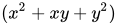
| Formula | x2 + xy + y2 for integer x, y |
| First terms | 0, 1, 3, 4, 7, 9, 12, 13, 16 |
| OEIS index |
|
In number theory, the numbers of the form x2 + xy + y2 for integer x, y are called the Löschian numbers (or Loeschian numbers). These numbers are named after August Lösch. They are the norms of the Eisenstein integers. They are a set of whole numbers, including zero, and having prime factorization in which all primes congruent to 2 mod 3 have even powers (there is no restriction of primes congruent to 0 or 1 mod 3).
Properties
- Every Löschian number is nonnegative.
- Every square number is a Löschian number (by setting x or y to 0).
- Moreover, every number of the form for m and x integers is a Löschian number (by setting y=mx).
- There are infinitely many Löschian numbers.
- Given that odd and even integers are equally numerous, the probability that a Löschian number is odd is 0.75, and the probability that it is even is 0.25. This follows from the fact that is even if only x and y are both even.
- The greatest common divisor and the least common multiple of any two or more Löschian numbers are also Löschian numbers.
- The product of two Löschian numbers is always a Löschian number; in other words, Löschian numbers are closed under multiplication.
- This property makes the set of Löschian numbers into a monoid under multiplication.
- The product of a Löschian number and a non-Löschian number is never a Löschian number.

References
- Marshall, J. U. (1975). "The Loeschian numbers as a problem in number theory". Geographical Analysis. 7 (4): 421–426. doi:10.1111/j.1538-4632.1975.tb01054.x.
- "A003136". On-Line Encyclopedia of Integer Sequences. Retrieved 19 July 2018.
 | This number theory–related article is a stub. You can help Wikipedia by adding missing information. |
