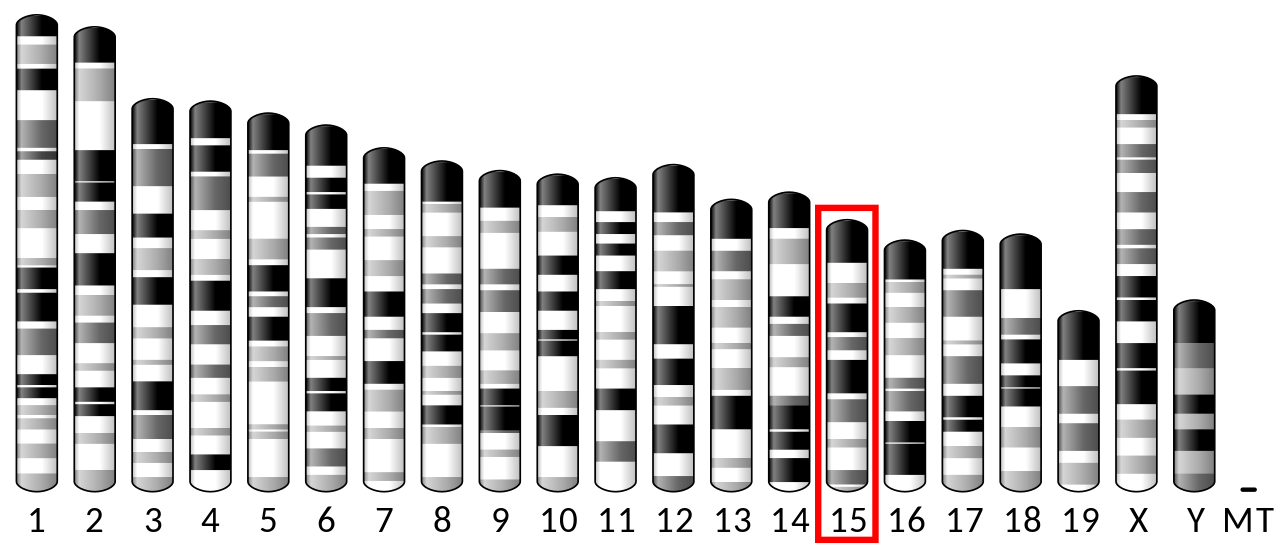
E3 ubiquitin-protein ligase MARCH6 is an enzyme that in humans is encoded by the MARCH6gene.[5][6]
Gene name error in Excel
Like the other MARCH and septin genes, care must be exercised when analyzing genetic data containing the MARCH6 gene in Microsoft Excel.[7] This is due to Excel's autocorrect feature treating the text "MARCH6" as a date and converting it to a standard date format. The original text cannot be recovered as a result of the conversion. A 2016 study found up to 19.6% of all papers in selected journals to be affected by the gene name error.[8] The issue can be prevented by using an alias name (such as MARCHF6), prepending with an apostrophe ('), or preformatting the cell as text.
^ a b cGRCh38: Ensembl release 89: ENSG00000145495 – Ensembl, May 2017
^ a b cGRCm38: Ensembl release 89: ENSMUSG00000039100 – Ensembl, May 2017
^"Human PubMed Reference:". National Center for Biotechnology Information, U.S. National Library of Medicine.
^"Mouse PubMed Reference:". National Center for Biotechnology Information, U.S. National Library of Medicine.
^Bartee E, Mansouri M, Hovey Nerenberg BT, Gouveia K, Fruh K (Jan 2004). "Downregulation of major histocompatibility complex class I by human ubiquitin ligases related to viral immune evasion proteins". J Virol. 78 (3): 1109–20. doi:10.1128/JVI.78.3.1109-1120.2004. PMC321412. PMID 14722266.
^"Entrez Gene: MARCH6 membrane-associated ring finger (C3HC4) 6".
^Zeeberg BR, Riss J, Kane DW, Bussey KJ, Uchio E, Linehan WM, et al. (June 2004). "Mistaken identifiers: gene name errors can be introduced inadvertently when using Excel in bioinformatics". BMC Bioinformatics. 5 (1): 80. doi:10.1186/1471-2105-5-80. PMC459209. PMID 15214961.
^Ziemann M, Eren Y, El-Osta A (August 2016). "Gene name errors are widespread in the scientific literature". Genome Biology. 17 (1): 177. doi:10.1186/s13059-016-1044-7. PMC4994289. PMID 27552985.
Further reading
Kreft SG, Wang L, Hochstrasser M (2006). "Membrane topology of the yeast endoplasmic reticulum-localized ubiquitin ligase Doa10 and comparison with its human ortholog TEB4 (MARCH-VI)". J. Biol. Chem. 281 (8): 4646–53. doi:10.1074/jbc.M512215200. PMID 16373356.
Hassink G, Kikkert M, van Voorden S, et al. (2005). "TEB4 is a C4HC3 RING finger-containing ubiquitin ligase of the endoplasmic reticulum". Biochem. J. 388 (Pt 2): 647–55. doi:10.1042/BJ20041241. PMC1138973. PMID 15673284.
Gerhard DS, Wagner L, Feingold EA, et al. (2004). "The status, quality, and expansion of the NIH full-length cDNA project: the Mammalian Gene Collection (MGC)". Genome Res. 14 (10B): 2121–7. doi:10.1101/gr.2596504. PMC528928. PMID 15489334.
Ota T, Suzuki Y, Nishikawa T, et al. (2004). "Complete sequencing and characterization of 21,243 full-length human cDNAs". Nat. Genet. 36 (1): 40–5. doi:10.1038/ng1285. PMID 14702039.
Strausberg RL, Feingold EA, Grouse LH, et al. (2003). "Generation and initial analysis of more than 15,000 full-length human and mouse cDNA sequences". Proc. Natl. Acad. Sci. U.S.A. 99 (26): 16899–903. Bibcode:2002PNAS...9916899M. doi:10.1073/pnas.242603899. PMC139241. PMID 12477932.
Swanson R, Locher M, Hochstrasser M (2001). "A conserved ubiquitin ligase of the nuclear envelope/endoplasmic reticulum that functions in both ER-associated and Matalpha2 repressor degradation". Genes Dev. 15 (20): 2660–74. doi:10.1101/gad.933301. PMC312819. PMID 11641273.
Nagase T, Ishikawa K, Miyajima N, et al. (1998). "Prediction of the coding sequences of unidentified human genes. IX. The complete sequences of 100 new cDNA clones from brain which can code for large proteins in vitro". DNA Res. 5 (1): 31–9. doi:10.1093/dnares/5.1.31. PMID 9628581.