Maria Baumgartner


Maria Baumgartner (born 13 March 1952 in Königswiesen, Austria) is an Austrian studio potter and was professor of ceramics at the University of Arts and Industrial Design Linz.
Biography
From 1972 to 1979 Maria Baumgartner studied ceramics at the University of Arts and Industrial Design Linz and graduated as Master of Fine Arts. 1980 she founded her first studio near Lienz/ Tirol and worked there as freelance artist until 2014.[1] 1986 she additionally started working as Assistant professor at the University of Arts and Industrial Design Linz and continued her career there as Associate professor until her retirement in 2014.[2] 2015 she founded a new studio in Puchenau near Linz. Besides being artist and professor she also acted as curator and academic author in the field of ceramic art.
Work
As artist she won awards, prizes and grants in Austria, Germany, Croatia und Hungary. She participated in 40 personal and 140 group exhibitions in Austria, Germany, Switzerland, France, Italy, Belgium, Czechia, Spain, Denmark, Hungary, Lithuania, Croatia, Latvia, Turkey, Egypt, USA, Korea and Japan. Her artworks can be found in several art museums and other well known public or private art collections, like the Museum of Applied Arts, Vienna, the Museum of Design, Zürich, Sèvres – Cité de la céramique, France, the Igal & Diane Silber Collection, Laguna Beach/ Cal., the American Museum of Ceramic Art, Pomona/Cal., the Panevėžys Civic Art Gallery (Lithuania), the International Ceramics Studio in Kecskemét (Hungary), the Museum of Modern Ceramic Art, Mino Ceramic Park, Gifu (Japan), the Grassi Museum, Leipzig, or the collection of the Veste Coburg.[3]
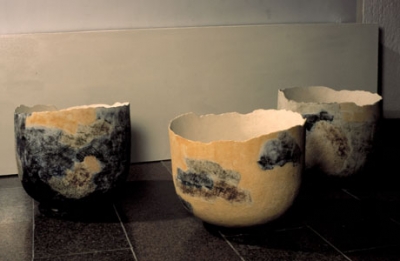
Maria Baumgartner herself writes about her recent objects of ceramic art: "My objects are each built up and hand-formed to their individual shape. The surface is smoothed only partially. This free development of the ceramic form can be seen in the sometimes dissolving rims and in the often thin-walled shells of the objects. The forms are inspired by an architectural aesthetic, hinting at vertical axes, playing with orthogonal or other geometric structures, but deconstructing, tilting and intertwining them. Thus a positive disquiet can be experienced. The entire surface of the ceramic objects is worked out in multiple layering by paintbrush, sgraffito or other pictorial techniques. Aim is to reach the impression of »three-dimensional paintings«"[4]
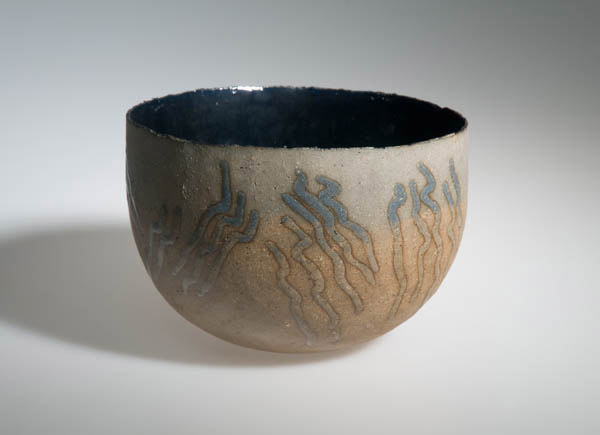
The following pictures show this formative development of the ceramic sculptural objects by Maria Baumgartner: starting from experimenting with circular or cylindrical forms (figure 1), she developed more complicated objects, using thin-walled wavelike shapes with experimental glazes (figure 2), or more solid houselike structures with straight angles (figures 3, 4). Now her objects are a free combination of various geometric shapes and conceptional graphics (figure 5)
- fig.1 "Trefoil 1991" (Austrian state prize)
- fig.2 "Blue and Lines 1998"
- fig.3 "House I & II 2010"
- fig.4 "1000 grams 2012"
- fig.5 "Waves 2016"


Internationally significant awards (a selection)
- 1991 Austrian State Prize for Design ("österr. Staatspreis für gestaltendes Handwerk") (winner)[5]
- 1993 Nagrada (award) "Slavonski Brod" (= Medal "New Positions") (winner), 4. Svetski Triennale Male Keramike, Zagreb/ Croatia.[6]
- 1998 Salzburg Award for Ceramic Art ("Salzburger Keramikpreis", winner).[7]
- 2020: GRACIS 2020. Zagreb, Zelina award: silver medal.
Internationally significant exhibitions (a selection)
- 1984 Ceramics and Porcellain, Galerie Thaddaeus Ropac, then Lienz (solo)
- 1986 European Contemporary Ceramics, Ceramics museum "Keramion", Frechen near Cologne.[8] (group)
- 1989 L’Europe des Ceramistes. Actualité de la Céramique Européenne, Abbey of Saint-Germain d'Auxerre/ FRA (and other places).[9](group)
- 1992 Maria Baumgartner: Ceramics, Gallery L in the "Heine-Haus",[10]Hamburg/ BRD (solo)
- 1993 4th World Triennial Exhibition of Small Ceramics, Meštrović Pavilion, Zagreb/ CRO (group).
- 1994 The 2nd Cairo International Biennale for Ceramics, Zamalek Art Gallery, Cairo/ EGY.[11](group).
- 1998 International Contemporary Ceramics from the Igal and Diane Silber Collection, Laguna Art Museum, Laguna Beach/ Cal.[12](group).
- 2000 Maria Baumgartner: New Ceramics, Gallery "b15", Munich/ BRD[13] (solo)
- 2000, 2001 SOFA Art Fair,[14] New York/ NY & Chicago/ Ill.[15][16](group)
- 2007 Modern Ceramics from Central Europe – A Focus on Hungary, the Czech Republic and Greater Central Europe, Museum of Modern Ceramic Art, Gifu/ JAP.[17](group).
- 2010 A Plentiful Portion, Kulturkeller Schloss Dobersberg, Austria[18] (solo)
- 2016 Heritage and Diversity. East and West Invitational Ceramic Exhibition, Hanyang University Museum, Seoul/ (group).
- 2017 Ceramics out of Passion: Kurt Ohnsorg, Günther Praschak, Maria Baumgartner and others, Lower Austrian Centre of Modern Arts, Sankt Pölten/ AUT.[19] (group)
- 2020 G.R.A.C.I.S. 2020 (Ceramics from Germany, Romania, Austria, Croatia, Italy, Slovenia), Zvonimir Gallery, Zagreb.[20] (group)
- 2023 From a Gift to a Collection: Igal and Diane Silber, American Museum of Ceramic Art[21] (group)
- 2024 GARDEN OF CLAY, Gallery of the "Kammerhof"-Museum, Gmunden,[22] exhibition as part of the SalzkammergutEuropean Capital of Culture 2024.[23](group)
- 2025 Asymmetrisch - Maria Baumgartner, Ceramic Art Space Vienna[24](solo)
Publications (a selection)
- Die Österreich-Seite: »Man muss in die Werkstatt gehen«. Über Franz Josef Altenburg (The Austria page: on Franz Josef Altenburg. In: Neue Keramik.ISSN 0933-2367, vol 3 (1989), no. 5, pp. 583–584.
- Keramikerinnen in Salzburg (Female Ceramists in Salzburg). In: Wally, Barbara (ed.): Künstlerinnen in Salzburg (Female Artists in Salzburg). ed. Museum Carolino Augusteum, Salzburg 1991, ISBN 3-901014-08-X, pp. 83–98.
- Ceramics in Austria – Survival in the Invisible. In: European Ceramic from 13 counties: exhibition catalogue, Kunsthalle Dominikanerkirche Osnabrück. ed. Rasch (Bramsche/ Germany) 1998, ISBN 3-932147-47-2, pp. 120–123.
- GARDEN OF CLAY. An exhibition of the European Capital of Culture Bad Ischl Salzkammergut 2024 within the project „City of Ceramics“ Gmunden, ed. Society for Promoting European Ceramic Artists, Gmunden 2024, ISBN 978-3-200-10043-5.[25]
References
- ^Maria Baumgartner, österreichische Keramikerin (Austrian Ceramist). In: Beyer, Andreas (ed.): Allgemeines Künstlerlexikon(General Dictionary of Artists), vol. 7: Barbieri-Bayona. ed. de Gruyter, Berlin etc. 1993, ISBN 3-598-22747-7, p. 43.
- ^Maria Baumgartner in the data base of Ars Panevėžys/ LITArchived 27 February 2016 at the Wayback Machine accessed 25 February 2016.
- ^Mitgliederverzeichnis (membership register) of the Tyrolean artists associationArchived 27 February 2016 at the Wayback Machine accessed 27 February 2016.
- ^from the catalogue of the exhibition Heritage and Diversity, April 2016, Hanyang University Museum, Seoul/KOR, p. 27, courtesy Maria Baumgartner
- ^Nicola, K. G.: Arts and Crafts in Austria: Österreichischer Staatspreis '91. In: Kunst und Handwerk. no. 5 (1991), pp. 35–39.
- ^ULUPUH (Association of Artists of Applied Arts in Croatia) (ed.): 4th World Triennial Exhibition of Small Ceramics: Catalogue. Zagreb 1993, p. 36.
- ^Keramikpreise des Landes überreicht (Salzburg ceramic Awards presented) In: Salzburger Landeskorrespondenz. accessed 27 February 2016.
- ^Keramion Museum (ed.): Europäische Keramik der Gegenwart. ed. Greven & Bechthold, Cologne 1986, pp. 30–31, pp. 184–185, p. 325.
- ^Societe d’Encouragement aux Metiers d’Art (SEMA) (ed.): L'Europe des ceramistes (special issue of the journal Metiers d'Art). Paris 1989, p. 38.
- ^Infos zum Heine-Haus Hamburg, accessed 31 July 2024.
- ^National Center for Fine Arts (NCFA), Ministry for Culture, Arab Republic of Egypt (ed.): The 2nd Cairo International Biennale for Ceramics: Catalogue, Cairo 1994, pp. 62–63.
- ^Mansfield, Janet: International contemporary ceramics from the Igal and Diane Silber collection (28 March – 28 June 1998), ed. Laguna Art Museum, Laguna Beach/ Cal. 1998, pp. 26–27.
- ^Wunderle, Renate: Maria Baumgartner. Catalogue ed. Gallery Wunderle, Munich/ BRD 2000, p. 2.
- ^general infos SOFA, accessed 20 October 2024.
- ^Exhibiting Galleries: Galerie b15 – artist Maria Baumgartner, object "Orkas" 1996. In: Catalogues of the Annual International Exhibition of Sculpture, Objects and Functional Art (SOFA), vol. 2 (2000), p. 107.
- ^Also online accessed 1 March 2016.
- ^Iwai, Mieko: Modern Ceramic Art in Central Europe: From Revolution to New Order. In: "Modern Ceramics from Central Europe. Exhibition Folder." ed. Museum of Modern Ceramic Art, Gifu (Japan) 2007, pp. 2–3.
- ^Infos on the exhibition by Maria Baumgartner, accessed September 9, 2025.
- ^German Info Text on the Exhibition, accessed 15 May 2017.
- ^Article on the GRACIS-exhibition, Zagreb, accessed 1 September 2020
- ^on the exhibition at the AMOCA, accessed 9 May 2023.
- ^Infos on the "Kammerhof", accessed 31 July 2024.
- ^homepage of Salzkammergut 2024, online, see "calendar of events", accessed July 31, 2024.
- ^homepage Ceramic Art Space, accessed September 10, 2025.
- ^Description of the exhibition, in German, accessed 20 October 2024.
External links

- website Maria Baumgartner (in development)
- Entry Maria Baumgartner in the Austrian artist data base of the "Tiroler Künstlerschaft"
- Entry Maria Baumgartner in the international arts data base "artfacts.net"
- Entry Maria Baumgartner in the international arts database "basis Vienna"
- Bowl 1981 on the website of "basis Vienna" from the personal exhibition 1982 in Zell am See/AUT;
- Bowl 1983 from the collection of the Academy of Arts (Hochschule der Künste), Zurich/ CH;
- Bowl 1986 from the collection of the "Veste Coburg", Germany;
- "Rain Vase 1991" and "Blue Vase 1993" from the collection of the Austrian Federal Government in Vienna;
- Shell 1991 on the website of the Austrian National Library from the solo exhibition in Lienz/AUT;
- Patches 1998 from the collection of the "Panevezys Civic Art Gallery" (Lithuania);
- Kasbah 2001 in the collection of Sèvres – Cité de la céramique/ FRA;
- Orcas 2001 with text at the solo exhibition "Baumgertner: Ceramics", Innsbruck 2001;
- Kasbah 2002 from the "All Ceramics" exhibition 2003–2004 by the "Lower Austria Art Association (NÖ-Art)";
- Composition 2017 from the "Ceramics out of Passion" exhibition 2017 in St. Pölten/AUT;