Provides conditions for a parametric optimization problem to have continuous solutions
最大 値定理は 、最適 化された 関数とその最大化関数の集合がそのパラメータに関して 連続性を持つ ための条件を規定する。この定理は 1959年に クロード・ベルジュによって初めて証明された。 [1]この定理は主に 数理経済学 と 最適制御 において用いられる 。
定理の記述 最大値定理 。 [2] [3] [4] [5]
と を 位相空間とし、 を 積 上の連続関数とし 、を すべての に対して と なるコンパクト値 対応とする。 周辺関数 (または 値関数 ) を次のように
定義する。
X
{\displaystyle X}
Θ
{\displaystyle \Theta }
f
:
X
×
Θ
→
R
{\displaystyle f:X\times \Theta \to \mathbb {R} }
X
×
Θ
{\displaystyle X\times \Theta }
C
:
Θ
⇉
X
{\displaystyle C:\Theta \rightrightarrows X}
C
(
θ
)
≠
∅
{\displaystyle C(\theta )\neq \emptyset }
θ
∈
Θ
{\displaystyle \theta \in \Theta }
f
∗
:
Θ
→
R
{\displaystyle f^{*}:\Theta \to \mathbb {R} }
f
∗
(
θ
)
=
sup
{
f
(
x
,
θ
)
:
x
∈
C
(
θ
)
}
{\displaystyle f^{*}(\theta )=\sup\{f(x,\theta ):x\in C(\theta )\}}
そして 最大化者の集合 は
C
∗
:
Θ
⇉
X
{\displaystyle C^{*}:\Theta \rightrightarrows X}
C
∗
(
θ
)
=
a
r
g
max
{
f
(
x
,
θ
)
:
x
∈
C
(
θ
)
}
=
{
x
∈
C
(
θ
)
:
f
(
x
,
θ
)
=
f
∗
(
θ
)
}
{\displaystyle C^{*}(\theta )=\mathrm {arg} \max\{f(x,\theta ):x\in C(\theta )\}=\{x\in C(\theta ):f(x,\theta )=f^{*}(\theta )\}}
。 が において連続(すなわち、上半連続 と下半 連続 の 両方) である 場合 、値関数は 連続であり、最大化集合は 空でないコンパクトな値を持つ上半連続である。結果として、 は に置き換えることができる 。
C
{\displaystyle C}
θ
{\displaystyle \theta }
f
∗
{\displaystyle f^{*}}
C
∗
{\displaystyle C^{*}}
sup
{\displaystyle \sup }
max
{\displaystyle \max }
変種 代わりに関数を考慮することで、最大値定理を最小化に使用できます 。
−
f
{\displaystyle -f}
解釈 この定理は、典型的には、パラメトリック最適化問題がパラメータに関して連続解を持つための条件を与えるものとして解釈されます。この場合、 はパラメータ空間、 は最大化される関数、 は上で最大化される 制約集合を与えます 。そして、 は関数の最大値、 は を最大化する点の集合です 。
Θ
{\displaystyle \Theta }
f
(
x
,
θ
)
{\displaystyle f(x,\theta )}
C
(
θ
)
{\displaystyle C(\theta )}
f
{\displaystyle f}
f
∗
(
θ
)
{\displaystyle f^{*}(\theta )}
C
∗
{\displaystyle C^{*}}
f
{\displaystyle f}
その結果、最適化問題の要素が十分に連続している場合、その連続性の一部(すべてではない)がソリューションで保持されます。
証拠 この証明全体を通して、特定の点を含む開集合 を指すために「 近傍」 という用語を使用します。まず、対応計算における一般的な事実である予備的な補題を述べます。対応が閉じているという ことは、その グラフが 閉じて いるということを思い出しましょう 。
補題 [6] [7] [8]が対応関係に あり 、 が上半連続かつコンパクト値であり、 が閉じている場合、 によって 定義されるは 上半連続である。
A
,
B
:
Θ
⇉
X
{\displaystyle A,B:\Theta \rightrightarrows X}
A
{\displaystyle A}
B
{\displaystyle B}
A
∩
B
:
Θ
⇉
X
{\displaystyle A\cap B:\Theta \rightrightarrows X}
(
A
∩
B
)
(
θ
)
=
A
(
θ
)
∩
B
(
θ
)
{\displaystyle (A\cap B)(\theta )=A(\theta )\cap B(\theta )}
証拠
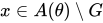
とし 、 が を含む開集合であると仮定する 。 の場合 、 は直ちに結果が導かれる。 でない場合、各 に対して が成り立ち 、は閉集合な ので、 のときは 必ず の 近傍が存在する 。集合の集合は コンパクト集合 の開被覆を形成し 、これにより有限部分被覆 を抽出することができる。上半連続性により、 となる の 近傍が存在する 。すると 、 のときは必ず が成り立ち 、したがって となる 。これで証明は完了である。
θ
∈
Θ
{\displaystyle \theta \in \Theta }
G
{\displaystyle G}
(
A
∩
B
)
(
θ
)
{\displaystyle (A\cap B)(\theta )}
A
(
θ
)
⊆
G
{\displaystyle A(\theta )\subseteq G}
x
∈
A
(
θ
)
∖
G
{\displaystyle x\in A(\theta )\setminus G}
x
∉
B
(
θ
)
{\displaystyle x\notin B(\theta )}
B
{\displaystyle B}
U
x
×
V
x
{\displaystyle U_{x}\times V_{x}}
(
θ
,
x
)
{\displaystyle (\theta ,x)}
x
′
∉
B
(
θ
′
)
{\displaystyle x'\notin B(\theta ')}
(
θ
′
,
x
′
)
∈
U
x
×
V
x
{\displaystyle (\theta ',x')\in U_{x}\times V_{x}}
{
G
}
∪
{
V
x
:
x
∈
A
(
θ
)
∖
G
}
{\displaystyle \{G\}\cup \{V_{x}:x\in A(\theta )\setminus G\}}
A
(
θ
)
{\displaystyle A(\theta )}
G
,
V
x
1
,
…
,
V
x
n
{\displaystyle G,V_{x_{1}},\dots ,V_{x_{n}}}
U
θ
{\displaystyle U_{\theta }}
θ
{\displaystyle \theta }
A
(
U
θ
)
⊆
G
∪
V
x
1
∪
⋯
∪
V
x
n
{\displaystyle A(U_{\theta })\subseteq G\cup V_{x_{1}}\cup \dots \cup V_{x_{n}}}
θ
′
∈
U
θ
∩
U
x
1
∩
⋯
∩
U
x
n
{\displaystyle \theta '\in U_{\theta }\cap U_{x_{1}}\cap \dots \cap U_{x_{n}}}
A
(
θ
′
)
⊆
G
∪
V
x
1
∪
⋯
∪
V
x
n
{\displaystyle A(\theta ')\subseteq G\cup V_{x_{1}}\cup \dots \cup V_{x_{n}}}
(
A
∩
B
)
(
θ
′
)
⊆
G
{\displaystyle (A\cap B)(\theta ')\subseteq G}
◻
{\displaystyle \square }
最大値定理における連続性は 、2 つの独立した定理を組み合わせた結果です。
f
∗
{\displaystyle f^{*}}
定理1. [ 9] [10] [11] が上半連続で 上半連続、空でなくコンパクト値である 場合、 は 上半連続である。
f
{\displaystyle f}
C
{\displaystyle C}
f
∗
{\displaystyle f^{*}}
定理1の証明
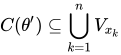
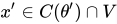
を固定し 、 を 任意のものとする。各 に対して、 の 近傍が存在し、 の ときはいつでも が成り立つ 。近傍集合は をカバーし 、これはコンパクトであるため、 で 十分である。さらに、 は上半連続であるため、 が成り立つ ときはいつでも が成り立つ の 近傍が存在する 。 としよう 。すると、すべての に対して 、 の各 に対して、 が成り立ち 、 ある に対して が成り立つ 。したがって
、
θ
∈
Θ
{\displaystyle \theta \in \Theta }
ε
>
0
{\displaystyle \varepsilon >0}
x
∈
C
(
θ
)
{\displaystyle x\in C(\theta )}
U
x
×
V
x
{\displaystyle U_{x}\times V_{x}}
(
θ
,
x
)
{\displaystyle (\theta ,x)}
(
θ
′
,
x
′
)
∈
U
x
×
V
x
{\displaystyle (\theta ',x')\in U_{x}\times V_{x}}
f
(
x
′
,
θ
′
)
<
f
(
x
,
θ
)
+
ε
{\displaystyle f(x',\theta ')<f(x,\theta )+\varepsilon }
{
V
x
:
x
∈
C
(
θ
)
}
{\displaystyle \{V_{x}:x\in C(\theta )\}}
C
(
θ
)
{\displaystyle C(\theta )}
V
x
1
,
…
,
V
x
n
{\displaystyle V_{x_{1}},\dots ,V_{x_{n}}}
C
{\displaystyle C}
U
′
{\displaystyle U'}
θ
{\displaystyle \theta }
θ
′
∈
U
′
{\displaystyle \theta '\in U'}
C
(
θ
′
)
⊆
⋃
k
=
1
n
V
x
k
{\displaystyle C(\theta ')\subseteq \bigcup _{k=1}^{n}V_{x_{k}}}
U
=
U
′
∩
U
x
1
∩
⋯
∩
U
x
n
{\displaystyle U=U'\cap U_{x_{1}}\cap \dots \cap U_{x_{n}}}
θ
′
∈
U
{\displaystyle \theta '\in U}
f
(
x
′
,
θ
′
)
<
f
(
x
k
,
θ
)
+
ε
{\displaystyle f(x',\theta ')<f(x_{k},\theta )+\varepsilon }
x
′
∈
C
(
θ
′
)
{\displaystyle x'\in C(\theta ')}
x
′
∈
V
x
k
{\displaystyle x'\in V_{x_{k}}}
k
{\displaystyle k}
f
∗
(
θ
′
)
=
sup
x
′
∈
C
(
θ
′
)
f
(
x
′
,
θ
′
)
<
max
k
=
1
,
…
,
n
f
(
x
k
,
θ
)
+
ε
≤
f
∗
(
θ
)
+
ε
,
{\displaystyle f^{*}(\theta ')=\sup _{x'\in C(\theta ')}f(x',\theta ')<\max _{k=1,\dots ,n}f(x_{k},\theta )+\varepsilon \leq f^{*}(\theta )+\varepsilon ,}
それは望まれていた。
◻
{\displaystyle \square }
定理2. [ 12] [13] [14] が下半連続で が下半連続で あれば 、 は下半連続である。
f
{\displaystyle f}
C
{\displaystyle C}
f
∗
{\displaystyle f^{*}}
定理2の証明
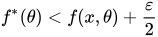
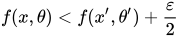
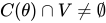
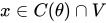
を固定し 、 を任意とする。 の定義により 、 となるような が存在する 。ここで、 は下半連続なので、 が成り立つ ときはいつでも となるような の 近傍が存在する 。 特に に注目する 。したがって、 は下半連続なので、 が存在する ときはいつでも となるような 近傍が存在する 。 とする 。すると、 が存在するときはいつでも となり 、これは次を意味する。
θ
∈
Θ
{\displaystyle \theta \in \Theta }
ε
>
0
{\displaystyle \varepsilon >0}
f
∗
{\displaystyle f^{*}}
x
∈
C
(
θ
)
{\displaystyle x\in C(\theta )}
f
∗
(
θ
)
<
f
(
x
,
θ
)
+
ε
2
{\displaystyle f^{*}(\theta )<f(x,\theta )+{\frac {\varepsilon }{2}}}
f
{\displaystyle f}
U
1
×
V
{\displaystyle U_{1}\times V}
(
θ
,
x
)
{\displaystyle (\theta ,x)}
(
θ
′
,
x
′
)
∈
U
1
×
V
{\displaystyle (\theta ',x')\in U_{1}\times V}
f
(
x
,
θ
)
<
f
(
x
′
,
θ
′
)
+
ε
2
{\displaystyle f(x,\theta )<f(x',\theta ')+{\frac {\varepsilon }{2}}}
C
(
θ
)
∩
V
≠
∅
{\displaystyle C(\theta )\cap V\neq \emptyset }
x
∈
C
(
θ
)
∩
V
{\displaystyle x\in C(\theta )\cap V}
C
{\displaystyle C}
U
2
{\displaystyle U_{2}}
θ
′
∈
U
2
{\displaystyle \theta '\in U_{2}}
x
′
∈
C
(
θ
′
)
∩
V
{\displaystyle x'\in C(\theta ')\cap V}
U
=
U
1
∩
U
2
{\displaystyle U=U_{1}\cap U_{2}}
θ
′
∈
U
{\displaystyle \theta '\in U}
x
′
∈
C
(
θ
′
)
∩
V
{\displaystyle x'\in C(\theta ')\cap V}
f
∗
(
θ
)
<
f
(
x
,
θ
)
+
ε
2
<
f
(
x
′
,
θ
′
)
+
ε
≤
f
∗
(
θ
′
)
+
ε
{\displaystyle f^{*}(\theta )<f(x,\theta )+{\frac {\varepsilon }{2}}<f(x',\theta ')+\varepsilon \leq f^{*}(\theta ')+\varepsilon }
それは望まれていた。
◻
{\displaystyle \square }
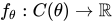
最大値定理の仮定の下では、 は連続です。残っているのは、が コンパクト値を持つ上半連続対応であることを証明することです。 とします 。 が空でないことを確認するには、 による 関数が コンパクト集合 上で連続していることに注目してください 。 極値定理は、 が空でないことを意味します 。さらに、 は連続なので、 コンパクト集合 の閉部分集合が成り立ち 、これは がコンパクトであることを意味します。最後に、 が によって定義されるとします 。 は連続関数なので、 は閉対応です。さらに、 なので 、予備的な補題は が上半連続であることを意味します 。
f
∗
{\displaystyle f^{*}}
C
∗
{\displaystyle C^{*}}
θ
∈
Θ
{\displaystyle \theta \in \Theta }
C
∗
(
θ
)
{\displaystyle C^{*}(\theta )}
f
θ
:
C
(
θ
)
→
R
{\displaystyle f_{\theta }:C(\theta )\to \mathbb {R} }
f
θ
(
x
)
=
f
(
x
,
θ
)
{\displaystyle f_{\theta }(x)=f(x,\theta )}
C
(
θ
)
{\displaystyle C(\theta )}
C
∗
(
θ
)
{\displaystyle C^{*}(\theta )}
f
θ
{\displaystyle f_{\theta }}
C
∗
(
θ
)
{\displaystyle C^{*}(\theta )}
C
(
θ
)
{\displaystyle C(\theta )}
C
∗
(
θ
)
{\displaystyle C^{*}(\theta )}
D
:
Θ
⇉
X
{\displaystyle D:\Theta \rightrightarrows X}
D
(
θ
)
=
{
x
∈
X
:
f
(
x
,
θ
)
=
f
∗
(
θ
)
}
{\textstyle D(\theta )=\{x\in X:f(x,\theta )=f^{*}(\theta )\}}
f
{\displaystyle f}
D
{\displaystyle D}
C
∗
(
θ
)
=
C
(
θ
)
∩
D
(
θ
)
{\displaystyle C^{*}(\theta )=C(\theta )\cap D(\theta )}
C
∗
{\displaystyle C^{*}}
◻
{\displaystyle \square }
変種と一般化 上記の結果から自然に一般化すると、 が連続であり 、空でなく、コンパクト値であり、上側半連続である
ための十分な 局所 条件が得られます。
f
∗
{\displaystyle f^{*}}
C
∗
{\displaystyle C^{*}}
上記の条件に加えて、 が それぞれ に対して 準凹関数 で あり 、凸値である場合、 も凸値である。が それぞれ に対して 厳密に準凹関数であり 、 凸値である場合、 は 単値関数であり、したがって対応ではなく連続関数である。 [15]
f
{\displaystyle f}
x
{\displaystyle x}
θ
{\displaystyle \theta }
C
{\displaystyle C}
C
∗
{\displaystyle C^{*}}
f
{\displaystyle f}
x
{\displaystyle x}
θ
{\displaystyle \theta }
C
{\displaystyle C}
C
∗
{\displaystyle C^{*}}
が 凹 で 、 凸 グラフを持つ 場合 、 は凹であり、 凸値である。同様に、 が厳密に凹である場合、 は連続関数である。 [15]
f
{\displaystyle f}
X
×
Θ
{\displaystyle X\times \Theta }
C
{\displaystyle C}
f
∗
{\displaystyle f^{*}}
C
∗
{\displaystyle C^{*}}
f
{\displaystyle f}
C
∗
{\displaystyle C^{*}}
目的関数がK無限コンパクトであれば、ベルゲの定理を非コンパクト対応に一般化することもできる。 [ 16 ]
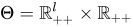
例 消費者が予算集合の中から選択を行う効用最大化問題 を考えてみましょう 。上記の表記を標準的な消費者理論の表記に置き換えると、
X
=
R
+
l
{\displaystyle X=\mathbb {R} _{+}^{l}}
あらゆる商品の束の空間であり 、
l
{\displaystyle l}
Θ
=
R
+
+
l
×
R
+
+
{\displaystyle \Theta =\mathbb {R} _{++}^{l}\times \mathbb {R} _{++}}
商品の価格ベクトル と消費者の富を表し 、
p
{\displaystyle p}
w
{\displaystyle w}
f
(
x
,
θ
)
=
u
(
x
)
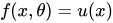
{\displaystyle f(x,\theta )=u(x)}
は消費者の 効用関数 であり、
C
(
θ
)
=
B
(
p
,
w
)
=
{
x
|
p
x
≤
w
}
{\displaystyle C(\theta )=B(p,w)=\{x\,|\,px\leq w\}}
消費者の 予算セット です。 それから、
f
∗
(
θ
)
=
v
(
p
,
w
)
{\displaystyle f^{*}(\theta )=v(p,w)}
は間接効用関数 で あり、
C
∗
(
θ
)
=
x
(
p
,
w
)
{\displaystyle C^{*}(\theta )=x(p,w)}
はマーシャルの需要 です 。 一般均衡理論 の証明では、 消費者の需要に
ブラウワー または 角谷の不動点定理を 適用することが多く、コンパクト性と連続性が求められ、最大値定理はそのために必要な条件を提供します。
参照
注記
^ Ok, Efe (2007). 実分析と経済学への応用 . プリンストン大学出版局. p. 306. ISBN 978-0-691-11768-3 。 ^元の参考文献は 、Claude Berge (1963). Topological Spaces . Oliver and Boyd. p. 116 の第6章第3節の最大値定理です。 ベルゲはハウスドルフ位相空間のみを考慮し、ハウスドルフ空間そのものとなるコンパクト集合のみを許容するという、有名な、あるいは悪名高い主張をした。また、上半連続対応がコンパクト値を持つことも要求した。これらの性質は、後の文献で明らかにされ、分解された。 ^ Charalambos D. Aliprantis、 Kim C. Border (2006). Infinite Dimensional Analysis: A Hitchhiker's Guide の 定理17.31と比較。Springer . pp. 570. ISBN 9783540295860 。 これは任意の位相空間に対して与えられている。また、が のグラフ上でのみ定義される 可能性も考慮されている 。
f
{\displaystyle f}
C
{\displaystyle C}
^ Shouchuan Hu; Nikolas S. Papageorgiou (1997). Handbook of Multivalued Analysis . Vol. 1: Theory. Springer-Science + Business Media, BV p. 84 の定理3.5と比較してください。 彼らは、 とがハウスドルフ空間である 場合を考察する 。
Θ
{\displaystyle \Theta }
X
{\displaystyle X}
^ 定理3.6 、ブライアン・ビービス、イアン・ドブス共著(1990年)『 経済分析のための最適化と安定性理論 』ニューヨーク:ケンブリッジ大学出版局、pp. 83-84 、 ISBN 0-521-33605-8 。 ^ Claude Berge (1963) 『位相空間 』第6章第1節の定理7と比較 。Oliver and Boyd、p. 112。 ベルゲは、基礎空間がハウスドルフであると仮定し、 証明においてこの性質を に対して ( に対しては用いない)用いている。
X
{\displaystyle X}
C
{\displaystyle C}
^ ニコラス・S・パパゲオルギウ(1997年) 『多値解析ハンドブック 第1巻 理論』Springer-Science + Business Media, BV p. 53 の命題2.46と比較。 彼らは暗黙的に と が ハウスドルフ空間であると仮定していますが、その証明は一般論的です。
Θ
{\displaystyle \Theta }
X
{\displaystyle X}
^ Charalambos D. Aliprantis、Kim C. Border (2006) 『無限次元解析:ヒッチハイク・ガイド 』Springer、pp. 564、 ISBNの 系17.18と比較。 9783540295860 。 これは任意の位相空間に対して与えられますが、証明は位相ネットの仕組みに依存します。 ^ Claude Berge (1963) 『位相空間 』第6章第3節の定理2と比較 。Oliver and Boyd、p. 116。 ベルゲの議論は本質的にはここで提示されているものですが、彼はここでも基礎空間がハウスドルフであるという仮定のもとで証明された補助的な結果を使用しています。 ^ ニコラス・S・パパゲオルギウ(1997年) 『多値解析ハンドブック 第1巻 理論』Springer-Science + Business Media, BV p. 82 の命題3.1と比較。 彼らはハウスドルフ空間のみを対象としており、その証明も位相ネットに依存している。彼らの結果により、 が の 値を取ることも可能となる 。
f
{\displaystyle f}
±
∞
{\displaystyle \pm \infty }
^ Charalambos D. Aliprantis、Kim C. Border (2006). Infinite Dimensional Analysis: A Hitchhiker's Guide の 補題17.30と比較。Springer . pp. 569. ISBN 9783540295860 。 彼らは任意の位相空間を考慮し、位相ネットに基づいた議論を使用します。 ^ Claude Berge (1963)の第6章第3節の定理1と比較してください 。 位相空間 、OliverとBoyd、p. 115。 ここで提示されている議論は本質的に彼のものである。 ^ ニコラス・S・パパゲオルギウ(1997年) 『多値解析ハンドブック 第1巻 理論』Springer-Science + Business Media, BV p. 83 の命題3.3と比較。 彼らはハウスドルフ空間のみを対象としており、その証明も位相ネットに依存している。彼らの結果により、 が の 値を取ることも可能となる 。
f
{\displaystyle f}
±
∞
{\displaystyle \pm \infty }
^ Charalambos D. Aliprantis、Kim C. Border (2006). Infinite Dimensional Analysis: A Hitchhiker's Guide の 補題17.29と比較 。Springer. pp. 569. ISBN 9783540295860 。 彼らは任意の位相空間を考慮し、位相ネットを含む議論を使用します。 ^ ab Sundaram, Rangarajan K. (1996). 『最適化理論入門 』 ケンブリッジ大学出版局. p. 237. ISBN 0-521-49770-1 。 ^ ユージン A. のファインバーグの定理 1.2 ;カシャノフ、パブロ・O.ザドイアンチュク、ニーナ V. (2013 年 1 月)。 「非コンパクト画像セットに対するベルジェの定理」。 数学的分析と応用のジャーナル 。 397 (1 ) : 255–259.arXiv : 1203.1340 。 土井 :10.1016/j.jmaa.2012.07.051。 S2CID 8603060。
参考文献 クロード・ベルジュ (1963). 位相空間 . オリバーとボイド. pp. 115– 117. チャラランボス・D・アリプランティス、 キム・C・ボーダー (2006年) 『無限次元解析:ヒッチハイク・ガイド』 シュプリンガー社、pp. 569-571. ISBN 9783540295860 。 Shouchuan Hu; Nikolas S. Papageorgiou (1997). 多値解析ハンドブック 第1巻 理論. Springer-Science + Business Media, BV pp. 82– 89.