


feet of the perpendicular:

center of the circumcircle:

the green segments are used in the formula for radius


6 feet on the pedal circle:

center of the pedal circle and midpoint of :


angle bisectors:


The pedal circle of the a triangle and a point in the plane is a special circle determined by those two entities. More specifically for the three perpendiculars through the point onto the three (extended) triangle sides you get three points of intersection and the circle defined by those three points is the pedal circle. By definition the pedal circle is the circumcircle of the pedal triangle.[1][2]

For radius of the pedal circle the following formula holds with being the radius and being the center of the circumcircle:[2]


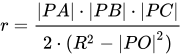
Note that the denominator in the formula turns 0 if the point lies on the circumcircle. In this case the three points determine a degenerated circle with an infinite radius, that is a line. This is the Simson line. If is the incenter of the triangle then the pedal circle is the incircle of the triangle and if is the orthocenter of the triangle the pedal circle is the nine-point circle.[3]
If does not lie on the circumcircle then its isogonal conjugate yields the same pedal circle, that is the six points and lie on the same circle. Moreover, the midpoint of the line segment is the center of that pedal circle.[1]

Griffiths' theorem states that all the pedal circles for a points located on a line through the center of the triangle's circumcircle share a common (fixed) point.[4]
Consider four points with no three of them being on a common line. Then you can build four different subsets of three points. Take the points of such a subset as the vertices of a triangle and the fourth point as the point , then they define a pedal circle. The four pedal circles you get this way intersect in a common point.[3]
References
- ^ a b Ross Honsberger: Episodes in Nineteenth and Twentieth Century Euclidean Geometry. MAA, 1995, pp. 67–75
- ^ a b Roger A. Johnson: Advanced Euclidean Geometry. Dover 2007 (reprint), ISBN 978-0-486-46237-0, pp. 135–144, 155, 240
- ^ a b Weisstein, Eric W. "Pedal Circle". MathWorld.
- ^ Weisstein, Eric W. "Griffiths' Theorem". MathWorld.
External links


