Psi Hydrae
| Observation dataEpochJ2000.0 EquinoxJ2000.0 (ICRS) | |
|---|---|
| Constellation | Hydra |
| Right ascension | 13h 09m 03.27026s[1] |
| Declination | −23° 07′ 05.0501″[1] |
| Apparent magnitude (V) | 4.97[2] |
| Characteristics | |
| Spectral type | K0 III[3] |
| U−B color index | +0.95[2] |
| B−V color index | +1.05[2] |
| Astrometry | |
| Radial velocity (Rv) | −17.2±0.6[4] km/s |
| Proper motion (μ) | RA: −20.08[1]mas/yrDec.: −39.81[1]mas/yr |
| Parallax (π) | 14.09±0.48 mas[1] |
| Distance | 231 ± 8 ly (71 ± 2 pc) |
| Absolute magnitude (MV) | +0.54[5] |
| Details | |
| Radius | 10.6[6] R☉ |
| Luminosity | 56[7] L☉ |
| Surface gravity (log g) | 2.72[5] cgs |
| Temperature | 4,680[5] K |
| Metallicity[Fe/H] | −0.19±0.04[5] dex |
| Other designations | |
| ψ Hya, 45 Hydrae, BD−22°3515, HD 114149, HIP 64166, HR 4958, SAO 181410[8] | |
| Database references | |
| SIMBAD | data |
Psi Hydrae (ψ Hydrae) is a star system in the equatorial constellation of Hydra. Based upon an annual parallax shift of 14.09 mas as seen from Earth, it is located around 231 light years away from the Sun. It is faintly visible to the naked eye with an apparent magnitude of 4.97.[2]
System
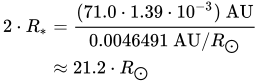
This is a probable astrometric binary system.[9] The primary, component A, is an evolvedgiant star with a stellar classification of K0 III.[3] It is a red clump star that is generating energy through the fusion of helium at its core.[10] The measured angular diameter is 1.39±0.02 mas,[11] which, at the estimated distance of Psi Hydrae, yields a physical size of about 10.6 times the radius of the Sun.[6] It is radiating 56[7] times the solar luminosity from its photosphere at an effective temperature of 4,680. K.[5]
Cultural significance
The Kalapalo people of Mato Grosso state in Brazil called this star and β HyaKafanifani.[12]
References
- ^ abcdevan Leeuwen, F. (2007), "Validation of the new Hipparcos reduction", Astronomy and Astrophysics, 474 (2): 653–664, arXiv:0708.1752, Bibcode:2007A&A...474..653V, doi:10.1051/0004-6361:20078357, S2CID 18759600.
- ^ abcdMermilliod, J.-C. (1986), "Compilation of Eggen's UBV data, transformed to UBV (unpublished)", Catalogue of Eggen's UBV Data, SIMBAD, Bibcode:1986EgUBV........0M.
- ^ abHouk, Nancy; Smith-Moore, M. (1978), Michigan catalogue of two-dimensional spectral types for the HD stars, vol. 4, Ann Arbor: Dept. of Astronomy, University of Michigan, Bibcode:1988mcts.book.....H.
- ^de Bruijne, J. H. J.; Eilers, A.-C. (October 2012), "Radial velocities for the HIPPARCOS-Gaia Hundred-Thousand-Proper-Motion project", Astronomy & Astrophysics, 546: 14, arXiv:1208.3048, Bibcode:2012A&A...546A..61D, doi:10.1051/0004-6361/201219219, S2CID 59451347, A61.
- ^ abcdeMcWilliam, Andrew (December 1990), "High-resolution spectroscopic survey of 671 GK giants", Astrophysical Journal Supplement Series, 74: 1075–1128, Bibcode:1990ApJS...74.1075M, doi:10.1086/191527.
- ^ abLang, Kenneth R. (2006), Astrophysical formulae, Astronomy and astrophysics library, vol. 1 (3rd ed.), Birkhäuser, ISBN 3-540-29692-1. The radius (R*) is given by:
- ^ abMcDonald, I.; et al. (2012), "Fundamental Parameters and Infrared Excesses of Hipparcos Stars", Monthly Notices of the Royal Astronomical Society, 427 (1): 343–57, arXiv:1208.2037, Bibcode:2012MNRAS.427..343M, doi:10.1111/j.1365-2966.2012.21873.x, S2CID 118665352.
- ^"* psi Hya". SIMBAD. Centre de données astronomiques de Strasbourg. Retrieved 2017-03-17.
{{cite web}}: CS1 maint: postscript (link) - ^Makarov, V. V.; Kaplan, G. H. (May 2005), "Statistical Constraints for Astrometric Binaries with Nonlinear Motion", The Astronomical Journal, 129 (5): 2420–2427, Bibcode:2005AJ....129.2420M, doi:10.1086/429590.
- ^Alves, David R. (August 2000), "K-Band Calibration of the Red Clump Luminosity", The Astrophysical Journal, 539 (2): 732–741, arXiv:astro-ph/0003329, Bibcode:2000ApJ...539..732A, doi:10.1086/309278, S2CID 16673121.
- ^Richichi, A.; et al. (February 2005), "CHARM2: An updated Catalog of High Angular Resolution Measurements", Astronomy and Astrophysics, 431 (2): 773–777, Bibcode:2005A&A...431..773R, doi:10.1051/0004-6361:20042039.
- ^Basso, Ellen B. (1987). In Favor of Deceit: A Study of Tricksters in an Amazonian Society. Tucson, Arizona: University of Arizona Press. p. 360. ISBN 0-8165-1022-9.