Quasi-finite field
In mathematics, a quasi-finite field[1] is a generalisation of a finite field. Standard local class field theory usually deals with complete valued fields whose residue field is finite (i.e., non-archimedean local fields), but the theory applies equally well when the residue field is only assumed quasi-finite.[2]
Formal definition
A quasi-finite field is a perfect fieldK together with an isomorphism of topological groups

where Ks is an algebraic closure of K (necessarily separable because K is perfect). The field extensionKs/K is infinite, and the Galois group is accordingly given the Krull topology. The group is the profinite completion of integers with respect to its subgroups of finite index.

This definition is equivalent to saying that K has a unique (necessarily cyclic) extension Kn of degree n for each integer n ≥ 1, and that the union of these extensions is equal to Ks.[3] Moreover, as part of the structure of the quasi-finite field, there is a generator Fn for each Gal(Kn/K), and the generators must be coherent, in the sense that if n divides m, the restriction of Fm to Kn is equal to Fn.
Examples
The most basic example, which motivates the definition, is the finite field K = GF(q). It has a unique cyclic extension of degree n, namely Kn = GF(qn). The union of the Kn is the algebraic closure Ks. We take Fn to be the Frobenius element; that is, Fn(x) = xq.
もう一つの例は、複素数体C上のTの形式ローラン級数の環であるK = C (( T ))である。(これらは単に形式的な冪級数であり、負の次数の項を有限個許容する。) このとき、Kは一意の巡回拡大を持つ。
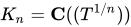
の各n≥1についてn次の体で、その和集合はピュイズー級数体と呼ばれるKの代数的閉包であり、Gal( Kn / K )の生成元は

この構成は、Cを任意の特性0の代数閉体Cに置き換えても成り立つ。[ 4 ]
参照
注記
- ^ ( Artin & Tate 2009、§XI.3) は、この体が「守屋の公理」を満たすと述べている。
- ^守谷美香夫による記載 ( Serre 1979、第 XIII 章、p. 188)
- ^ ( Serre 1979、§XIII.2 演習 1、p. 192)
- ^ ( Serre 1979、§XIII.2、p. 191)
参考文献
