Sumner's conjecture


Sumner's conjecture (also called Sumner's universal tournament conjecture) is a conjecture in extremal graph theory on oriented trees in tournaments. It states that every orientation of every -vertex tree is a subgraph of every -vertex tournament.[1]David Sumner, a graph theorist at the University of South Carolina, conjectured in 1971 that tournaments are universal graphs for polytrees. The conjecture was proven for all large by Daniela Kühn, Richard Mycroft, and Deryk Osthus.[2]
Examples
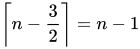
Let polytree be a star, in which all edges are oriented outward from the central vertex to the leaves. Then, cannot be embedded in the tournament formed from the vertices of a regular -gon by directing every edge clockwise around the polygon. For, in this tournament, every vertex has indegree and outdegree equal to , while the central vertex in has larger outdegree .[3] Thus, if true, Sumner's conjecture would give the best possible size of a universal graph for polytrees.


However, in every tournament of vertices, the average outdegree is , and the maximum outdegree is an integer greater than or equal to the average. Therefore, there exists a vertex of outdegree , which can be used as the central vertex for a copy of .


Partial results
The following partial results on the conjecture have been proven.
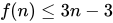
- There is a function with asymptotic growth rate with the property that every -vertex polytree can be embedded as a subgraph of every -vertex tournament. Additionally and more explicitly, .[4]
- There is a function such that tournaments on vertices are universal for polytrees with leaves.[5]
- There is a function such that every -vertex polytree with maximum degree at most forms a subgraph of every tournament with vertices. When is a fixed constant, the asymptotic growth rate of is .[6]
- Every "near-regular" tournament on vertices contains every -vertex polytree.[7]
- Every orientation of an -vertex caterpillar tree with diameter at most four can be embedded as a subgraph of every -vertex tournament.[7]
- Every -vertex tournament contains as a subgraph every -vertex arborescence.[8]




Related conjectures
Rosenfeld (1972) conjectured that every orientation of an -vertex path graph (with ) can be embedded as a subgraph into every -vertex tournament.[7] After partial results by Thomason (1986), this was proven by Havet & Thomassé (2000a).

Havet and Thomassé[9] in turn conjectured a strengthening of Sumner's conjecture, that every tournament on vertices contains as a subgraph every polytree with at most leaves. This has been confirmed for almost every tree by Mycroft and Naia (2018).

Burr (1980) conjectured that, whenever a graph requires or more colors in a coloring of , then every orientation of contains every orientation of an -vertex tree. Because complete graphs require a different color for each vertex, Sumner's conjecture would follow immediately from Burr's conjecture.[10] As Burr showed, orientations of graphs whose chromatic number grows quadratically as a function of are universal for polytrees.

Notes
- ^Kühn, Mycroft & Osthus (2011a). However the earliest published citations given by Kühn et al. are to Reid & Wormald (1983) and Wormald (1983). Wormald (1983) cites the conjecture as an undated private communication by Sumner.
- ^Kühn, Mycroft & Osthus (2011b).
- ^This example is from Kühn, Mycroft & Osthus (2011a).
- ^Kühn, Mycroft & Osthus (2011a) and El Sahili (2004). For earlier weaker bounds on , see Chung (1981), Wormald (1983), Häggkvist & Thomason (1991), Havet & Thomassé (2000b), and Havet (2002).
- ^Häggkvist & Thomason (1991); Havet & Thomassé (2000a); Havet (2002).
- ^Kühn, Mycroft & Osthus (2011a).
- ^ abcReid & Wormald (1983).
- ^Havet & Thomassé (2000b).
- ^In Havet (2002), but jointly credited to Thomassé in that paper.
- ^This is a corrected version of Burr's conjecture from Wormald (1983).
References
- Burr, Stefan A. (1980), "Subtrees of directed graphs and hypergraphs", Proceedings of the Eleventh Southeastern Conference on Combinatorics, Graph Theory and Computing (Florida Atlantic Univ., Boca Raton, Fla., 1980), Vol. I, Congressus Numerantium, vol. 28, pp. 227–239, MR 0608430.
- Chung, F.R.K. (1981), A note on subtrees in tournaments, Internal Memorandum, Bell Laboratories. As cited by Wormald (1983).
- El Sahili, A. (2004), "Trees in tournaments", Journal of Combinatorial Theory, Series B, 92 (1): 183–187, doi:10.1016/j.jctb.2004.04.002, MR 2078502.
- Häggkvist, Roland; Thomason, Andrew (1991), "Trees in tournaments", Combinatorica, 11 (2): 123–130, doi:10.1007/BF01206356, MR 1136161.
- Havet, Frédéric (2002), "Trees in tournaments", Discrete Mathematics, 243 (1–3): 121–134, doi:10.1016/S0012-365X(00)00463-5, MR 1874730.
- Havet, Frédéric; Thomassé, Stéphan (2000a), "Oriented Hamiltonian paths in tournaments: a proof of Rosenfeld's conjecture", Journal of Combinatorial Theory, Series B, 78 (2): 243–273, doi:10.1006/jctb.1999.1945, MR 1750898.
- Havet, Frédéric; Thomassé, Stéphan (2000b), "Median orders of tournaments: a tool for the second neighborhood problem and Sumner's conjecture", Journal of Graph Theory, 35 (4): 244–256, doi:10.1002/1097-0118(200012)35:4<244::AID-JGT2>3.0.CO;2-H, MR 1791347.
- Kühn, Daniela; Mycroft, Richard; Osthus, Deryk (2011a), "An approximate version of Sumner's universal tournament conjecture", Journal of Combinatorial Theory, Series B, 101 (6): 415–447, arXiv:1010.4429, doi:10.1016/j.jctb.2010.12.006, MR 2832810, Zbl 1234.05115.
- Kühn, Daniela; Mycroft, Richard; Osthus, Deryk (2011b), "A proof of Sumner's universal tournament conjecture for large tournaments", Proceedings of the London Mathematical Society, Third Series, 102 (4): 731–766, arXiv:1010.4430, doi:10.1112/plms/pdq035, MR 2793448, Zbl 1218.05034.
- Naia, Tássio (2018), Large structures in dense directed graphs (Doctoral thesis), University of Birmingham.
- Reid, K. B.; Wormald, N. C. (1983), "Embedding oriented n-trees in tournaments", Studia Scientiarum Mathematicarum Hungarica, 18 (2–4): 377–387, MR 0787942.
- Rosenfeld, M. (1972), "Antidirected Hamiltonian paths in tournaments", Journal of Combinatorial Theory, Series B, 12: 93–99, doi:10.1016/0095-8956(72)90035-4, MR 0285452.
- Thomason, Andrew (1986), "Paths and cycles in tournaments", Transactions of the American Mathematical Society, 296 (1): 167–180, doi:10.2307/2000567, JSTOR 2000567, MR 0837805.
- Wormald, Nicholas C. (1983), "Subtrees of large tournaments", Combinatorial mathematics, X (Adelaide, 1982), Lecture Notes in Math., vol. 1036, Berlin: Springer, pp. 417–419, doi:10.1007/BFb0071535, ISBN 978-3-540-12708-6, MR 0731598.
External links
- Sumner's Universal Tournament Conjecture (1971), D. B. West, updated July 2008.
