
配位化学において、配位子円錐角(θ)は、遷移金属配位錯体中の配位子の立体的嵩高さの尺度である。これは、円錐の頂点の金属と、円錐の底面の周囲にある配位子原子のファンデルワールス球の最外縁とのなす立体角として定義される。三級ホスフィン配位子は一般的にこのパラメータを用いて分類されるが、この方法はどの配位子にも適用できる。円錐角という用語は、デュポン社の研究化学者チャドウィック・A・トルマンによって初めて導入された。トルマンはもともとこの方法をニッケル錯体のホスフィン配位子用に開発し、正確な物理モデルの測定からそれらを決定した。[1] [2] [3]
非対称の場合
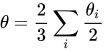
円錐角の概念は、PR3のような対称的な配位子で最も簡単に視覚化できます。しかし、このアプローチは、PRR′R″型やジホスフィンのような、より対称性の低い配位子も含むように改良されています。このような非対称の場合、置換基角の半角は、θ i/2を平均し、それを2倍にして合計円錐角θを求めます。ジホスフィンの場合、θ i/2骨格のキレートバイト角は、メチレン、エチレン、プロピレン骨格を持つジホスフィンのバイト角をそれぞれ74°、85°、90°と仮定した場合、キレートバイト角の半分として近似される。マンツコーン角は、トルマンコーン角よりも計算が容易な場合が多い:[4] [説明が必要]
| 配位子 | 角度 (°) |
|---|---|
| pH 3 | 87 [1] |
| PF 3 | 104 [1] |
| P(OCH 3 ) 3 | 107 [1] |
| dmpe | 107 |
| depe | 115 |
| P(CH 3 ) 3 | 118 [1] |
| dppm | 121 |
| dppe | 125 |
| dppp | 127 |
| P(CH 2 CH 3 ) 3 | 132 [1] |
| dcpe | 142 |
| P(C 6 H 5 ) 3 | 145 [1] |
| P(シクロ-C 6 H 11 ) 3 | 179 [1] |
| P( t -Bu) 3 | 182 [1] |
| P(C 6 F 5 ) 3 | 184 [1] |
| P(C 6 H 4 -2-CH 3 ) 3 | 194[1] |
| P(2,4,6-Me3C6H2)3 | 212 |

Variations
The Tolman cone angle method assumes empirical bond data and defines the perimeter as the maximum possible circumscription of an idealized free-spinning substituent. The metal-ligand bond length in the Tolman model was determined empirically from crystal structures of tetrahedral nickel complexes. In contrast, the solid-angle concept derives both bond length and the perimeter from empirical solid state crystal structures.[5][6] There are advantages to each system.
If the geometry of a ligand is known, either through crystallography or computations, an exact cone angle (θ) can be calculated.[7][8][9] No assumptions about the geometry are made, unlike the Tolman method.
Application
The concept of cone angle is of practical importance in homogeneous catalysis because the size of the ligand affects the reactivity of the attached metal center. In an example,[10] the selectivity of hydroformylation catalysts is strongly influenced by the size of the coligands. Despite being monovalent, some phosphines are large enough to occupy more than half of the coordination sphere of a metal center. Recent research has found that other descriptors—such as percent buried volume—are more accurate than cone angle at capturing the relevant steric effects of the phosphine ligand(s) when bound to the metal center.[11]
See also
- Steric effects (versus electronic effects)
- Tolman electronic parameter
References
- ^ a b c d e f g h i j k Tolman, Chadwick A. (1970-05-01). "Phosphorus ligand exchange equilibriums on zerovalent nickel. Dominant role for steric effects". J. Am. Chem. Soc. 92 (10): 2956–2965. Bibcode:1970JAChS..92.2956T. doi:10.1021/ja00713a007.
- ^ Tolman, CA; Seidel, WC; Gosser, LW (1974-01-01). 「NiL 4からのリン配位子解離による三配位ニッケル(0)錯体の形成」. J. Am. Chem. Soc . 96 (1): 53– 60. Bibcode :1974JAChS..96...53T. doi :10.1021/ja00808a009.
- ^ Tolman, CA (1977). 「有機金属化学および均一触媒におけるリン配位子の立体効果」. Chem. Rev. 77 (3): 313– 48. doi :10.1021/cr60307a002.
- ^ Manz, TA; Phomphrai, K.; Medvedev, G.; Krishnamurthy, BB; Sharma, S.; Haq, J.; Novstrup, KA; Thomson, KT; Delgass, WN; Caruthers, JM; Abu-Omar, MM (2007). 「シクロペンタジエニル/アリールオキシド混合配位子を含むチタンシングルサイトオレフィン重合触媒の構造活性相関」. J. Am. Chem. Soc . 129 (13): 3776– 3777. Bibcode :2007JAChS.129.3776M. doi :10.1021/ja0640849. PMID 17348648.
- ^ Immirzi, A.; Musco, A. (1977). 「配位錯体中のリン配位子の大きさを測定する方法」Inorg. Chim. Acta . 25 : L41 – L42 . doi :10.1016/S0020-1693(00)95635-4. [リンク切れ]
- ^ Niksch, Tobias; Görls, Helmar; Weigand, Wolfgang (2009). 「立体角概念の二座配位子への拡張」Eur. J. Inorg. Chem . 2010 (1): 95– 105. doi :10.1002/ejic.200900825.
- ^ Bilbrey, Jenna A.; Kazez, Arianna H.; Locklin, J.; Allen, Wesley D. (2013). 「正確なリガンドコーン角」. Journal of Computational Chemistry . 34 (14): 1189– 1197. Bibcode :2013JCoCh..34.1189B. doi :10.1002/jcc.23217. PMID : 23408559. S2CID : 23864226.
- ^ "AaronTools". aarontools.readthedocs.io . 2023年5月30日閲覧。
- ^ プティジャン、ミシェル (2015). 「配位子の円錐角計算のための解析アルゴリズム。トリフェニルホスフィンパラジウム錯体への応用」。コンテス・レンダス・チミエ。18 (6): 678–684。土井: 10.1016/j.crci.2015.04.004。
- ^ Evans, D.; Osborn, JA; Wilkinson, G. (1968). 「ロジウム錯体触媒を用いたアルケンのヒドロホルミル化」. Journal of the Chemical Society . 33 (21): 3133– 3142. doi :10.1039/J19680003133.
- ^ Newman-Stonebraker, Samuel H.; Smith, Sleight R.; Borowski, Julia E.; Peters, Ellyn; Gensch, Tobias; Johnson, Heather C.; Sigman, Matthew S.; Doyle, Abigail G. (2021). 「クロスカップリング触媒におけるホスフィン連結状態と反応性の単変量分類」. Science . 374 (6565): 301– 308. Bibcode :2021Sci...374..301N. doi :10.1126/science.abj4213. PMID: 34648340. S2CID : 238991361.
