In this article, the demons' names are taken from the goeticgrimoireArs Goetia, which differs in terms of number and ranking from the Pseudomonarchia Daemonum of Johann Weyer. As a result of multiple translations, there are multiple spellings for some of the names, explained in more detail in the articles concerning them.[1][2]
Each ranking represents association with one of the traditional astrological planets; kings with the Sun, marquises with the Moon, presidents with Mercury, dukes with Venus, earls with Mars, princes with Jupiter, and the sole knight with Saturn. The sole demon which appears in Pseudomonarchia Daemonum but not in the Ars Goetia is Pruflas.
The 72 angels of the Shem HaMephorash are considered to be opposite and balancing forces against these fallen angels.
When appearing, he looks very fierce to frighten the conjurer or to see if he is courageous. The conjurer must be brave, and holding a hazel wand in his hand must draw a triangle by striking towards the South, East, and upwards, and command Beleth into it by means of some conjurations.
If he does not obey, the conjurer must rehearse all threats the conjurations said. Then, Beleth will obey and do all that he is commanded, but the conjurer must be respectful and pay homage unto Beleth due to his rank, and hold a silver ring in the middle finger of the left hand against his face, as it is the use of hellish kings and princes before Amaymon.
Beleth gives all the love of men and women he is commanded until the conjurer is satisfied.
Purson (also Curson, Pursan) is a Great King of Hell, being served and obeyed by twenty-two legions of demons. He knows of hidden things, can find treasures, and tells past, present and future. Taking a human or aerial body he answers truly of all secret and divine things of Earth and the creation of the world. He also brings good familiars. Purson is depicted as a man with the face of a lion, carrying a ferocious viper in his hand, and riding a bear. Before him, there can be heard many trumpets sounding. This demon blows internal trumpets, and is believed connected to the revelator to the Antichrist.
Asmodeus (also Ashmodai, Asmodeus, Asmody, Asmoday) appears as the king 'Asmoday' in the Ars Goetia, where he is said to have a seal in gold and is listed as number thirty-two according to respective rank.[4] He "is strong, powerful and appears with three heads; the first is like a bull, the second like a man, and the third like a ram or a goat; the tail of a serpent, and from his mouth issue flames of fire."[4] Also, he sits upon an infernal dragon, holds a lance with a banner, and amongst the Legions of Amaymon, Asmoday governs seventy two legions of inferior spirits.[4]
Amdusias[5] (also Amduscias, Amdukias or Ambduscias) has 29 legions of demons and spirits under his command. He is depicted as a human with claws instead of hands and feet, the head of a unicorn, and a trumpet to symbolize his powerful voice. Amdusias is associated with thunder and it has been said that his voice is heard during storms. In other sources, he is accompanied by the sound of trumpets when he comes and will give concerts if commanded, but while all his types of musical instruments can be heard they cannot be seen. He is regarded as being the demon in charge of the cacophonousmusic that is played in Hell. He can make trees bend at will.
Agares (or Agreas),[5] ruling the eastern zone of Hell, and being served by 31 legions of demons. He can make runaways come back and those who stand still[7] run, finding pleasure in teaching immoral expressions. He also has the power to destroy dignities, both temporal and supernatural.[5][8] He is depicted as a pale old man riding a crocodile.[8][9]
Valefar (or Malaphar, Malephar, Valafar, Valefor) is a Duke of Hell.[10] He tempts people to steal and is in charge of a good relationship among thieves. Valefar is considered a good familiar by his associates "till they are caught in the trap."[11] He commands ten legions of demons.[6] He is represented as a lion with the head of a man, or as a lion with the head of a donkey.[6]
Barbatos is an Earl and Duke of Hell, ruling thirty legions of demons and has four kings as his companions to command his legions. He gives the understanding of the voices of the animals, says past and future, conciliates friends and rulers, and he can lead men to hidden treasures that have been hidden by the enchantment of magicians. His name seems to derive from Latin "barbatus", bearded, old man, philosopher. He is mentioned in The Lesser Key of Solomon.
Buné is a Great Duke of Hell, mighty and strong, who has thirty legions of demons under his command. He changes the place of the dead and makes them demons that are under his power to gather together upon those sepulchres. Buné makes men eloquent and wise, and gives true answers to their demands and also richness. He speaks with a comely high voice. Buné is depicted as a three-headed dragon, being his heads like those of a dog, a griffin, and a man (although according to some grimoires he has two heads like a dragon and the third like a man).
Berith (also Baal-berith) is a Great Duke of Hell, powerful and terrible, and has twenty-six legions of demons under his command. He tells things of the past, present and future with true answers; he can also turn all metals into gold, give dignities to men and confirm them. He speaks with a clear and subtle voice, and as recounted in Aleister Crowley's Illustrated Goetia, he is a liar when not answering questions. To speak with him the conjurer must wear a silver ring and put it before his face in the same form as it is needed in Beleth's case and demons do before Amaymon. He is depicted as a soldier wearing red clothes, a golden crown, and riding a red horse. Books on the subject tell that he is called according to whom invokes him, being called Berith by the Jews (see below). According to some demonologists from the 16th century, his power is stronger in June, meanwhile to Sebastien Michaelis he suggests murder and blasphemy and his adversary is St. Barnabas. His name was surely taken from Ba'al Berith, a form of Baal worshiped in Berith (Beirut), Phoenicia. In Alchemy Berith was the element with which all metals could be transmuted into gold. "Berith" is the Hebrew word for covenant, it was originated from the Akkadian (Babylonian) word "Biritu" which means "to fetter" or "to bond".
Astaroth (also Ashtaroth, Astarot and Asteroth) is referred to in The Lesser Key of Solomon as a very powerful demon who commands 40 legions of demons. Seal of Astaroth, as depicted in The Lesser Key of Solomon美術では、『地獄の辞典』の中で、アスタロトは羽根の生えた翼を持ち、王冠をかぶり、片手に蛇を持ち、竜のような翼と蛇のような尾を持つ獣に乗る裸の男として描かれている。セバスチャン・ミカエリスによると、彼は第一階層の悪魔であり、怠惰、虚栄心、合理化された哲学で誘惑する。彼の敵は聖バルトロマイであり、彼はアスタロトの誘惑を退けたので、彼から彼を守ることができる。彼は他の人々に数学と手工芸を教え、人々を透明にして隠された宝物へと導き、自分に向けられたあらゆる質問に答えることができる。彼はまた、死すべき存在に蛇を支配する力を与えるとも言われている。彼の名前は、おそらく女神アシェラまたはアスタルトから取られている。
Vassago (also Vasago, Usagoo) is a mighty Prince of Hell (see Hierarchy of demons), ruling over twenty-six legions of demons. He can be persuaded to tell the magician of events past and future, can discover hidden and lost things, and has a "good" nature.[9] A partial description from The Lesser Key of Solomon is as follows: "The Third Spirit is a Mighty Prince, being of the same nature as Agares. He is called Vassago. This Spirit is of a Good Nature, and his office is to declare things Past and to Come, and to discover all things Hidden or Lost." According to the Liber Officium Spirituum, he manifests as an angel.
Sitri[5] (also spelled Bitru, Sytry) is a Great Prince of Hell, and reigns over sixty legions of demons. He causes men to love women and vice versa, and can make people bare themselves naked if desired. He is depicted with the face of a leopard and the wings of a griffin, but under the conjurer's request he changes into a very beautiful man.
(Count/Prince) Ipos (also Aiperos, Ayperos, Ayporos, Ipes) is an Earl and powerful Prince of Hell who has thirty-six legions of demons under his command. He knows and can reveal all things, past, present and future. He can make men witty and valiant. He is commonly depicted with the body of an angel with the head of a lion, the tail of a hare, and the feet of a goose, less frequently in the same shape but with the body of a lion, and rarely as a vulture.
(Prince/President) Gaap (also Goap, Tap) is a mighty Prince and Great President of Hell, commanding sixty-six legions of demons. He is, according to The Lesser Key of Solomon, the king and prince of the southern region of Hell and Earth, and according to the Pseudomonarchia Daemonum (False Monarchy of the Demons) the king of the western region and as mighty as Beleth, but for both he is the guide of the four kings (the others being Ziminiar, Corson and Amaymon, although some translations of The Lesser Key of Solomon consider Belial, Beleth, Asmodai and Gaap, not giving detail on the cardinal point they rule). He is said to be better conjured to appear when the Sun is in a southern zodiacal sign. Gaap teaches Philosophy and all liberal sciences, can cause love or hate and make men insensible and invisible, deliver familiars out of the custody of other magicians, teaches how to consecrate those things that belong to the dominion of Amaymon his king (there is a contradiction here, see above), gives true answers concerning past, present and future, and can carry and re-carry men and things speedily from one nation to another at the conjurer's will. According to a few authors he can make men ignorant. According to Pseudomonarchia Daemonum, certain necromancers honour him with sacrifices and burning offerings. He is depicted in human shape.
Stolas[5] (also known as Stolos, Stoppas and Solas) is "a Great Prince of Hell, commands twenty-six legions of demons. He teaches astronomy and is knowledgeable about herbs, plants, and precious stones. He is often depicted as a raven or a crowned owl with long legs."[15]
Orobas is a very powerful Great Prince of Hell, having twenty legions of demons under his control. He supposedly gives true answers of things past, present and to come, divinity, and the creation of the world; he also confers dignities and prelacies, and the favour of friends and foes. Orobas is faithful to the conjurer, does not permit that any spirit tempts him, and never deceives anyone. He is depicted as a horse that changes into a man under the conjurer's request. The name could come from Latin "orobias", a type of incense.
Seir (also known as Seire, Seere, or Sear) is a Prince of Hell with 26 legions of demons under his command. He can go to any place on earth in a matter of seconds to accomplish the will of the conjurer, bring abundance, help in finding hidden treasures or in robbery, and is not a demon of evil but good nature, being mostly indifferent to evilness. He is depicted as a man riding a winged horse, and is said to be beautiful.
Marquises
Gamigin (also Gamygin, Gamigm or Samigina) is a Great Marquis of Hell who rules over thirty legions of demons.[8][9][16] He teaches all liberal sciences and gives an account of the souls of those who died in sin[9][16] and who drowned in the sea,[8] speaking with a rough voice.[8][9][16] He also answers what is asked about, and stays with the conjurer until they are satisfied.[8] Gamigin is depicted as a little horse[8][9][16] or a donkey,[9][16] which changes form into a man under the conjurer's request.[8][9][16]
Aamon[5] (or Amon, Nahum) is a Marquis of Hell who governs forty infernal legions. He appears as a wolf with a serpent's tail who can breathe fire, or as a man with a raven's head, sometimes depicted with canine teeth. He tells of all things past and future. He procures feuds, and reconciles controversies between friends and foes.
Leraje (also Leraie, Leraikha, Leraye, Loray, Oray) is a mighty Great Marquis of Hell who has thirty legions of demons under his power. He causes great battles and disputes, and makes gangrene wounds caused by arrows. He is depicted as a gallant and handsome archer clad in green, carrying a bow and quiver.
Kimaris (also known by the alternate names Cimeies, Cimejes and Cimeries) is most widely known as the 66th demon of the first part of the Lemegeton (popularly known as the Ars Goetia). He is described as a warrior riding a goodly black horse, and possesses the abilities of locating lost or hidden treasures, teaching trivium (grammar, logic and rhetoric) and making a man into a warrior of his own likeness. He holds the rank of marquis, and is served by 20 legions. He also rules over all the spirits of Africa. Much the same description is found in the earlier text of Johann Weyer's catalog of demons, Pseudomonarchia Daemonum (published 1563). Earlier still is the Munich Handbook of Necromancy: Clm 849 (published by Richard Kieckhefer, as Forbidden Rites: a necromancer's manual of the 15th century 1998) which lists an entity named Tuvries with much the same characteristics, except that he has 30 legions of servitors, and can cause a person to cross seas and rivers quickly. Most likely, Tuvries is a mistranscription of Cymries. Kimaris, as Cimeries, is also found on Anton LaVey's list of infernal names, although it is not known why LaVey chose Kimaris as one of the comparatively few Goetic daimons included. Aleister Crowley, in 777, gives Kimaris the Hebrew spelling KYMAVR and attributes him to the four of disks and the third decan of Capricorn by night. KYMAVR may allude to "Khem-our" (black light), a form of Horus mentioned in H. P. Blavatsky's Secret Doctrine. In Sepher Sephiroth, he is listed as KYTzAVR, with a gematria of 327, although KYMAVR=277. Since Tzaddi=90, which is also Mem spelled in full, the gematric substitution may be deliberate or a blind. In Harleian Ms. 6482, titled "The Rosie Crucian Secrets" (printed by the Aquarian Press, 1985), Dr. Rudd lists Cimeries as the 26th spirit made use of by King Solomon. He also attributes an angel Cimeriel to one of Dee'sEnochian Ensigns of Creation, the tablet of 24 mansions (see McLean, Treatise on Angel Magic). The earliest mention of Chamariel is in Rossi's Gnostic tractate (see Meyer and Smith, Ancient Christian Magic). It is probable that the earliest mention of Kimaris is also Coptic, found in the London oriental mss 6796 where the name "Akathama Chamaris" appears (Meyer and Smith). In this text, the entity in question does not appear to be evil; rather, he is addressed as a godlike helping spirit. Baskin's Dictionary of Satanism speculates that Cimeries is derived from Cimmerians, a warlike people mentioned in the works of several classical authors as dwelling totally in darkness. It is also possible that Cimeries is derived from Chimaira, the three-headed, fire-breathing lion-goat-serpent who eventually became one of the guardians of the underworld. There is a precedent, considering that the harmless Phoenix is also demonized in the Goetia.
Decarabia[5] (also called Carabia) is a demon and, according to The Lesser Key of Solomon, a Great Marquis of Hell, or a King and Earl according to the original Latin version of the Pseudomonarchia Daemonum[18] (these were somehow left out of the English translation by Reginald Scot). He has thirty legions of demons under his command. Decarabia knows the virtues of all herbs and precious stones, and can change into all birds and sing and fly like them before the conjurer. He is depicted as appearing as a pentagram star, changing into a man under the conjurer's request.
Earls
Image of Furfur from Collin de Plancy's Dictionnaire InfernalFurfur (also Furtur) is a powerful Great Earl of Hell, being the ruler of twenty-six legions of demons.[19] He is a liar unless compelled to enter a magic triangle where he gives true answers to every question, speaking with a rough voice. Furfur causes love between a man and a woman, creates storms, tempests, thunder, lightning, and blasts, and teaches on secret and divine things. He is depicted as a hart or winged hart, and also as an angel. "Furfur" or "furfurēs" in Latin means "bran". However, it seems more likely that the name is a corruption of "Furcifer", the Latin word for "scoundrel". Slightly less likely considering the context, but still possible, is that the name originated from "fūr", Latin for "thief".
Malthus (also Halphas, Malthas, or Malthous) is an Earl of Hell, commanding 26 legions of demons, who is said to have a rough voice when speaking. He is often depicted in the shape of a stork. Malthus builds towers and fills them with ammunition and weapons, an armorer of sorts. He is a prince of Hell. He is also said to send his legions into battle, or to places designated by higher commanding demons.
Raum (also Raim, Raym, Räum) is a Great Earl of Hell, ruling thirty legions of demons. He is depicted as a crow which adopts a human form at the request of the conjurer. Raum steals treasures out of kings' houses, carrying them where he wishes, and destroys cities and dignities of men (he is said to have great dispraise for dignities). Raum can also tell things past, present, and future, reconcile friends and foes and invoke love.
Bifrons, illustrated in the "Dictionnaire Infernal" (1863)Bifrons (also Bifrovs, Bifröus, Bifronze) is a demon, Earl of Hell, with six legions of demons under his command. He teaches sciences and arts, the virtues of the gems and woods, herbs, and changes corpses from their original grave into other places, sometimes putting magic lights on the graves that seem candles. He appears as a monster but then changes his shape into that of a man. The origin of the name is the Roman god Janus.
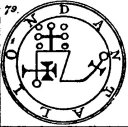
Andromalius[5] is a mighty Great Earl of Hell, having thirty-six legions of demons at his service. He can bring back both a thief and the stolen goods, punishes all thieves and other wicked people, and discovers hidden treasures, all evilness, and all dishonest dealing. Andromalius is depicted as a man holding a big serpent in his hand.
The Seventy-second Spirit in Order is named Andromalius. He is an Earl, Great and Mighty, appearing in the form of a Man holding a Great Serpent in his Hand. His Office is to bring back both a Thief, and the Goods which be stolen, and to discover all Wickedness and Underhand Dealing, and to punish all Thieves and other Wicked People and also to discover Treasures that be Hid. He ruleth over 36 Legions of Spirits. His Seal is this, the which wear thou as aforesaid, etc. —The Lesser Key of Solomon
(Count/President) Botis (or Otis) is a Great President and Earl of Hell, commanding sixty legions of demons. He tells of all things past and future, and reconciles friends and foes. He is depicted as an ugly viper, but when he changes shape, he puts himself in human shape, with big teeth and two horns. When in human shape he carries a sharp and bright sword in his hand.
(Count/President)Morax (also Foraii, Marax and Farax) is a Great Earl and President of Hell, having thirty-six legions of demons under his command. He teaches Astronomy and all other liberal sciences, and gives good and wise familiars that know the virtues of all herbs and precious stones. He is depicted as a big bull with the face of a man. It has been proposed that Morax is related to the Minotaur which Dante places in Hell (Inferno, Canto xii). See Fred Gettings, Dictionary of Demons (1988) His name seems to come from Latin "morax", that delays, that stops.
Glasya-Labolas as depicted in the "Dictionnaire Infernal" (1863)(Count/President)Glasya-Labolas (also Caacrinolaas, Caassimolar, Classyalabolas, Glassia-labolis, Glasya Labolas, Gaylos-Lobos) is a mighty President of Hell who commands thirty-six legions of demons.[24] He is the author and captain of manslaughter and bloodshed, tells all things past and to come, gains the minds and love of friends and foes causing love among them if desired, incites homicides and can make a man invisible. He is depicted as a dog with the wings of a griffin.
Foras (alternatively Forcas or Forrasis) is a powerful President of Hell, being obeyed by twenty-nine legions of demons. He teaches logic and ethics in all their branches, the virtues of all herbs and precious stones, can make a man witty, eloquent, invisible, and live long, and can discover treasures and recover lost things. He is depicted as a strong man. His name seems to derive from Latin foras (out, outside).
The Thirty-first Spirit is Foras. He is a Mighty President, and appeareth in the Form of a Strong Man in Human Shape. He can give the understanding to Men how they may know the Virtues of all Herbs and Precious Stones. He teacheth the Arts of Logic and Ethics in all their parts. If desired he maketh men invisible, and to live long, and to be eloquent. He can discover Treasures and recover things Lost. He ruleth over 29 Legions of Spirits, and his Seal is this, which wear thou, etc.
^Biagioli, Filippo (2023). Trattato di Demonologia, Summa verborum, numeri, temporis et spatii [Essay on demonology, Summa verborum, numeri, temporis et spatii] (in Italian and English). Italia: Handmade book in 24 copies. pp. 90–91.


 アルス・ゴエティアによるつぶやきの封印


.jpg/1280px-Andras(demon).jpg)


.jpg)