Affine gauge theory
Affine gauge theory is classical gauge theory where gauge fields are affine connections on the tangent bundle over a smooth manifold. For instance, these are gauge theory of dislocations in continuous media when , the generalization of metric-affine gravitation theory when is a world manifold and, in particular, gauge theory of the fifth force.


Affine tangent bundle
Being a vector bundle, the tangent bundle of an -dimensional manifold admits a natural structure of an affine bundle, called the affine tangent bundle, possessing bundle atlases with affine transition functions. It is associated to a principal bundle of affine frames in tangent space over , whose structure group is a general affine group.


The tangent bundle is associated to a principal linear frame bundle, whose structure group is a general linear group. This is a subgroup of so that the latter is a semidirect product of and a group of translations.


There is the canonical imbedding of to onto a reduced principal subbundle which corresponds to the canonical structure of a vector bundle as the affine one.
Given linear bundle coordinates

on the tangent bundle , the affine tangent bundle can be provided with affine bundle coordinates

and, in particular, with the linear coordinates (1).
Affine gauge fields
The affine tangent bundle admits an affine connection which is associated to a principal connection on an affine frame bundle . In affine gauge theory, it is treated as an affine gauge field.

Given the linear bundle coordinates (1) on , an affine connection is represented by a connection tangent-valued form

![{\displaystyle A=dx^{\lambda }\otimes [\partial _{\lambda }+(\Gamma _{\lambda }{}^{\mu }{}_{\nu }(x^{\alpha }){\dot {x}}^{\nu }+\sigma _{\lambda }^{\mu }(x^{\alpha })){\dot {\partial }}_{\mu }].\qquad \qquad (3)}](https://wikimedia.org/api/rest_v1/media/math/render/svg/eac67777b29a235766ae71b4958137e56940fa5f)
This affine connection defines a unique linear connection
![{\displaystyle \Gamma =dx^{\lambda }\otimes [\partial _{\lambda }+\Gamma _{\lambda }{}^{\mu }{}_{\nu }(x^{\alpha }){\dot {x}}^{\nu }{\dot {\partial }}_{\mu }]\qquad \qquad (4)}](https://wikimedia.org/api/rest_v1/media/math/render/svg/a25235a08594f247004589b1442515c3b4eff206)
on , which is associated to a principal connection on .
Conversely, every linear connection (4) on is extended to the affine one on which is given by the same expression (4) as with respect to the bundle coordinates (1) on , but it takes a form


![{\displaystyle A\Gamma =dx^{\lambda }\otimes [\partial _{\lambda }+(\Gamma _{\lambda }{}^{\mu }{}_{\nu }(x^{\alpha }){\widetilde {x}}^{\nu }+s_{\lambda }^{\mu }(x^{\alpha })){\widetilde {\partial }}_{\mu }],\qquad s_{\lambda }^{\mu }=-\Gamma _{\lambda }{}^{\mu }{}_{\nu }a^{\nu }+\partial _{\lambda }a^{\mu },}](https://wikimedia.org/api/rest_v1/media/math/render/svg/5e551e72fbe1f570cb35327c6bf0c53198d6fd6e)
relative to the affine coordinates (2).
Then any affine connection (3) on is represented by a sum


of the extended linear connection and a basic soldering form

on , where due to the canonical isomorphism of the vertical tangent bundle of .



Relative to the linear coordinates (1), the sum (5) is brought into a sum of a linear connection and the soldering form (6). In this case, the soldering form (6) often is treated as a translation gauge field, though it is not a connection.


Let us note that a true translation gauge field (i.e., an affine connection which yields a flat linear connection on ) is well defined only on a parallelizable manifold.
Gauge theory of dislocations
In field theory, one meets a problem of physical interpretation of translation gauge fields because there are no fields subject to gauge translations . At the same time, one observes such a field in gauge theory of dislocations in continuous media because, in the presence of dislocations, displacement vectors , , of small deformations are determined only with accuracy to gauge translations .




In this case, let , and let an affine connection take a form

with respect to the affine bundle coordinates (2). This is a translation gauge field whose coefficients describe plastic distortion, covariant derivatives coincide with elastic distortion, and a strength is a dislocation density.

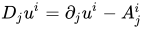

Equations of gauge theory of dislocations are derived from a gauge invariant Lagrangian density

where and are the Lamé parameters of isotropic media. These equations however are not independent since a displacement field can be removed by gauge translations and, thereby, it fails to be a dynamic variable.


Gauge theory of the fifth force
In gauge gravitation theory on a world manifold , one can consider an affine, but not linear connection on the tangent bundle of . Given bundle coordinates (1) on , it takes the form (3) where the linear connection (4) and the basic soldering form (6) are considered as independent variables.
As was mentioned above, the soldering form (6) often is treated as a translation gauge field, though it is not a connection. On another side, one mistakenly identifies with a tetrad field. However, these are different mathematical object because a soldering form is a section of the tensor bundle , whereas a tetrad field is a local section of a Lorentz reduced subbundle of a frame bundle .

In the spirit of the above-mentioned gauge theory of dislocations, it has been suggested that a soldering field can describe sui generi deformations of a world manifold which are given by a bundle morphism

where is a tautological one-form.
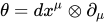
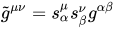
Then one considers metric-affine gravitation theory on a deformed world manifold as that with a deformed pseudo-Riemannian metric when a Lagrangian of a soldering field takes a form

- ,
![{\displaystyle L_{(\sigma )}={\frac {1}{2}}[a_{1}T^{\mu }{}_{\nu \mu }T_{\alpha }{}^{\nu \alpha }+a_{2}T_{\mu \nu \alpha }T^{\mu \nu \alpha }+a_{3}T_{\mu \nu \alpha }T^{\nu \mu \alpha }+a_{4}\epsilon ^{\mu \nu \alpha \beta }T^{\gamma }{}_{\mu \gamma }T_{\beta \nu \alpha }-\mu \sigma ^{\mu }{}_{\nu }\sigma ^{\nu }{}_{\mu }+\lambda \sigma ^{\mu }{}_{\mu }\sigma ^{\nu }{}_{\nu }]{\sqrt {-g}}}](https://wikimedia.org/api/rest_v1/media/math/render/svg/32b964baeb0e1e4aaac8020c1fd9763795f4295e)
where is the Levi-Civita symbol, and


is the torsion of a linear connection with respect to a soldering form .
In particular, let us consider this gauge model in the case of small gravitational and soldering fields whose matter source is a point mass. Then one comes to a modified Newtonian potential of the fifth force type.
See also
- Connection (affine bundle)
- Dislocations
- Fifth force
- Gauge gravitation theory
- Metric-affine gravitation theory
- Classical unified field theories
References
- A. Kadic, D. Edelen, A Gauge Theory of Dislocations and Disclinations, Lecture Notes in Physics 174 (Springer, New York, 1983), ISBN 3-540-11977-9
- G. Sardanashvily, O. Zakharov, Gauge Gravitation Theory (World Scientific, Singapore, 1992), ISBN 981-02-0799-9
- C. Malyshev, The dislocation stress functions from the double curl T(3)-gauge equations: Linearity and look beyond, Annals of Physics286 (2000) 249.
External links
- G. Sardanashvily, Gravity as a Higgs field. III. Nongravitational deviations of gravitational field, arXiv:gr-qc/9411013.
