Bloch's higher Chow group
In algebraic geometry, Bloch's higher Chow groups, a generalization of Chow group, is a precursor and a basic example of motivic cohomology (for smooth varieties). It was introduced by Spencer Bloch (Bloch 1986) and the basic theory has been developed by Bloch and Marc Levine.
In more precise terms, a theorem of Voevodsky[1] implies: for a smooth schemeX over a field and integers p, q, there is a natural isomorphism

between motivic cohomology groups and higher Chow groups.
Motivation
One of the motivations for higher Chow groups comes from homotopy theory. In particular, if are algebraic cycles in which are rationally equivalent via a cycle , then can be thought of as a path between and , and the higher Chow groups are meant to encode the information of higher homotopy coherence. For example,
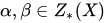




can be thought of as the homotopy classes of cycles while

can be thought of as the homotopy classes of homotopies of cycles.
Definition
Let X be a quasi-projective algebraic scheme over a field (“algebraic” means separated and of finite type).
For each integer , define

![{\displaystyle \Delta ^{q}=\operatorname {Spec} (\mathbb {Z} [t_{0},\dots ,t_{q}]/(t_{0}+\dots +t_{q}-1)),}](https://wikimedia.org/api/rest_v1/media/math/render/svg/576f883bd25d20fa2ccf0c5dbd691ab85fcf6d2e)
which is an algebraic analog of a standard q-simplex. For each sequence , the closed subscheme , which is isomorphic to , is called a face of .




For each i, there is the embedding

We write for the group of algebraic i-cycles on X and for the subgroup generated by closed subvarieties that intersect properly with for each face F of .



Since is an effective Cartier divisor, there is the Gysin homomorphism:

- ,

that (by definition) maps a subvariety V to the intersection

Define the boundary operator which yields the chain complex
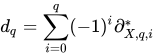

Finally, the q-th higher Chow group of X is defined as the q-th homology of the above complex:

(More simply, since is naturally a simplicial abelian group, in view of the Dold–Kan correspondence, higher Chow groups can also be defined as homotopy groups .)


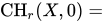
For example, if [2] is a closed subvariety such that the intersections with the faces are proper, then and this means, by Proposition 1.6. in Fulton’s intersection theory, that the image of is precisely the group of cycles rationally equivalent to zero; that is,
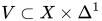




- the r-th Chow group of X.
Properties
Functoriality
Proper maps are covariant between the higher chow groups while flat maps are contravariant. Also, whenever is smooth, any map to is contravariant.


Homotopy invariance
If is an algebraic vector bundle, then there is the homotopy equivalence


Localization
Given a closed equidimensional subscheme there is a localization long exact sequence

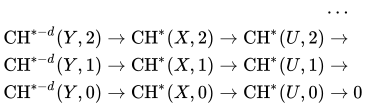
where . In particular, this shows the higher chow groups naturally extend the exact sequence of chow groups.

Localization theorem
(Bloch 1994) showed that, given an open subset , for ,


is a homotopy equivalence. In particular, if has pure codimension, then it yields the long exact sequence for higher Chow groups (called the localization sequence).
References
- ^Lecture Notes on Motivic Cohomology(PDF). Clay Math Monographs. p. 159.
- ^Here, we identify with a subscheme of and then, without loss of generality, assume one vertex is the origin 0 and the other is ∞.


- Bloch, Spencer (September 1986). "Algebraic cycles and higher K-theory". Advances in Mathematics. 61: 267–304. doi:10.1016/0001-8708(86)90081-2.
- Bloch, Spencer (1994). "The moving lemma for higher Chow groups". Journal of Algebraic Geometry. 3: 537–568.
- Peter Haine, An Overview of Motivic Cohomology
- Vladmir Voevodsky, “Motivic cohomology groups are isomorphic to higher Chow groups in any characteristic,” International Mathematics Research Notices 7 (2002), 351–355.
