ロドニー・ヒル によって開発された ヒル 降伏条件は 、異方性塑性変形を記述するための複数の降伏条件の一つです。初期のバージョンは フォン・ミーゼス降伏条件を単純に拡張したもので、 二次形式 でした 。このモデルは後に指数 m を許容することで一般化されました。これらの条件のバリエーションは、金属、ポリマー、および特定の複合材料に広く用いられています。
二次ヒル降伏基準 二次ヒル降伏条件 [1] は次の式で表される:
ここで 、F、G、H、L、M、N は実験的に決定しなければならない定数であり、 は応力である。二次ヒル降伏条件は偏差応力のみに依存し、圧力に依存しない。この条件は、引張と圧縮において同じ降伏応力を予測する。
F
(
σ
22
−
σ
33
)
2
+
G
(
σ
33
−
σ
11
)
2
+
H
(
σ
11
−
σ
22
)
2
+
2
L
σ
23
2
+
2
M
σ
31
2
+
2
N
σ
12
2
=
1
.
{\displaystyle F(\sigma _{22}-\sigma _{33})^{2}+G(\sigma _{33}-\sigma _{11})^{2}+H(\sigma _{11}-\sigma _{22})^{2}+2L\sigma _{23}^{2}+2M\sigma _{31}^{2}+2N\sigma _{12}^{2}=1~.}
σ
i
j
{\displaystyle \sigma _{ij}}
の表現 F 、 G 、 H 、 L 、 M 、 N 物質の異方性の軸が直交していると仮定すると、次のように書ける。
(
G
+
H
)
(
σ
1
y
)
2
=
1
;
(
F
+
H
)
(
σ
2
y
)
2
=
1
;
(
F
+
G
)
(
σ
3
y
)
2
=
1
{\displaystyle (G+H)~(\sigma _{1}^{y})^{2}=1~;~~(F+H)~(\sigma _{2}^{y})^{2}=1~;~~(F+G)~(\sigma _{3}^{y})^{2}=1}
ここで 、異方性軸に対する法線方向の降伏応力である。したがって、
σ
1
y
,
σ
2
y
,
σ
3
y
{\displaystyle \sigma _{1}^{y},\sigma _{2}^{y},\sigma _{3}^{y}}
F
=
1
2
[
1
(
σ
2
y
)
2
+
1
(
σ
3
y
)
2
−
1
(
σ
1
y
)
2
]
{\displaystyle F={\cfrac {1}{2}}\left[{\cfrac {1}{(\sigma _{2}^{y})^{2}}}+{\cfrac {1}{(\sigma _{3}^{y})^{2}}}-{\cfrac {1}{(\sigma _{1}^{y})^{2}}}\right]}
G
=
1
2
[
1
(
σ
3
y
)
2
+
1
(
σ
1
y
)
2
−
1
(
σ
2
y
)
2
]
{\displaystyle G={\cfrac {1}{2}}\left[{\cfrac {1}{(\sigma _{3}^{y})^{2}}}+{\cfrac {1}{(\sigma _{1}^{y})^{2}}}-{\cfrac {1}{(\sigma _{2}^{y})^{2}}}\right]}
H
=
1
2
[
1
(
σ
1
y
)
2
+
1
(
σ
2
y
)
2
−
1
(
σ
3
y
)
2
]
{\displaystyle H={\cfrac {1}{2}}\left[{\cfrac {1}{(\sigma _{1}^{y})^{2}}}+{\cfrac {1}{(\sigma _{2}^{y})^{2}}}-{\cfrac {1}{(\sigma _{3}^{y})^{2}}}\right]}
同様に、 せん断降伏応力(異方性軸に関して)の場合、
τ
12
y
,
τ
23
y
,
τ
31
y
{\displaystyle \tau _{12}^{y},\tau _{23}^{y},\tau _{31}^{y}}
L
=
1
2
(
τ
23
y
)
2
;
M
=
1
2
(
τ
31
y
)
2
;
N
=
1
2
(
τ
12
y
)
2
{\displaystyle L={\cfrac {1}{2~(\tau _{23}^{y})^{2}}}~;~~M={\cfrac {1}{2~(\tau _{31}^{y})^{2}}}~;~~N={\cfrac {1}{2~(\tau _{12}^{y})^{2}}}}
平面応力に対する二次ヒル降伏条件 薄板圧延材(平面応力条件)の二次ヒル降伏条件は次のように表される。
σ
1
2
+
R
0
(
1
+
R
90
)
R
90
(
1
+
R
0
)
σ
2
2
−
2
R
0
1
+
R
0
σ
1
σ
2
=
(
σ
1
y
)
2
{\displaystyle \sigma _{1}^{2}+{\cfrac {R_{0}~(1+R_{90})}{R_{90}~(1+R_{0})}}~\sigma _{2}^{2}-{\cfrac {2~R_{0}}{1+R_{0}}}~\sigma _{1}\sigma _{2}=(\sigma _{1}^{y})^{2}}
ここで、主応力は、 圧延方向内では異方性軸、 圧延方向に垂直な方向では 異方性軸と一致するものと仮定し 、は 圧延方向の R値 、は 圧延方向に垂直な
R値 です。
σ
1
,
σ
2
{\displaystyle \sigma _{1},\sigma _{2}}
σ
1
{\displaystyle \sigma _{1}}
σ
2
{\displaystyle \sigma _{2}}
σ
3
=
0
{\displaystyle \sigma _{3}=0}
R
0
{\displaystyle R_{0}}
R
90
{\displaystyle R_{90}}
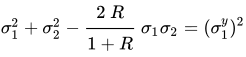
横方向等方性 の特別な場合には、 次の式が成り立ち
、
R
=
R
0
=
R
90
{\displaystyle R=R_{0}=R_{90}}
σ
1
2
+
σ
2
2
−
2
R
1
+
R
σ
1
σ
2
=
(
σ
1
y
)
2
{\displaystyle \sigma _{1}^{2}+\sigma _{2}^{2}-{\cfrac {2~R}{1+R}}~\sigma _{1}\sigma _{2}=(\sigma _{1}^{y})^{2}}
平面応力に対するヒルの基準の導出
主応力が異方性の方向と一致する場合、
f
:=
F
(
σ
2
−
σ
3
)
2
+
G
(
σ
3
−
σ
1
)
2
+
H
(
σ
1
−
σ
2
)
2
−
1
=
0
{\displaystyle f:=F(\sigma _{2}-\sigma _{3})^{2}+G(\sigma _{3}-\sigma _{1})^{2}+H(\sigma _{1}-\sigma _{2})^{2}-1=0\,}
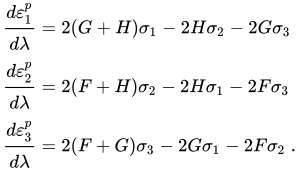
ここで 主応力は次式で表される。関連する流れ則を仮定すると、
σ
1
,
σ
2
,
σ
3
{\displaystyle \sigma _{1},\sigma _{2},\sigma _{3}}
ε
˙
i
p
=
λ
˙
∂
f
∂
σ
i
⟹
d
ε
i
p
d
λ
=
∂
f
∂
σ
i
.
{\displaystyle {\dot {\varepsilon }}_{i}^{p}={\dot {\lambda }}~{\cfrac {\partial f}{\partial \sigma _{i}}}\qquad \implies \qquad {\cfrac {d\varepsilon _{i}^{p}}{d\lambda }}={\cfrac {\partial f}{\partial \sigma _{i}}}~.}
これは次のことを意味します
d
ε
1
p
d
λ
=
2
(
G
+
H
)
σ
1
−
2
H
σ
2
−
2
G
σ
3
d
ε
2
p
d
λ
=
2
(
F
+
H
)
σ
2
−
2
H
σ
1
−
2
F
σ
3
d
ε
3
p
d
λ
=
2
(
F
+
G
)
σ
3
−
2
G
σ
1
−
2
F
σ
2
.
{\displaystyle {\begin{aligned}{\cfrac {d\varepsilon _{1}^{p}}{d\lambda }}&=2(G+H)\sigma _{1}-2H\sigma _{2}-2G\sigma _{3}\\{\cfrac {d\varepsilon _{2}^{p}}{d\lambda }}&=2(F+H)\sigma _{2}-2H\sigma _{1}-2F\sigma _{3}\\{\cfrac {d\varepsilon _{3}^{p}}{d\lambda }}&=2(F+G)\sigma _{3}-2G\sigma _{1}-2F\sigma _{2}~.\end{aligned}}}
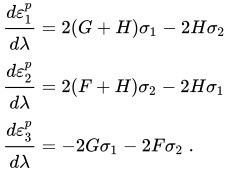
平面応力の 場合、
σ
3
=
0
{\displaystyle \sigma _{3}=0}
d
ε
1
p
d
λ
=
2
(
G
+
H
)
σ
1
−
2
H
σ
2
d
ε
2
p
d
λ
=
2
(
F
+
H
)
σ
2
−
2
H
σ
1
d
ε
3
p
d
λ
=
−
2
G
σ
1
−
2
F
σ
2
.
{\displaystyle {\begin{aligned}{\cfrac {d\varepsilon _{1}^{p}}{d\lambda }}&=2(G+H)\sigma _{1}-2H\sigma _{2}\\{\cfrac {d\varepsilon _{2}^{p}}{d\lambda }}&=2(F+H)\sigma _{2}-2H\sigma _{1}\\{\cfrac {d\varepsilon _{3}^{p}}{d\lambda }}&=-2G\sigma _{1}-2F\sigma _{2}~.\end{aligned}}}
R 値は 、単軸応力下での面内塑性ひずみと面外塑性ひずみの比として定義されます 。この量 は、単軸応力下での塑性ひずみ比です 。したがって、
R
0
{\displaystyle R_{0}}
σ
1
{\displaystyle \sigma _{1}}
R
90
{\displaystyle R_{90}}
σ
2
{\displaystyle \sigma _{2}}
R
0
=
d
ε
2
p
d
ε
3
p
=
H
G
;
R
90
=
d
ε
1
p
d
ε
3
p
=
H
F
.
{\displaystyle R_{0}={\cfrac {d\varepsilon _{2}^{p}}{d\varepsilon _{3}^{p}}}={\cfrac {H}{G}}~;~~R_{90}={\cfrac {d\varepsilon _{1}^{p}}{d\varepsilon _{3}^{p}}}={\cfrac {H}{F}}~.}
そして、とを用いて 降伏 条件は次のように書ける。
H
=
R
0
G
{\displaystyle H=R_{0}G}
σ
3
=
0
{\displaystyle \sigma _{3}=0}
f
:=
F
σ
2
2
+
G
σ
1
2
+
R
0
G
(
σ
1
−
σ
2
)
2
−
1
=
0
{\displaystyle f:=F\sigma _{2}^{2}+G\sigma _{1}^{2}+R_{0}G(\sigma _{1}-\sigma _{2})^{2}-1=0\,}
これは次のように表現できる。
σ
1
2
+
F
+
R
0
G
G
(
1
+
R
0
)
σ
2
2
−
2
R
0
1
+
R
0
σ
1
σ
2
=
1
(
1
+
R
0
)
G
.
{\displaystyle \sigma _{1}^{2}+{\cfrac {F+R_{0}G}{G(1+R_{0})}}~\sigma _{2}^{2}-{\cfrac {2R_{0}}{1+R_{0}}}~\sigma _{1}\sigma _{2}={\cfrac {1}{(1+R_{0})G}}~.}
これは必要な式と同じ形です。 を使って表すだけで済み ます 。
F
,
G
{\displaystyle F,G}
σ
1
y
{\displaystyle \sigma _{1}^{y}}
F
=
1
2
[
1
(
σ
2
y
)
2
+
1
(
σ
3
y
)
2
−
1
(
σ
1
y
)
2
]
G
=
1
2
[
1
(
σ
3
y
)
2
+
1
(
σ
1
y
)
2
−
1
(
σ
2
y
)
2
]
H
=
1
2
[
1
(
σ
1
y
)
2
+
1
(
σ
2
y
)
2
−
1
(
σ
3
y
)
2
]
{\displaystyle {\begin{aligned}F&={\cfrac {1}{2}}\left[{\cfrac {1}{(\sigma _{2}^{y})^{2}}}+{\cfrac {1}{(\sigma _{3}^{y})^{2}}}-{\cfrac {1}{(\sigma _{1}^{y})^{2}}}\right]\\G&={\cfrac {1}{2}}\left[{\cfrac {1}{(\sigma _{3}^{y})^{2}}}+{\cfrac {1}{(\sigma _{1}^{y})^{2}}}-{\cfrac {1}{(\sigma _{2}^{y})^{2}}}\right]\\H&={\cfrac {1}{2}}\left[{\cfrac {1}{(\sigma _{1}^{y})^{2}}}+{\cfrac {1}{(\sigma _{2}^{y})^{2}}}-{\cfrac {1}{(\sigma _{3}^{y})^{2}}}\right]\end{aligned}}}
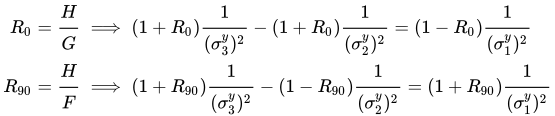
これらを使って
R
0
=
H
G
⟹
(
1
+
R
0
)
1
(
σ
3
y
)
2
−
(
1
+
R
0
)
1
(
σ
2
y
)
2
=
(
1
−
R
0
)
1
(
σ
1
y
)
2
R
90
=
H
F
⟹
(
1
+
R
90
)
1
(
σ
3
y
)
2
−
(
1
−
R
90
)
1
(
σ
2
y
)
2
=
(
1
+
R
90
)
1
(
σ
1
y
)
2
{\displaystyle {\begin{aligned}R_{0}={\cfrac {H}{G}}&\implies (1+R_{0}){\cfrac {1}{(\sigma _{3}^{y})^{2}}}-(1+R_{0}){\cfrac {1}{(\sigma _{2}^{y})^{2}}}=(1-R_{0}){\cfrac {1}{(\sigma _{1}^{y})^{2}}}\\R_{90}={\cfrac {H}{F}}&\implies (1+R_{90}){\cfrac {1}{(\sigma _{3}^{y})^{2}}}-(1-R_{90}){\cfrac {1}{(\sigma _{2}^{y})^{2}}}=(1+R_{90}){\cfrac {1}{(\sigma _{1}^{y})^{2}}}\end{aligned}}}
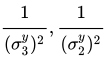
を
解くと
1
(
σ
3
y
)
2
,
1
(
σ
2
y
)
2
{\displaystyle {\cfrac {1}{(\sigma _{3}^{y})^{2}}},{\cfrac {1}{(\sigma _{2}^{y})^{2}}}}
1
(
σ
3
y
)
2
=
R
0
+
R
90
(
1
+
R
0
)
R
90
1
(
σ
1
y
)
2
;
1
(
σ
2
y
)
2
=
R
0
(
1
+
R
90
)
(
1
+
R
0
)
R
90
1
(
σ
1
y
)
2
{\displaystyle {\cfrac {1}{(\sigma _{3}^{y})^{2}}}={\cfrac {R_{0}+R_{90}}{(1+R_{0})~R_{90}}}~{\cfrac {1}{(\sigma _{1}^{y})^{2}}}~;~~{\cfrac {1}{(\sigma _{2}^{y})^{2}}}={\cfrac {R_{0}(1+R_{90})}{(1+R_{0})~R_{90}}}~{\cfrac {1}{(\sigma _{1}^{y})^{2}}}}
表現を再び 当てはめる
と、
F
,
G
{\displaystyle F,G}
F
=
R
0
(
1
+
R
0
)
R
90
1
(
σ
1
y
)
2
;
G
=
1
1
+
R
0
1
(
σ
1
y
)
2
{\displaystyle F={\cfrac {R_{0}}{(1+R_{0})~R_{90}}}~{\cfrac {1}{(\sigma _{1}^{y})^{2}}}~;~~G={\cfrac {1}{1+R_{0}}}~{\cfrac {1}{(\sigma _{1}^{y})^{2}}}}
これは次のことを意味します
1
G
(
1
+
R
0
)
=
(
σ
1
y
)
2
;
F
+
R
0
G
G
(
1
+
R
0
)
=
R
0
(
1
+
R
90
)
R
90
(
1
+
R
0
)
.
{\displaystyle {\cfrac {1}{G(1+R_{0})}}=(\sigma _{1}^{y})^{2}~;~~{\cfrac {F+R_{0}G}{G(1+R_{0})}}={\cfrac {R_{0}(1+R_{90})}{R_{90}(1+R_{0})}}~.}
したがって、二次ヒル降伏条件の平面応力形は次のように表すことができます
σ
1
2
+
R
0
(
1
+
R
90
)
R
90
(
1
+
R
0
)
σ
2
2
−
2
R
0
1
+
R
0
σ
1
σ
2
=
(
σ
1
y
)
2
{\displaystyle \sigma _{1}^{2}+{\cfrac {R_{0}~(1+R_{90})}{R_{90}~(1+R_{0})}}~\sigma _{2}^{2}-{\cfrac {2~R_{0}}{1+R_{0}}}~\sigma _{1}\sigma _{2}=(\sigma _{1}^{y})^{2}}
一般化ヒル降伏基準 一般化されたヒル降伏基準 [2] は次の式で表される。
F
|
σ
2
−
σ
3
|
m
+
G
|
σ
3
−
σ
1
|
m
+
H
|
σ
1
−
σ
2
|
m
+
L
|
2
σ
1
−
σ
2
−
σ
3
|
m
+
M
|
2
σ
2
−
σ
3
−
σ
1
|
m
+
N
|
2
σ
3
−
σ
1
−
σ
2
|
m
=
σ
y
m
.
{\displaystyle {\begin{aligned}F|\sigma _{2}-\sigma _{3}|^{m}&+G|\sigma _{3}-\sigma _{1}|^{m}+H|\sigma _{1}-\sigma _{2}|^{m}+L|2\sigma _{1}-\sigma _{2}-\sigma _{3}|^{m}\\&+M|2\sigma _{2}-\sigma _{3}-\sigma _{1}|^{m}+N|2\sigma _{3}-\sigma _{1}-\sigma _{2}|^{m}=\sigma _{y}^{m}~.\end{aligned}}}
ここで 、は主応力(異方性の方向と一致する)、 は降伏応力、 F、G、H、L、M、Nは定数です 。m の値は 材料の異方性の度合いによって決まり、 降伏面 の凸性を保証するためには1より大きくなければなりません。
σ
i
{\displaystyle \sigma _{i}}
σ
y
{\displaystyle \sigma _{y}}
異方性材料の一般化ヒル降伏条件 対称面が横 等方性材料の場合、一般化ヒル降伏条件は次のように簡約される( および )
1
−
2
{\displaystyle 1-2}
F
=
G
{\displaystyle F=G}
L
=
M
{\displaystyle L=M}
f
:=
F
|
σ
2
−
σ
3
|
m
+
G
|
σ
3
−
σ
1
|
m
+
H
|
σ
1
−
σ
2
|
m
+
L
|
2
σ
1
−
σ
2
−
σ
3
|
m
+
L
|
2
σ
2
−
σ
3
−
σ
1
|
m
+
N
|
2
σ
3
−
σ
1
−
σ
2
|
m
−
σ
y
m
≤
0
{\displaystyle {\begin{aligned}f:=&F|\sigma _{2}-\sigma _{3}|^{m}+G|\sigma _{3}-\sigma _{1}|^{m}+H|\sigma _{1}-\sigma _{2}|^{m}+L|2\sigma _{1}-\sigma _{2}-\sigma _{3}|^{m}\\&+L|2\sigma _{2}-\sigma _{3}-\sigma _{1}|^{m}+N|2\sigma _{3}-\sigma _{1}-\sigma _{2}|^{m}-\sigma _{y}^{m}\leq 0\end{aligned}}}
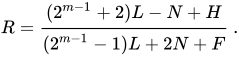
R 値 または ランクフォード係数は、 という状況を考慮することによって決定できます 。R値は次のように与えられます。
σ
1
>
(
σ
2
=
σ
3
=
0
)
{\displaystyle \sigma _{1}>(\sigma _{2}=\sigma _{3}=0)}
R
=
(
2
m
−
1
+
2
)
L
−
N
+
H
(
2
m
−
1
−
1
)
L
+
2
N
+
F
.
{\displaystyle R={\cfrac {(2^{m-1}+2)L-N+H}{(2^{m-1}-1)L+2N+F}}~.}
平面応力 条件下では 、いくつかの仮定のもとで、一般化ヒル基準はいくつかの形をとることができる。 [3]
ケース1:
L
=
0
,
H
=
0.
{\displaystyle L=0,H=0.}
f
:=
1
+
2
R
1
+
R
(
|
σ
1
|
m
+
|
σ
2
|
m
)
−
R
1
+
R
|
σ
1
+
σ
2
|
m
−
σ
y
m
≤
0
{\displaystyle f:={\cfrac {1+2R}{1+R}}(|\sigma _{1}|^{m}+|\sigma _{2}|^{m})-{\cfrac {R}{1+R}}|\sigma _{1}+\sigma _{2}|^{m}-\sigma _{y}^{m}\leq 0}
ケース2:
N
=
0
,
F
=
0.
{\displaystyle N=0,F=0.}
f
:=
2
m
−
1
(
1
−
R
)
+
(
R
+
2
)
(
1
−
2
m
−
1
)
(
1
+
R
)
|
σ
1
−
σ
2
|
m
−
1
(
1
−
2
m
−
1
)
(
1
+
R
)
(
|
2
σ
1
−
σ
2
|
m
+
|
2
σ
2
−
σ
1
|
m
)
−
σ
y
m
≤
0
{\displaystyle f:={\cfrac {2^{m-1}(1-R)+(R+2)}{(1-2^{m-1})(1+R)}}|\sigma _{1}-\sigma _{2}|^{m}-{\cfrac {1}{(1-2^{m-1})(1+R)}}(|2\sigma _{1}-\sigma _{2}|^{m}+|2\sigma _{2}-\sigma _{1}|^{m})-\sigma _{y}^{m}\leq 0}
ケース3:
N
=
0
,
H
=
0.
{\displaystyle N=0,H=0.}
f
:=
2
m
−
1
(
1
−
R
)
+
(
R
+
2
)
(
2
+
2
m
−
1
)
(
1
+
R
)
(
|
σ
1
|
m
−
|
σ
2
|
m
)
+
R
(
2
+
2
m
−
1
)
(
1
+
R
)
(
|
2
σ
1
−
σ
2
|
m
+
|
2
σ
2
−
σ
1
|
m
)
−
σ
y
m
≤
0
{\displaystyle f:={\cfrac {2^{m-1}(1-R)+(R+2)}{(2+2^{m-1})(1+R)}}(|\sigma _{1}|^{m}-|\sigma _{2}|^{m})+{\cfrac {R}{(2+2^{m-1})(1+R)}}(|2\sigma _{1}-\sigma _{2}|^{m}+|2\sigma _{2}-\sigma _{1}|^{m})-\sigma _{y}^{m}\leq 0}
ケース4:
L
=
0
,
F
=
0.
{\displaystyle L=0,F=0.}
f
:=
1
+
2
R
2
(
1
+
R
)
|
σ
1
−
σ
2
|
m
+
1
2
(
1
+
R
)
|
σ
1
+
σ
2
|
m
−
σ
y
m
≤
0
{\displaystyle f:={\cfrac {1+2R}{2(1+R)}}|\sigma _{1}-\sigma _{2}|^{m}+{\cfrac {1}{2(1+R)}}|\sigma _{1}+\sigma _{2}|^{m}-\sigma _{y}^{m}\leq 0}
ケース5: これは ホスフォードの降伏条件 です
L
=
0
,
N
=
0.
{\displaystyle L=0,N=0.}
f
:=
1
1
+
R
(
|
σ
1
|
m
+
|
σ
2
|
m
)
+
R
1
+
R
|
σ
1
−
σ
2
|
m
−
σ
y
m
≤
0
{\displaystyle f:={\cfrac {1}{1+R}}(|\sigma _{1}|^{m}+|\sigma _{2}|^{m})+{\cfrac {R}{1+R}}|\sigma _{1}-\sigma _{2}|^{m}-\sigma _{y}^{m}\leq 0}
一般化ヒル降伏条件のこれらの形式を使用する際には注意が必要である。なぜなら、と の組み合わせによっては降伏面が凹状になる(場合によっては無限大になる)からである 。 [4]
R
{\displaystyle R}
m
{\displaystyle m}
ヒル1993の降伏基準 1993年にヒルは 平面異方性を持つ平面応力問題に対する
別の降伏条件 [5]を提案した。ヒル93の条件は次の式で表される。
(
σ
1
σ
0
)
2
+
(
σ
2
σ
90
)
2
+
[
(
p
+
q
−
c
)
−
p
σ
1
+
q
σ
2
σ
b
]
(
σ
1
σ
2
σ
0
σ
90
)
=
1
{\displaystyle \left({\cfrac {\sigma _{1}}{\sigma _{0}}}\right)^{2}+\left({\cfrac {\sigma _{2}}{\sigma _{90}}}\right)^{2}+\left[(p+q-c)-{\cfrac {p\sigma _{1}+q\sigma _{2}}{\sigma _{b}}}\right]\left({\cfrac {\sigma _{1}\sigma _{2}}{\sigma _{0}\sigma _{90}}}\right)=1}
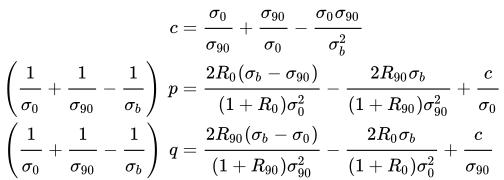
ここで 、は圧延方向の一軸引張降伏応力、 は圧延方向に垂直な方向の一軸引張降伏応力、 は均一二軸引張下の降伏応力、は 次のように定義されるパラメータである。
σ
0
{\displaystyle \sigma _{0}}
σ
90
{\displaystyle \sigma _{90}}
σ
b
{\displaystyle \sigma _{b}}
c
,
p
,
q
{\displaystyle c,p,q}
c
=
σ
0
σ
90
+
σ
90
σ
0
−
σ
0
σ
90
σ
b
2
(
1
σ
0
+
1
σ
90
−
1
σ
b
)
p
=
2
R
0
(
σ
b
−
σ
90
)
(
1
+
R
0
)
σ
0
2
−
2
R
90
σ
b
(
1
+
R
90
)
σ
90
2
+
c
σ
0
(
1
σ
0
+
1
σ
90
−
1
σ
b
)
q
=
2
R
90
(
σ
b
−
σ
0
)
(
1
+
R
90
)
σ
90
2
−
2
R
0
σ
b
(
1
+
R
0
)
σ
0
2
+
c
σ
90
{\displaystyle {\begin{aligned}c&={\cfrac {\sigma _{0}}{\sigma _{90}}}+{\cfrac {\sigma _{90}}{\sigma _{0}}}-{\cfrac {\sigma _{0}\sigma _{90}}{\sigma _{b}^{2}}}\\\left({\cfrac {1}{\sigma _{0}}}+{\cfrac {1}{\sigma _{90}}}-{\cfrac {1}{\sigma _{b}}}\right)~p&={\cfrac {2R_{0}(\sigma _{b}-\sigma _{90})}{(1+R_{0})\sigma _{0}^{2}}}-{\cfrac {2R_{90}\sigma _{b}}{(1+R_{90})\sigma _{90}^{2}}}+{\cfrac {c}{\sigma _{0}}}\\\left({\cfrac {1}{\sigma _{0}}}+{\cfrac {1}{\sigma _{90}}}-{\cfrac {1}{\sigma _{b}}}\right)~q&={\cfrac {2R_{90}(\sigma _{b}-\sigma _{0})}{(1+R_{90})\sigma _{90}^{2}}}-{\cfrac {2R_{0}\sigma _{b}}{(1+R_{0})\sigma _{0}^{2}}}+{\cfrac {c}{\sigma _{90}}}\end{aligned}}}
は 圧延方向の一軸張力に対する R 値であり、 は 圧延方向に垂直な面内方向の一軸張力に対する R 値です。
R
0
{\displaystyle R_{0}}
R
90
{\displaystyle R_{90}}
ヒルの降伏基準の拡張 Hill の降伏基準のオリジナル バージョンは、ポリマー や フォームを モデル化するために必要な圧力依存の降伏面を持たない材料用に設計されました 。
カデル・ラガヴァ・アトキンスの降伏基準 圧力依存性を考慮した拡張として、Caddell-Raghava-Atkins(CRA)モデル [6] があり、これは次の式で表される。
F
(
σ
22
−
σ
33
)
2
+
G
(
σ
33
−
σ
11
)
2
+
H
(
σ
11
−
σ
22
)
2
+
2
L
σ
23
2
+
2
M
σ
31
2
+
2
N
σ
12
2
+
I
σ
11
+
J
σ
22
+
K
σ
33
=
1
.
{\displaystyle F(\sigma _{22}-\sigma _{33})^{2}+G(\sigma _{33}-\sigma _{11})^{2}+H(\sigma _{11}-\sigma _{22})^{2}+2L\sigma _{23}^{2}+2M\sigma _{31}^{2}+2N\sigma _{12}^{2}+I\sigma _{11}+J\sigma _{22}+K\sigma _{33}=1~.}
デシュパンデ・フレック・アシュビー降伏基準 ヒルの二次降伏条件の圧力依存拡張で、 ブレスラー・ピスター降伏条件に似た形を持つものとして、 ハニカム構造( サンドイッチ複合 構造に使用) に対する デシュパンデ、フレック、アシュビー(DFA)降伏条件 [7] がある。この降伏条件は、
F
(
σ
22
−
σ
33
)
2
+
G
(
σ
33
−
σ
11
)
2
+
H
(
σ
11
−
σ
22
)
2
+
2
L
σ
23
2
+
2
M
σ
31
2
+
2
N
σ
12
2
+
K
(
σ
11
+
σ
22
+
σ
33
)
2
=
1
.
{\displaystyle F(\sigma _{22}-\sigma _{33})^{2}+G(\sigma _{33}-\sigma _{11})^{2}+H(\sigma _{11}-\sigma _{22})^{2}+2L\sigma _{23}^{2}+2M\sigma _{31}^{2}+2N\sigma _{12}^{2}+K(\sigma _{11}+\sigma _{22}+\sigma _{33})^{2}=1~.}
参照
参考文献
^ Hill, R. (1948). 「異方性金属の降伏および塑性流動の理論」 Proceedings of the Royal Society A . 193 (1033): 281– 297. Bibcode :1948RSPSA.193..281H. doi :10.1098/rspa.1948.0045. ^ Hill, R. (1979). 「テクスチャ集合体の理論的可塑性」. ケンブリッジ哲学協会数学紀要 . 85 (1): 179– 191. Bibcode :1979MPCPS..85..179H. doi :10.1017/S0305004100055596. ^ Chu, E. (1995). 「Hillの1979年の異方性降伏基準の一般化」. Journal of Materials Processing Technology . 50 ( 1–4 ): 207– 215. doi :10.1016/0924-0136(94)01381-A. ^ Zhu, Y.; Dodd, B.; Caddell, RM; Hosford, WF (1987). 「非二次異方性降伏基準に対する凸状制約」. International Journal of Mechanical Sciences . 29 ( 10–11 ): 733–741 . doi :10.1016/0020-7403(87)90059-2. hdl : 2027.42/26986 . ^ Hill, R. (1993). 「板金における直交異方性塑性に関するユーザーフレンドリーな理論」. International Journal of Mechanical Sciences . 35 (1): 19– 25. doi :10.1016/0020-7403(93)90061-X. ^ Caddell, Robert M.; Raghava, Ram S.; Atkins, Anthony G. (1973). 「配向ポリマーなどの異方性および圧力依存固体の降伏条件」. Journal of Materials Science . 8 (11): 1641– 1646. Bibcode :1973JMatS...8.1641C. doi :10.1007/BF00754900. hdl : 2027.42/44783 . ^ Deshpande, VS; Fleck, N. A; Ashby, MF (2001). 「オクテットトラス格子材料の有効特性」. Journal of the Mechanics and Physics of Solids . 49 (8): 1747– 1769. Bibcode :2001JMPSo..49.1747D. doi :10.1016/S0022-5096(01)00010-2.
外部リンク 



![{\displaystyle F={\cfrac {1}{2}}\left[{\cfrac {1}{(\sigma _{2}^{y})^{2}}}+{\cfrac {1}{(\sigma _{3}^{y})^{2}}}-{\cfrac {1}{(\sigma _{1}^{y})^{2}}}\right]}](https://wikimedia.org/api/rest_v1/media/math/render/svg/cfaed307481211b4a91f7d9e7c9f949afde88cb4)
![{\displaystyle G={\cfrac {1}{2}}\left[{\cfrac {1}{(\sigma _{3}^{y})^{2}}}+{\cfrac {1}{(\sigma _{1}^{y})^{2}}}-{\cfrac {1}{(\sigma _{2}^{y})^{2}}}\right]}](https://wikimedia.org/api/rest_v1/media/math/render/svg/0fb6bb43d23a5654cba1c82b82adbd0fba9d9250)
![{\displaystyle H={\cfrac {1}{2}}\left[{\cfrac {1}{(\sigma _{1}^{y})^{2}}}+{\cfrac {1}{(\sigma _{2}^{y})^{2}}}-{\cfrac {1}{(\sigma _{3}^{y})^{2}}}\right]}](https://wikimedia.org/api/rest_v1/media/math/render/svg/cac2750191c5937e64bc62b7634ffd86ef3dc934)















![{\displaystyle {\begin{aligned}F&={\cfrac {1}{2}}\left[{\cfrac {1}{(\sigma _{2}^{y})^{2}}}+{\cfrac {1}{(\sigma _{3}^{y})^{2}}}-{\cfrac {1}{(\sigma _{1}^{y})^{2}}}\right]\\G&={\cfrac {1}{2}}\left[{\cfrac {1}{(\sigma _{3}^{y})^{2}}}+{\cfrac {1}{(\sigma _{1}^{y})^{2}}}-{\cfrac {1}{(\sigma _{2}^{y})^{2}}}\right]\\H&={\cfrac {1}{2}}\left[{\cfrac {1}{(\sigma _{1}^{y})^{2}}}+{\cfrac {1}{(\sigma _{2}^{y})^{2}}}-{\cfrac {1}{(\sigma _{3}^{y})^{2}}}\right]\end{aligned}}}](https://wikimedia.org/api/rest_v1/media/math/render/svg/470b0bc61070673f267b0632ad9a61e60db5167a)




















![{\displaystyle \left({\cfrac {\sigma _{1}}{\sigma _{0}}}\right)^{2}+\left({\cfrac {\sigma _{2}}{\sigma _{90}}}\right)^{2}+\left[(p+qc)-{\cfrac {p\sigma _{1}+q\sigma _{2}}{\sigma _{b}}}\right]\left({\cfrac {\sigma _{1}\sigma _{2}}{\sigma _{0}\sigma _{90}}}\right)=1}](https://wikimedia.org/api/rest_v1/media/math/render/svg/eeb47165a06c7b8e610c42519ca7896f3ae99a45)