Lyapunov stability
 | This article's lead sectionmay need to be rewritten.(December 2021) |
| Part of a series on |
| Astrodynamics |
|---|
 |
Various types of stability may be discussed for the solutions of differential equations or difference equations describing dynamical systems. The most important type is that concerning the stability of solutions near to a point of equilibrium. This may be discussed by the theory of Aleksandr Lyapunov. In simple terms, if the solutions that start out near an equilibrium point stay near forever, then is Lyapunov stable. More strongly, if is Lyapunov stable and all solutions that start out near converge to , then is said to be asymptotically stable (see asymptotic analysis). The notion of exponential stability guarantees a minimal rate of decay, i.e., an estimate of how quickly the solutions converge. The idea of Lyapunov stability can be extended to infinite-dimensional manifolds, where it is known as structural stability, which concerns the behavior of different but "nearby" solutions to differential equations. Input-to-state stability (ISS) applies Lyapunov notions to systems with inputs.

History
Lyapunov stability is named after Aleksandr Mikhailovich Lyapunov, a Russian mathematician who defended the thesis The General Problem of Stability of Motion at Kharkov University (now VN Karazin Kharkiv National University) in 1892.[1] A. M. Lyapunov was a pioneer in successful endeavors to develop a global approach to the analysis of the stability of nonlinear dynamical systems by comparison with the widely spread local method of linearizing them about points of equilibrium. His work, initially published in Russian and then translated to French, received little attention for many years. The mathematical theory of stability of motion, founded by A. M. Lyapunov, considerably anticipated the time for its implementation in science and technology. Moreover Lyapunov did not himself make application in this field, his own interest being in the stability of rotating fluid masses with astronomical application. He did not have doctoral students who followed the research in the field of stability and his own destiny was terribly tragic because of his suicide in 1918.[2] For several decades the theory of stability sank into complete oblivion. The Russian-Soviet mathematician and mechanician Nikolay Gur'yevich Chetaev working at the Kazan Aviation Institute in the 1930s was the first who realized the incredible magnitude of the discovery made by A. M. Lyapunov. The contribution to the theory made by N. G. Chetaev[3] was so significant that many mathematicians, physicists and engineers consider him Lyapunov's direct successor and the next-in-line scientific descendant in the creation and development of the mathematical theory of stability.
The interest in it suddenly skyrocketed during the Cold War period when the so-called "Second Method of Lyapunov" (see below) was found to be applicable to the stability of aerospace guidance systems which typically contain strong nonlinearities not treatable by other methods. A large number of publications appeared then and since in the control and systems literature.[4][5][6][7][8] More recently the concept of the Lyapunov exponent (related to Lyapunov's First Method of discussing stability) has received wide interest in connection with chaos theory. Lyapunov stability methods have also been applied to finding equilibrium solutions in traffic assignment problems.[9]
Definition for continuous-time systems
Consider an autonomous nonlinear dynamical system
- ,

where denotes the system state vector, an open set containing the origin, and is a continuous vector field on . Suppose has an equilibrium at , so that . Then:



- This equilibrium is said to be Lyapunov stable if for every there exists a such that if then for every we have .
- The equilibrium of the above system is said to be asymptotically stable if it is Lyapunov stable and there exists such that if then .
- The equilibrium of the above system is said to be exponentially stable if it is asymptotically stable and there exist such that if then for all .





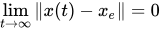


Conceptually, the meanings of the above terms are the following:
- Lyapunov stability of an equilibrium means that solutions starting "close enough" to the equilibrium (within a distance from it) remain "close enough" forever (within a distance from it). Note that this must be true for any that one may want to choose.
- Asymptotic stability means that solutions that start close enough not only remain close enough but also eventually converge to the equilibrium.
- Exponential stability means that solutions not only converge, but in fact converge faster than or at least as fast as a particular known rate .



The trajectory is (locally) attractive if

- as


for all trajectories that start close enough to , and globally attractive if this property holds for all trajectories.

That is, if x belongs to the interior of its stable manifold, it is asymptotically stable if it is both attractive and stable. (There are examples showing that attractivity does not imply asymptotic stability.[10][11][12] Such examples are easy to create using homoclinic connections.)
If the Jacobian of the dynamical system at an equilibrium happens to be a stability matrix (i.e., if the real part of each eigenvalue is strictly negative), then the equilibrium is asymptotically stable.
System of deviations
Instead of considering stability only near an equilibrium point (a constant solution ), one can formulate similar definitions of stability near an arbitrary solution . However, one can reduce the more general case to that of an equilibrium by a change of variables called a "system of deviations". Define , obeying the differential equation:


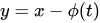
- .

This is no longer an autonomous system, but it has a guaranteed equilibrium point at whose stability is equivalent to the stability of the original solution .

Lyapunov's second method for stability
Lyapunov, in his original 1892 work, proposed two methods for demonstrating stability.[1] The first method developed the solution in a series which was then proved convergent within limits. The second method, which is now referred to as the Lyapunov stability criterion or the Direct Method, makes use of a Lyapunov function V(x) which has an analogy to the potential function of classical dynamics. It is introduced as follows for a system having a point of equilibrium at . Consider a function such that


- if and only if
- if and only if
- for all values of . Note: for asymptotic stability, for is required.




Then V(x) is called a Lyapunov function and the system is stable in the sense of Lyapunov. (Note that is required; otherwise for example would "prove" that is locally stable.) An additional condition called "properness" or "radial unboundedness" is required in order to conclude global stability. Global asymptotic stability (GAS) follows similarly.



It is easier to visualize this method of analysis by thinking of a physical system (e.g. vibrating spring and mass) and considering the energy of such a system. If the system loses energy over time and the energy is never restored then eventually the system must grind to a stop and reach some final resting state. This final state is called the attractor. However, finding a function that gives the precise energy of a physical system can be difficult, and for abstract mathematical systems, economic systems or biological systems, the concept of energy may not be applicable.
Lyapunov's realization was that stability can be proven without requiring knowledge of the true physical energy, provided a Lyapunov function can be found to satisfy the above constraints.
Definition for discrete-time systems
The definition for discrete-time systems is almost identical to that for continuous-time systems. The definition below provides this, using an alternate language commonly used in more mathematical texts.
Let (X, d) be a metric space and f : X → X a continuous function. A point x in X is said to be Lyapunov stable, if,
![{\displaystyle \forall \epsilon >0\ \exists \delta >0\ \forall y\in X\ \left[d(x,y)<\delta \Rightarrow \forall n\in \mathbf {N} \ d\left(f^{n}(x),f^{n}(y)\right)<\epsilon \right].}](https://wikimedia.org/api/rest_v1/media/math/render/svg/2b4cfd6d647435c3f4121fd43f1e81fc82b2a28b)
We say that x is asymptotically stable if it belongs to the interior of its stable set, i.e. if,
![{\displaystyle \exists \delta >0\left[d(x,y)<\delta \Rightarrow \lim _{n\to \infty }d\left(f^{n}(x),f^{n}(y)\right)=0\right].}](https://wikimedia.org/api/rest_v1/media/math/render/svg/8d7e98b526a203ea482726bc0f64d8452f360848)
Stability for linear state space models
A linear state space model
- ,

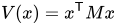
where is a finite matrix, is asymptotically stable (in fact, exponentially stable) if all real parts of the eigenvalues of are negative. This condition is equivalent to the following one:[13]


is negative definite for some positive definite matrix . (The relevant Lyapunov function is .)

Correspondingly, a time-discrete linear state space model

is asymptotically stable (in fact, exponentially stable) if all the eigenvalues of have a modulus smaller than one.
This latter condition has been generalized to switched systems: a linear switched discrete time system (ruled by a set of matrices )
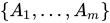

is asymptotically stable (in fact, exponentially stable) if the joint spectral radius of the set is smaller than one.
Stability for systems with inputs
A system with inputs (or controls) has the form

where the (generally time-dependent) input u(t) may be viewed as a control, external input, stimulus, disturbance, or forcing function. It has been shown [14] that near to a point of equilibrium which is Lyapunov stable the system remains stable under small disturbances. For larger input disturbances the study of such systems is the subject of control theory and applied in control engineering. For systems with inputs, one must quantify the effect of inputs on the stability of the system. The main two approaches to this analysis are BIBO stability (for linear systems) and input-to-state stability (ISS) (for nonlinear systems)
Example
This example shows a system where a Lyapunov function can be used to prove Lyapunov stability but cannot show asymptotic stability. Consider the following equation, based on the Van der Pol oscillator equation with the friction term changed:
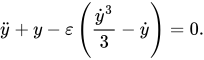
Let

so that the corresponding system is
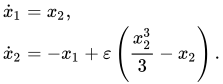
The origin is the only equilibrium point. Let us choose as a Lyapunov function

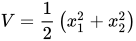
which is clearly positive definite. Its derivative is

It seems that if the parameter is positive, stability is asymptotic for But this is wrong, since does not depend on , and will be 0 everywhere on the axis. The equilibrium is Lyapunov stable but not asymptotically stable.


Barbalat's lemma and stability of time-varying systems
It may be difficult to find a Lyapunov function with a negative definite derivative as required by the Lyapunov stability criterion, however a function with that is only negative semi-definite may be available. In autonomous systems, the invariant set theorem can be applied to prove asymptotic stability, but this theorem is not applicable when the dynamics are a function of time.[15]

Instead, Barbalat's lemma allows for Lyapunov-like analysis of these non-autonomous systems. The lemma is motivated by the following observations. Assuming f is a function of time only:
- Having does not imply that has a limit at . For example, .
- Having approaching a limit as does not imply that . For example, .
- Having lower bounded and decreasing () implies it converges to a limit. But it does not say whether or not as .






Barbalat's Lemma says: If has a finite limit as and if is uniformly continuous (a sufficient condition for uniform continuity is that is bounded), then as .[16]


An alternative version is as follows: Let and . If and , then as [17]

![{\displaystyle q\in (1,\infty ]}](https://wikimedia.org/api/rest_v1/media/math/render/svg/ec4dd31b773d96aac2a9dec946f8a858ff2644b5)
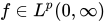
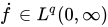


In the following form the Lemma is true also in the vector valued case: Let be a uniformly continuous function with values in a Banach space and assume that has a finite limit as . Then as .[18]


The following example is taken from page 125 of Slotine and Li's book Applied Nonlinear Control.[15]
Consider a non-autonomous system

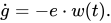
This is non-autonomous because the input is a function of time. Assume that the input is bounded.


Taking gives


This says that by first two conditions and hence and are bounded. But it does not say anything about the convergence of to zero, as is only negative semi-definite (note can be non-zero when =0) and the dynamics are non-autonomous.


Using Barbalat's lemma:
- .

This is bounded because , and are bounded. This implies as and hence . This proves that the error converges.


Stability of time-varying systems with vanishing and bounded perturbations
Consider the auxiliary differential equation for all , with state and initial condition . The function is strictly increasing and satisfies . The functions and belong to . The importance of the prior differential equation is that a wide class of Lyapunov inequalities can be linked to it by a comparison principle.


Assume that for all , and with and The prior property indicates a bounded perturbation when and a vanishing perturbation when .


For each initial condition and each solution with maximal interval of existence , where , the following properties hold: [19]


- for all .
- If and , then , and .
- If , is not uniformly zero, and , then and .


The prior results have been also derived in the literature within different contexts; see, e.g., [20][21][22][23][24] .
Lyapunov Stability of time-varying systems with unbounded perturbations
We present results from [25] which are related to Lyapunov inequalities with unbounded perturbations. Consider the system:


where , solution in ( is a strictly positive integer), and a well-defined function with , .


Assume that the system satisfies Carathéodory conditions; that is the mapping is locally essentially bounded on , is measurable for every and is continuous for almost every . The system admits a locally absolutely continuous local Carathéodory solution that is defined on a maximal interval .


Assume that there exist constants , with , locally absolutely continuous functions , and a Lebesgue measurable function satisfying the following:


(i) and is well-defined (we do not need to be well-defined if the positivity of solutions is guaranteed).


(ii) , , and for almost all .


(iii) (from which it follows that the perturbation is unbounded, as illustrated by the Lyapunov inequality given later).

(iv) and , where


(v) for each solution of the system with maximal interval of existence , there exist positive constants , , , , and a Lyapunov function , satisfying


for almost every that satisfies . Then, there exists such that for each , one get and


![{\displaystyle |\zeta (t)|\leq {\sqrt[{\sigma }]{\frac {c_{2}}{c_{1}}}}|\zeta _{0}|,\forall t\geq t_{0},}](https://wikimedia.org/api/rest_v1/media/math/render/svg/2986fefb7116708cf6e368ab8a09fa3d7f4e6c08)
so that is uniformly stable. Furthermore, the origin is asymptotically stable. [25]

Example. The population growth model with Allee effect can be represented by the differential equation ; where is the population density, has been extensively studied in the literature. The positive constants , , represent respectively, the decay rate, the carrying capacity and Allee threshold. In this example we generalize the prior cubic growth model to the time-varying case


where , state , a Lebesgue measurable function with for almost all , and locally absolutely continuous functions and so that and for all .


The right-hand side of the equation is locally Lipschitz in and thus a unique solution exists with a maximal interval of existence . The origin is an equilibrium point. We aim to derive conditions that make a uniformly stable and an asymptotically stable extinction equilibrium. To this end, assume that

- and


Let . The inequality is satisfied with , and . Simple computations yield


which has the form of the inequality with , , , , and is arbitrary in . Moreover, one can easily show the function goes to zero as goes to infinity. Thus, all conditions are satisfied and thus there exists such that for each , one get and


![{\displaystyle |N(t)|\leq {\sqrt[{\sigma }]{\frac {c_{2}}{c_{1}}}}|N_{0}|,\forall t\geq t_{0},}](https://wikimedia.org/api/rest_v1/media/math/render/svg/9353a3c37dd96be186f6543c81bd3d895fc53cc0)
and hence is uniformly stable. In fact, is uniformly stable and is asymptotically stable.
See also
- Lyapunov function
- LaSalle's invariance principle
- Lyapunov–Malkin theorem
- Markus–Yamabe conjecture
- Libration point orbit
- Hartman–Grobman theorem
- Perturbation theory
- Stability theory
References
- ^ abLyapunov, A. M.The General Problem of the Stability of Motion (In Russian), Doctoral dissertation, Univ. Kharkiv 1892 English translations: (1) Stability of Motion, Academic Press, New-York & London, 1966 (2) The General Problem of the Stability of Motion, (A. T. Fuller trans.) Taylor & Francis, London 1992. Included is a biography by Smirnov and an extensive bibliography of Lyapunov's work.
- ^Shcherbakov 1992.
- ^Chetaev, N. G. On stable trajectories of dynamics, Kazan Univ Sci Notes, vol.4 no.1 1936; The Stability of Motion, Originally published in Russian in 1946 by ОГИЗ. Гос. изд-во технико-теорет. лит., Москва-Ленинград.Translated by Morton Nadler, Oxford, 1961, 200 pages.
- ^Letov, A. M. (1955). Устойчивость нелинейных регулируемых систем [Stability of Nonlinear Control Systems] (in Russian). Moscow: Gostekhizdat. English tr. Princeton 1961
- ^Kalman, R. E.; Bertram, J. F (1960). "Control System Analysis and Design Via the "Second Method" of Lyapunov: I—Continuous-Time Systems". Journal of Basic Engineering. 82 (2): 371–393. doi:10.1115/1.3662604.
- ^LaSalle, J. P.; Lefschetz, S. (1961). Stability by Lyapunov's Second Method with Applications. New York: Academic Press.
- ^Parks, P. C. (1962). "Liapunov's method in automatic control theory". Control. I Nov 1962 II Dec 1962.
- ^Kalman, R. E. (1963). "Lyapunov functions for the problem of Lur'e in automatic control". Proc Natl Acad Sci USA. 49 (2): 201–205. Bibcode:1963PNAS...49..201K. doi:10.1073/pnas.49.2.201. PMC 299777. PMID 16591048.
- ^Smith, M. J.; Wisten, M. B. (1995). "A continuous day-to-day traffic assignment model and the existence of a continuous dynamic user equilibrium". Annals of Operations Research. 60 (1): 59–79. doi:10.1007/BF02031940. S2CID 14034490.
- ^Hahn, Wolfgang (1967). Stability of Motion. Springer. pp. 191–194, Section 40. doi:10.1007/978-3-642-50085-5. ISBN 978-3-642-50087-9.
- ^Braun, Philipp; Grune, Lars; Kellett, Christopher M. (2021). (In-)Stability of Differential Inclusions: Notions, Equivalences, and Lyapunov-like Characterizations. Springer. pp. 19–20, Example 2.18. doi:10.1007/978-3-030-76317-6. ISBN 978-3-030-76316-9. S2CID 237964551.
- ^Vinograd, R. E. (1957). "The inadequacy of the method of characteristic exponents for the study of nonlinear differential equations". Doklady Akademii Nauk (in Russian). 114 (2): 239–240.
- ^Goh, B. S. (1977). "Global stability in many-species systems". The American Naturalist. 111 (977): 135–143. Bibcode:1977ANat..111..135G. doi:10.1086/283144. S2CID 84826590.
- ^Malkin I.G. Theory of Stability of Motion, Moscow 1952 (Gostekhizdat) Chap II para 4 (Russian) Engl. transl, Language Service Bureau, Washington AEC -tr-3352; originally On stability under constantly acting disturbances Prikl Mat 1944, vol. 8 no.3 241-245 (Russian); Amer. Math. Soc. transl. no. 8
- ^ abSlotine, Jean-Jacques E.; Weiping Li (1991). Applied Nonlinear Control. NJ: Prentice Hall.
- ^I. Barbălat, Systèmes d'équations différentielles d'oscillations non Linéaires, Rev. Math. Pures Appl. 4 (1959) 267–270, p. 269.
- ^B. Farkas et al., Variations on Barbălat's Lemma, Amer. Math. Monthly (2016) 128, no. 8, 825-830, DOI: 10.4169/amer.math.monthly.123.8.825, p. 827.
- ^B. Farkas et al., Variations on Barbălat's Lemma, Amer. Math. Monthly (2016) 128, no. 8, 825-830, DOI: 10.4169/amer.math.monthly.123.8.825, p. 826.
- ^ Naser, M. F. M. (2020). State convergence of a class of time-varying differential equations. IMA Journal of Mathematical Control and Information, 37, 27–38.
- ^ Naser, M. F. M. & Ikhouane, F. (2019). Stability of time–-varying systems in the absence of strict Lyapunov functions. IMA Journal of Mathematical Control and Information. DOI: 10.1093/imamci/dnx056.
- ^ Jiang, Z., Lin, Y. & Wang, Y. (2009). Stabilization of nonlinear time-varying systems: a control Lyapunov function approach. Journal of Systems Science and Complexity, 22, 683–696.
- ^ Malisoff, M. & Mazenc, F. (2005). Further remarks on strict input-to-state stable Lyapunov functions for time-varying systems. Automatica, 41, 1973–1978.
- ^ Mazenc, F. (2003). Strict Lyapunov functions for time-varying systems. Automatica, 39, 349–353.
- ^ Mu, X. & Cheng, D. (2005). On the stability and stabilization of time-varying nonlinear control systems. Asian Journal of Control,
- ^ abNaser, M. F. M., Behavior near time infinity of solutions of nonautonomous systems with unbounded perturbations, IMA Journal of Mathematical Control & Information, Theorem 6.2, 2022.
Further reading
- Bhatia, Nam Parshad; Szegő, Giorgio P. (2002). Stability theory of dynamical systems. Springer. ISBN 978-3-540-42748-3.
- Chervin, Robert (1971). Lyapunov Stability and Feedback Control of Two-Stream Plasma Systems (PhD). Columbia University.
- Gandolfo, Giancarlo (1996). Economic Dynamics (Third ed.). Berlin: Springer. pp. 407–428. ISBN 978-3-540-60988-9.
- Shcherbakov, Pavel S. (1992), "Alexander Mikhailovitch Lyapunov: On the centenary of his doctoral dissertation on stability of motion", Automatica, 28 (5): 865–871, doi:10.1016/0005-1098(92)90140-B
- Parks, P. C. (1992). "A. M. Lyapunov's stability theory—100 years on". IMA Journal of Mathematical Control & Information. 9 (4): 275–303. doi:10.1093/imamci/9.4.275.
- Slotine, Jean-Jacques E.; Weiping Li (1991). Applied Nonlinear Control. NJ: Prentice Hall.
- Teschl, G. (2012). Ordinary Differential Equations and Dynamical Systems. Providence: American Mathematical Society. ISBN 978-0-8218-8328-0.
- Wiggins, S. (2003). Introduction to Applied Nonlinear Dynamical Systems and Chaos (2nd ed.). New York: Springer Verlag. ISBN 978-0-387-00177-7.
This article incorporates material from asymptotically stable on PlanetMath, which is licensed under the Creative Commons Attribution/Share-Alike License.
