Muesli

Muesli (/ˈmjuːzli/MEWZ-lee[1][2]) is a cold Swiss dish that has become a common breakfast cereal prepared without cooking. Developed around 1900 by Swiss physician Maximilian Bircher-Benner for patients in his hospital,[3] in Switzerland, it is also consumed for supper as Birchermüesli complet, 'Bircher's complete little mush', i.e., muesli with café complet (milk coffee accompanied by Butterbrot [bread, butter and jam]).[4][5]
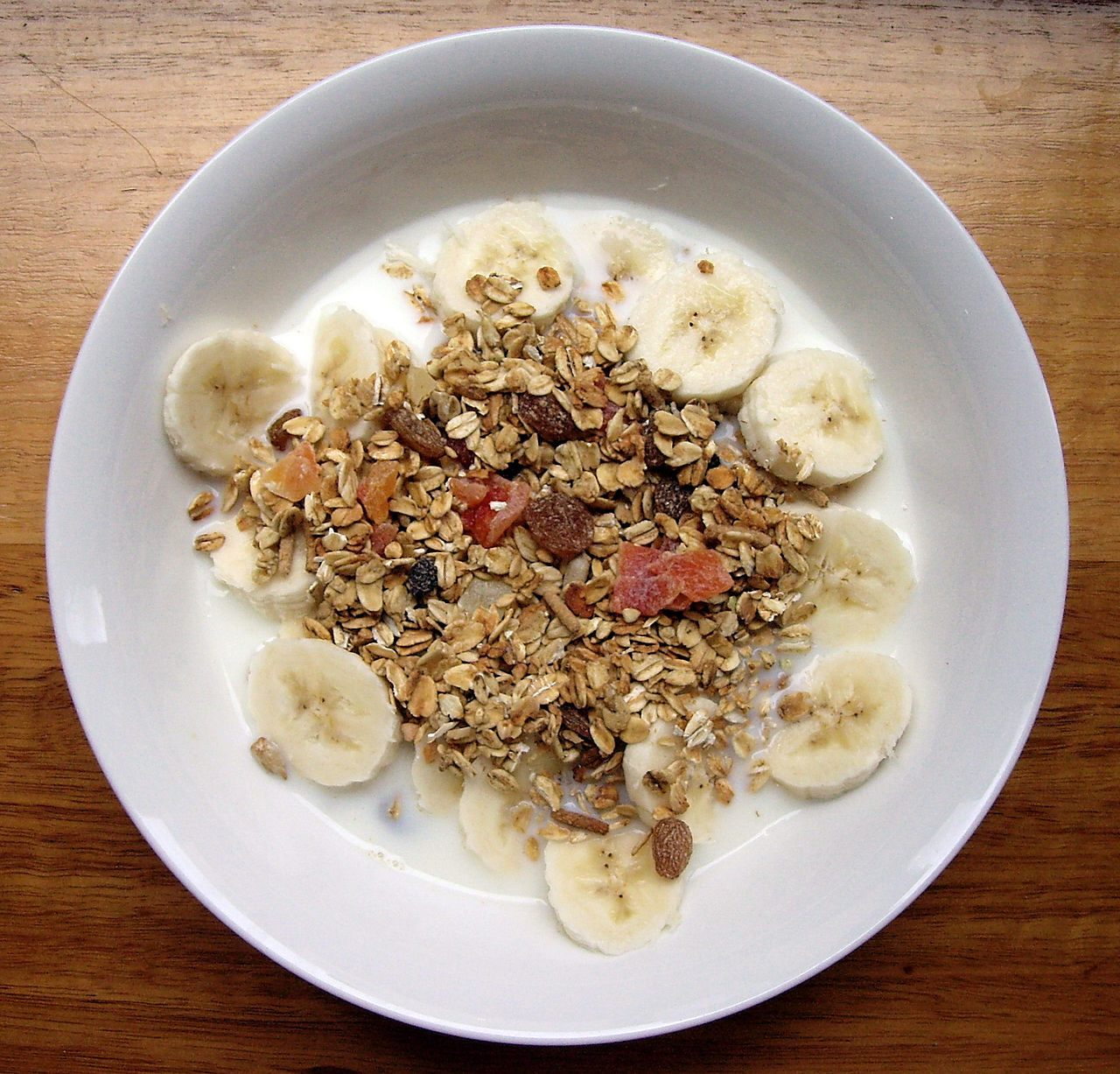
Traditionally, the primary ingredient is rolled oats which have not been processed further. The original preparation was to soak the oats in water overnight ("overnight oats") and eat the next morning with fresh apple, nuts, lemon juice, and sweetened condensed milk. Variation over time was natural: substituting other citrus juice or adding additional ingredients such as grains, seeds, and fresh and dried fruits.[4]Yogurt, milk or other milk products, or milk substitutes are now common ingredients in both homemade and commercially packaged muesli recipes.
Modern commercial brands market muesli that is toasted. If it is processed further, by adding sweetener and oil to bind the ingredients together and baked, it is granola.[6][7]
Etymology
Originally known in Swiss German as Birchermüesli after its creator Bircher-Benner, the word Müesli is an Alemannicdiminutive of Mues (non-Swiss Standard German: Mus) meaning 'mush' or 'purée'.[8]
History
Muesli was not originally intended as a breakfast food, but as an appetiser similar to bread and butter. It was consumed as Schweizer Znacht (lit.'Swiss supper'), but not as a breakfast cereal.[9]
It was introduced around 1900 by Bircher-Benner for patients in his hospital,[3] where a diet rich in fresh fruit and vegetables was an essential part of therapy. It was inspired by a similar "strange dish" that he and his wife had been served on a hike in the Swiss Alps.[4]
Bircher-Benner himself referred to the dish simply as d Spys, Swiss German for "the dish" (German: die Speise); it was commonly known as Apfeldiätspeise (lit.'Apple Diet Meal'). Bircher opened a chalet-style sanitorium on Zürichberg called Lebendige Kraft (lit.'lively power'). These facilities had risen in popularity during the era of lebensreform, a social movement which valued health foods and vegetarianism.[9]
Recipes
Original Bircher-Benner recipe
The original Bircher-Benner recipe consists of the following ingredients:
- Apples: "two or three small apples or one large one". The whole apple was to be used, including skin, core, and pips[a].
- Nuts, either walnuts, almonds, or hazelnuts: 1 tablespoon.
- Rolled oats: 1 tablespoon, "previously soaked in 3 tablespoons water for 12 hours".
- Lemon juice: from half a lemon.
- Either cream and honey, or sweetened condensed milk: 1 tablespoon.[10]
The dish was prepared by mixing the cream and honey or condensed milk with the soaked oats and lemon juice and, while stirring, grating the whole apple into the mixture. This method prevented the apple pulp from browning. The intent was to serve the dish fresh, immediately before any other dishes in the meal.[10][11]
Fresh muesli

Muesli traditionally is freshly prepared using dried rolled oats or whole grain oats that have been soaked in water or fruit juice.[12] Other common ingredients are grated or chopped fresh fruit (e.g., bananas, apples, berries, grapes, mango), dried fruit, milk products (e.g., fresh milk, yoghurt, cream, condensed milk, fromage frais, quark, cottage cheese) or nondairy milk substitutes, lemon juice, ground nuts, seeds, spices (especially cinnamon), honey and muesli mix.[13][14]
The preparation of home-made muesli varies according to the tastes and preferences of the cook, but the basic proportions are around 80% grain, 10% nuts and seeds and 10% dried fruits.[15] Some home cooks prefer to mix the dry ingredients ahead of time and store a batch of it in a container, adding wet ingredients such as fresh fruit, dairy products, honey and fruit juice immediately before serving.[16]
Packaged muesli
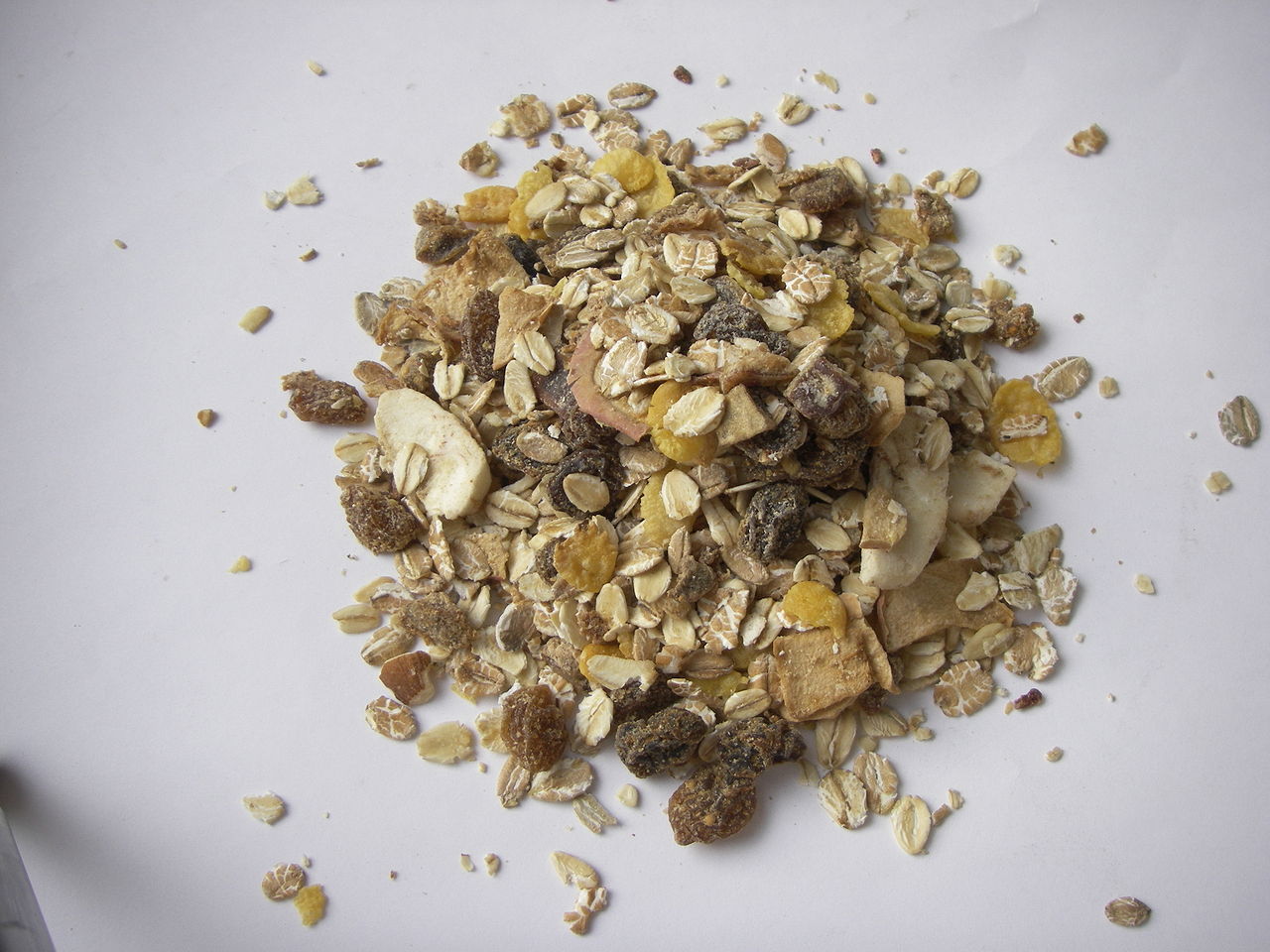
Packaged muesli is a loose mixture of mainly rolled oats or cornflakes together with various dried fruit pieces, nuts, and seeds – the main ingredients of any muesli. It commonly contains other rolled cereal grains such as wheat or rye flakes.[17]
There are many varieties, which may also contain honey, spices, or chocolate. Dry packaged muesli can be kept for many months and served quickly after mixing with milk, filmjölk, yogurt, coffee, hot chocolate, fruit juice or water. If desired, pieces of fresh fruit may be added. Alternatively, the mix may be soaked overnight in milk and then served with fresh fruit or compote to taste.[18]
Cultural specifics
English-speaking world adaptation
Cafes, restaurants and chefs in the English-speaking world often use the label Bircher muesli to distinguish their dishes from the store-bought variety, indicating it has been prepared in a manner based on the original recipe – with grated fresh apple, lemon juice, cream and honey – rather than just being poured from a packet and having milk added. However, these dishes are usually a marked modification of the original recipe rather than a faithful reproduction. Many use orange or apple juice instead of lemon juice, and add other more exotic ingredients such as berries, grated fresh pears, poached or roasted fruit, vanilla essence and agave syrup.[19][20]
Cultural connotations
Muesli has been associated from the beginning with health-conscious diets and back-to-nature lifestyles. In English-speaking countries, these connotations have led to the coinage of terms linking muesli to social liberalism and the middle classes. These include the British muesli belt[21] and the American granola type.[22]
Research
Regular muesli consumption has been associated with a lower body mass index and less risk of being overweight.[23] A 2025 analysis found that muesli consumption was significantly associated with reduced total and cause-specific mortality risks.[24] Muesli is recommended by the British Heart Foundation as a cholesterol-lowering food.[25]
See also
Notes
- ^This means "seeds" and is not advisable according to modern health advice.
References
- ^"muesli". Oxford Learner's Dictionaries. Oxford, England: Oxford University Press. Retrieved 2019-12-05.
- ^"muesli". Cambridge English Dictionary. Cambridge, England: Cambridge University Press. Retrieved 2019-12-05.
- ^ abKurmann, Joseph A.; Rasic, Jeremija L.; Kroger, Manfred (1992), "Bircher Muesli", Encyclopedia of Fermented Fresh Milk Products: An International Inventory of Fermented Milk, Cream, Buttermilk, Whey, and Related Products (1 ed.), Berlin, Germany: Springer Verlag, p. 75, ISBN 978-0-442-00869-7
- ^ abc"Birchermus / Bircher" (in French). Lausanne, Switzerland: Association Patrimoine Culinaire Suisse [Swiss Culinary Heritage Association]. 2017. Retrieved 2019-02-11.
- ^"Café complet, der" (in German). Berlin, Germany: Duden - Rechtschreibung. Retrieved 2019-09-17.
- ^Prakash, Sheela (1 May 2019). "What's the difference between muesli and granola?". Kitchn. Apartment Therapy. Retrieved 6 June 2022.
- ^"Toasted muesli". Hint of Healthy. 7 March 2021. Retrieved 6 June 2022.
- ^Other variants are: Swiss German: Müesli[ˈmyə̯slɪ], non-Swiss Standard German: Müsli[ˈmyːsli:]ⓘ); "Müsli, das" (in German). Berlin, Germany: Duden - Rechtschreibung. Retrieved 2019-02-19.
- ^ abMacEacheran, Mike (14 August 2017). "How Switzerland transformed breakfast". BBC Travel. London, England: British Broadcasting Corporation. Retrieved 2019-12-05.
- ^ abM. Bircher-Benner; Max E. Bircher (1985), "IV A. Raw Food Porridge (Bircher Müesli)", Fruit Dishes and Raw Vegetables, Translated by Reginald Snell, Health Research Books, pp. 19–20, ISBN 0787314110 – via Google books
- ^Eberhard Wolff (2010). "A new way of living: Maximilian Bircher-Benner"(PDF). Karger Gazette. 71: 11–12. Retrieved 2019-12-05 – via ZORA, University of Zurich.
- ^Bruck, Joshua (13 January 2021). "What is Muesli?". Simply Oatmeal. Retrieved 30 September 2022.
- ^Fun, Tanya, Swiss Family (2020-11-11). "Bircher Müesli Recipe • 7 Tips for making this classic Swiss breakfast". Swiss Family Fun. Retrieved 2022-09-30.
{{cite web}}: CS1 maint: multiple names: authors list (link) - ^Lords, Chelsea (2020-05-20). "Muesli". Chelsea's Messy Apron. Retrieved 2022-09-30.
- ^"The Muesli Formula - A Guide To Making Your Own Cycling Endurance Fuel". Biked Goods. Retrieved 2022-09-30.
- ^"Meal Prep Sundays: Muesli". 6 Pack Fitness. Retrieved 2022-09-30.
- ^"Swiss Müesli Original Recipe - bio-familia".
- ^"International products - bio-familia".
- ^Williams, John (29 January 2014). "Recipes for cancer sufferers: bircher muesli". The Telegraph. London, England: Telegraph Media Group. Retrieved 17 September 2019.
- ^Ottolenghi, Yotam (15 Jan 2011). "Bircher muesli recipe". The Guardian. London, England: Scott Trust Limited. Retrieved 17 September 2019.
- ^Definition of muesli belt in English. Oxford, England: Oxford University Press/Dictionary.com. Archived from the original on November 5, 2021. Retrieved 16 September 2019.
humorous, derogatoryBritish A region regarded as being populated by middle-class, health-conscious people.
{{cite encyclopedia}}:|website=ignored (help) - ^Definition of granola in English. Oxford, England: Oxford University Press/Dictionary.com. Archived from the original on April 28, 2022. Retrieved 16 September 2019.
1.1 derogatory [as modifier] Denoting people with liberal or Green political views, typified as eating health foods.
{{cite encyclopedia}}:|website=ignored (help) - ^Williams, P. G. (2014). "The benefits of breakfast cereal consumption: A systematic review of the evidence base". Advances in Nutrition. 5 (5): 636S–673S. doi:10.3945/an.114.006247. PMC 4188247. PMID 25225349.
- ^Lin, Zhengjun; Zeng, Min; Sui, Zijian; Wu, Yanlin; Zhang, Hong; Liu, Tang (2025). "Associations of breakfast cereal consumption with all-cause and cause-specific mortality: a large-scale prospective analysis". Nutrition Journal. 24 (48) 48. doi:10.1186/s12937-025-01109-5. PMC 11934668. PMID 40128757.
{{cite journal}}: CS1 maint: multiple names: authors list (link) - ^"5 cholesterol-lowering foods". British Heart Foundation. 2023. Archived from the original on June 10, 2025.
External links
 Media related to Muesli at Wikimedia Commons


