Nambu–Goto action
| String theory |
|---|
 |
| Fundamental objects |
| Perturbative theory |
| Non-perturbative results |
| Phenomenology |
| Mathematics |
The Nambu–Goto action is the simplest invariant action in bosonic string theory, and is also used in other theories that investigate string-like objects (for example, cosmic strings). It is the starting point of the analysis of zero-thickness (infinitely thin) string behaviour, using the principles of Lagrangian mechanics. Just as the action for a free point particle is proportional to its proper time – i.e., the "length" of its world-line – a relativistic string's action is proportional to the area of the sheet which the string traces as it travels through spacetime.
It is named after Japanese physicists Yoichiro Nambu and Tetsuo Goto.[1]
Background
Relativistic Lagrangian mechanics
ラグランジュ力学の基本原理、すなわち定常作用の原理は、外部の影響を受ける物体は、ある量、すなわち作用を極値とする経路を「選択する」というものです。作用は関数であり、経路全体から単一の数値を生成する数学的関係です。物体が実際に辿る物理的経路は、作用が「定常」(または極値)となる経路です。つまり、物理的経路からの経路のわずかな変化は、作用を大きく変化させません。(多くの場合、これは物理的経路とは、作用が最小値となる経路であると言うことと同義です。)作用は通常、ラグランジアンを用いて表されます。ラグランジアンは、空間および/または時間における特定の点における物体の状態に依存する式です。例えば、非相対論的力学では、点粒子のラグランジアンは、運動エネルギーと位置エネルギーの差です。作用は、しばしば と表記され、開始時刻から終了時刻までのこの量の積分です。


(通常、ラグランジアンを使用する場合、粒子の開始位置と終了位置がわかっていると想定し、それらの位置の間を粒子が移動する 経路を考慮します。)
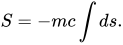
この力学へのアプローチは、拡張や一般化が容易であるという利点がある。例えば、相対論的粒子のラグランジアンを書くことができ、これは粒子が光速に近い速度で移動している場合でも有効である。ローレンツ不変性を保つためには、作用はすべての(ローレンツ)観測者にとって同じ量のみに依存するべきである。つまり、作用はローレンツスカラーであるべきである。そのような最も単純な量は固有時、つまり粒子が持つ時計によって測定される時間である。特殊相対論によれば、粒子の動きを観測するすべてのローレンツ観測者は、量

そしてそれは無限小の固有時間である。外力を受けない点粒子(すなわち慣性運動する点粒子)の場合、相対論的作用は

ワールドシート
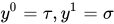
零次元点が時空図上で世界線を描くように、一次元弦は世界面によって表される。すべての世界面は二次元面であるため、世界面上の点を指定するには2つのパラメータが必要となる。弦理論家はこれらのパラメータにとという記号を用いる。弦理論は、我々が慣れ親しんでいる3次元世界よりも高次元の空間を扱う。ボソン弦理論は25の空間次元と1つの時間軸を必要とする。 を空間次元数とすると、点はベクトル によって表すことができる。



We describe a string using functions which map a position in the parameter space (, ) to a point in spacetime. For each value of and , these functions specify a unique spacetime vector:

The functions determine the shape which the world-sheet takes. Different Lorentz observers will disagree on the coordinates they assign to particular points on the world-sheet, but they must all agree on the total proper area which the world-sheet has. The Nambu–Goto action is chosen to be proportional to this total proper area.

Let be the metric on the -dimensional spacetime. Then,


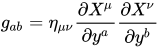
is the induced metric on the world-sheet, where and .

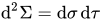
For the area of the world-sheet the following holds:

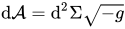
where and
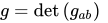
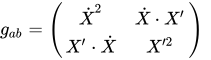
Using the notation that:

and

one can rewrite the metric:


the Nambu–Goto action is defined as[2]

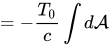
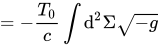

where . The factors before the integral give the action the correct units, energy multiplied by time. is the tension in the string, and is the speed of light. Typically, string theorists work in "natural units" where is set to 1 (along with the reduced Planck constant and the Newtonian constant of gravitation ). Also, partly for historical reasons, they use the "slope parameter" instead of . With these changes, the Nambu–Goto action becomes




These two forms are, of course, entirely equivalent: choosing one over the other is a matter of convention and convenience.
Two further equivalent forms (on shell but not off shell) are

and

The conjugate momentum field
- .
![{\displaystyle P=-{\frac {T}{\sqrt {({\dot {X}}\cdot X')^{2}-{\dot {X}}^{2}{X'}^{2}}}}\left[X'({\dot {X}}\cdot X')-{\dot {X}}{X'}^{2}\right]}](https://wikimedia.org/api/rest_v1/media/math/render/svg/68c08f7280202ecd6cf5406412cd06e01a2cb4f3)
Then,
![{\displaystyle P^{2}={\frac {T^{2}}{({\dot {X}}\cdot X')^{2}-{\dot {X}}^{2}{X'}^{2}}}\left[{X'}^{2}({\dot {X}}\cdot X')^{2}-2({\dot {X}}\cdot X')^{2}X'^{2}+{\dot {X}}^{2}{X'}^{4}\right]=-T^{2}{X'}^{2}}](https://wikimedia.org/api/rest_v1/media/math/render/svg/e4b5de5fc8b571462b68a8c626fc02e97f7adfee)
is a primary constraint. The secondary constraint is . These constraints generate timelike diffeomorphisms and spacelike diffeomorphisms on the worldsheet. The Hamiltonian. The extended Hamiltonian is given by


![{\displaystyle H=\int d\sigma \left[\lambda (P^{2}+T^{2}{X'}^{2})+\rho P\cdot X'\right]}](https://wikimedia.org/api/rest_v1/media/math/render/svg/874c98326fab39d50cc814302d95c80b305e529b)
where and are Lagrange multipliers.


The equations of motion satisfy the Virasoro constraints and .


典型的には、南部-後藤作用は、弦の量子物理学を研究するのに適した形をまだ持っていない。このため、点粒子の作用と同様に修正する必要がある。これは古典的には負の質量と時空における不変長の積に等しいが、同じ古典的値を持つ二次式に置き換える必要がある。[ 3 ]弦の場合、類似の補正はポリヤコフ作用 によって提供される。これは古典的には南部-後藤作用と等価であるが、「正しい」量子論を与える。しかし、光円錐ゲージにおける南部-後藤作用から量子論を展開することは可能である。
参照
参考文献
- ^南部陽一郎、コペンハーゲン夏季シンポジウム講演集(1970年)、未出版。
- ^ツヴィーバッハ、バートン(2003). 『弦理論入門』ケンブリッジ大学出版局. ISBN 978-0521880329。
- ^ Kleinertの標準教科書『量子力学、統計、高分子物理学、金融市場における経路積分』第5版第19章、 World Scientific(シンガポール、2009年)を参照。2009年4月24日にWayback Machineでアーカイブ(オンラインでも入手可能。 2009年1月1日にWayback Machineでアーカイブ)
さらに読む
- オーティン、トーマス『重力と弦』ケンブリッジ・モノグラフ、ケンブリッジ大学出版局(2004年)。ISBN 978-0-521-03546-0。
