Les Misérables (musical)
| Les Misérables | |
|---|---|
 | |
| Music | Claude-Michel Schönberg |
| Lyrics | Herbert Kretzmer |
| Original text |
|
| Book |
|
| Basis | Les Misérablesby Victor Hugo |
| Premiere | 24 September 1980: Palais des Sports, Paris |
| Productions | Multiple international productions |
| Awards | |
Les Misérables (/leɪˌmɪzəˈrɑːb(əl),-blə/lay MIZ-ə-RAHB(-əl), -RAH-blə, French:[lemizeʁabl]), colloquially known as Les Mis or Les Miz (/leɪˈmɪz/lay MIZ), is a sung-throughmusical with music by Claude-Michel Schönberg, lyrics by Alain Boublil and Jean-Marc Natel, and a book by Boublil and Schönberg, based on the 1862 novel of the same name by Victor Hugo. Set in early 19th-century France, Les Misérables tells the story of Jean Valjean, a French convict, and his desire for redemption. After stealing a loaf of bread for his sister's starving child, Valjean is imprisoned for 19 years and released in 1815. When a bishop inspires him with a tremendous act of mercy, Valjean breaks his parole and starts his life anew and in disguise. He becomes wealthy and adopts an orphan, Cosette. A police inspector named Javert pursues Valjean over the decades in a single-minded quest for "justice". The characters are swept into a revolutionary period in France, where a group of young idealists attempts to overthrow the government at a street barricade in Paris.
The French musical premiered in Paris in 1980 with direction by Robert Hossein. Its English-language adaptation, with lyrics by Herbert Kretzmer, produced by Cameron Mackintosh and directed by Trevor Nunn and John Caird, has been running in London since October 1985, making it the longest-running musical in the West End and the second longest-running musical in the world after the original off-Broadway run of The Fantasticks. Many other long-running productions followed on Broadway and around the world, and a film adaptation was released in 2012.
Background
Alain Boublil's initial idea to adapt Victor Hugo's novel into a musical came while at a performance of the musical Oliver! in London:
As soon as the Artful Dodger came onstage, Gavroche came to mind. It was like a blow to the solar plexus. I started seeing all the characters of Victor Hugo's Les Misérables—Valjean, Javert, Gavroche, Cosette, Marius, and Éponine—in my mind's eye, laughing, crying, and singing onstage.[1]
He shared the idea with French composer Claude-Michel Schönberg, and the two developed a rough synopsis and analysis of each character's mental and emotional state, as well as that of an audience. Schönberg then began work on the music, while Boublil started writing the text. According to Boublil, "I [began] work on the words ... after myself deciding on the subject and title of every song—in collaboration with my friend, poet Jean-Marc Natel."[2] Two years later, a two-hour demo tape of Schönberg accompanying himself on the piano and singing every role was completed. An album of this collaboration was recorded at CTS Studios in Wembley and was released in 1980, selling 260,000 copies.
The Les Misérablesconcept album was released in French in 1980[3]. It starred Maurice Barrier as Jean Valjean, with Jacques Mercier as Javert, Rose Laurens as Fantine, Yvan Dautin and Marie-France Roussel as the Thénardiers, Richard Dewitte as Marius, Fabienne Guyon as Cosette, Marie-France Dufour as Éponine, Michel Sardou as Enjolras, Schönberg as Courfeyrac and Salvatore Adamo as Combeferre,. The first stage adaptation was presented at the Palais des Sports in September of that year with many of the same cast, including Barrier, Laurens, Dautin, Roussel, and Guyon; Jean Vallée played Javert.[4]
In 1983, about six months after producer Cameron Mackintosh had opened Cats on Broadway, he received a copy of the French concept album from director Peter Farago. Farago had asked Mackintosh to produce an English-language version of the show. Initially reluctant, Mackintosh eventually agreed. In conjunction with the Royal Shakespeare Company (RSC), Mackintosh assembled a production team to adapt the French musical for a British audience. After two years in development, the English-language version, translated by Herbert Kretzmer (lyrics) and Siobhan Bracke (book), and expanded with additional material by James Fenton, opened in London in October 1985 at the Barbican Centre, then the London home of the RSC, before transferring to the West End.[5]
Initial reception; milestones
Critical reviews for Les Misérables were initially negative. At the opening of the London production, The Sunday Telegraph's Francis King described the musical as "a lurid Victorian melodrama produced with Victorian lavishness", and Michael Ratcliffe of The Observer considered the show "a witless and synthetic entertainment", while literary scholars condemned the project for converting classic literature into a musical.[6][7]Irving Wardle of The Times dissented, calling the musical's book was a bold and ingenious abridgement of Hugo's plot.[8]Public opinion differed from the critical consensus: the box office received record orders. The three-month engagement sold out, and reviews improved. The London production has played over 15,000 performances, making it the second longest-running musical in the world after The Fantasticks,[9] the second longest-running West End show after The Mousetrap,[10] and the longest-running musical in the West End.[11] On 3 October 2010, the show celebrated its 25th anniversary with three productions running in London: the original production at the Queen's Theatre; the 25th Anniversary touring production at the Barbican Centre; and a concert at London's O2 Arena.[11]
The first Broadway production opened on 12 March 1987 and ran until 18 May 2003, closing after 6,680 performances. At the time of its closing, it was the second-longest-running musical in Broadway history.[12] As of 2022, it remains the sixth longest-running Broadway show.[13] The show was nominated for 12 Tony Awards, winning eight, including Best Musical and Best Original Score.
Subsequently, numerous tours and international and regional productions have been staged, as well as concert and broadcast productions. Several recordings have also been made. Broadway revivals played from 2006 to 2008 and 2014 to 2016. The show placed first in a BBC Radio 2 listener poll of Britain's "Number One Essential Musicals" in 2005, receiving more than forty percent of the votes.[14] A film version directed by Tom Hooper was released at in 2012 to generally positive reviews; it won three Academy Awards and was nominated for five more, including Best Picture.[15]
Emblem
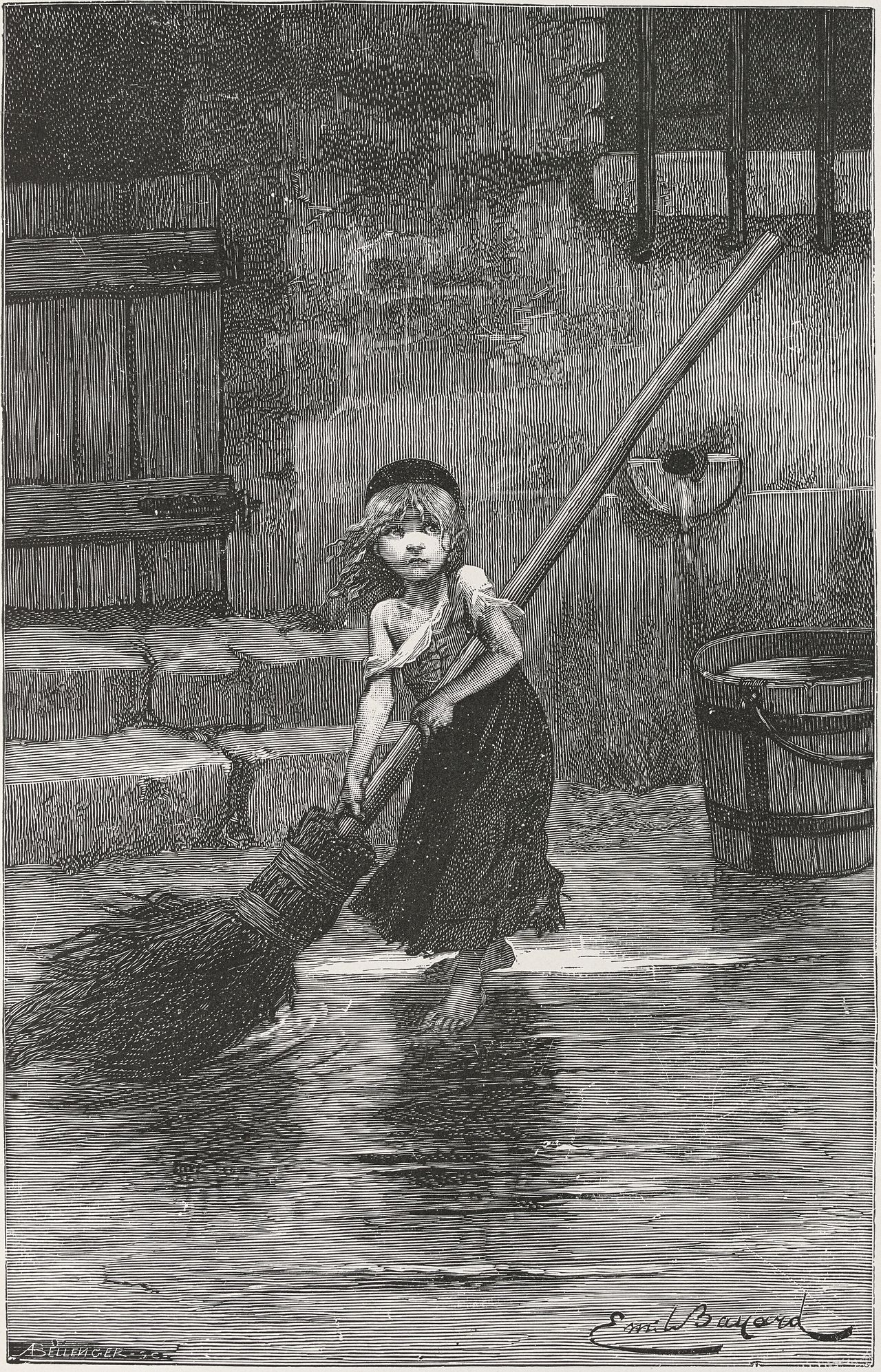
The musical's emblem is a picture of the waifCosette sweeping the Thénardiers' inn, usually cropped to a head-and-shoulders portrait, superimposed on the French flag. The image is modeled on an 1879 illustration of Cosette by Émile Bayard, which appeared in early French editions of Victor Hugo’s novel.[16]
Synopsis
Prologue
In 1815 France, Jean Valjean, "Prisoner 24601", is released on parole by guard Javert after 19 years hard labor in prison for stealing bread ("Work Song (Look Down)"). Marked by his yellow ticket of leave ("On Parole"), Valjean is shunned and cannot find decent work until the Bishop of Digne offers him shelter. Valjean steals the Bishop's silver, but the Bishop pretends to have given it to him and also gives him a pair of silver candlesticks ("Valjean Arrested, Valjean Forgiven"). Valjean vows to start an honest life ("Valjean's Soliloquy (What Have I Done?)"). He tears up his ticket, breaking parole.
Act I
By 1823, Valjean is living disguised as Monsieur Madeleine, a factory owner and the mayor of Montreuil-sur-Mer. Fantine, a single mother working at Valjean's factory, is fired after a disagreement with the lustful foreman and sinks into poverty ("At the End of the Day"; "I Dreamed a Dream"), selling her locket and hair, and becoming a prostitute ("Lovely Ladies"). When she fights back against an abusive customer, Javert, now a police inspector, arrests her. Valjean intervenes and takes her to a hospital ("Fantine's Arrest").
When Valjean rescues a man pinned by a runaway cart, Javert, who has pursued him over the years, suspects his true identity. Learning an innocent man is about to be jailed in his place, Valjean confesses ("Who Am I?"). At the hospital, Fantine dies after Valjean promises to rescue her daughter Cosette from the thieving Thénardiers, innkeepers who are paid to raise her ("Fantine's Death (Come to Me)"). Valjean escapes Javert ("The Confrontation"). In Montfermeil, the Thénardiers use Cosette as a servant, treating her cruelly, while extorting money from Fantine ("Castle on a Cloud"; "Master of the House"). Valjean pays them 1,500 francs to release Cosette ("The Bargain") and takes her to Paris ("The Waltz of Treachery").
In 1832 Paris, unrest grows with the impending death of the merciful General Lamarque. Student revolutionaries Marius Pontmercy and Enjolras prepare for an uprising. The Thénardiers, who have lost their inn and now lead a gang of street criminals, plot scams. Their daughter Éponine befriends the streetwise urchin Gavroche ("Look Down"). She secretly loves Marius, but he falls instantly for Cosette when he meets her with Valjean, whom the Thénardiers attempt to rob ("The Robbery"). Valjean is recognized, but he and Cosette escape; Javert vows to recapture him ("Stars"). Marius persuades Éponine to help him find Cosette ("Éponine’s Errand").
As Enjolras rallies the students ("The ABC Café/Red and Black"), Marius pines for Cosette. News of Lamarque’s death sparks plans for revolution ("Do You Hear the People Sing?"). Cosette confronts Valjean about his secrets ("In My Life"). Éponine finds Cosette, and Marius and Cosette confess their love ("A Heart Full of Love"). Thénardier and his gang arrive to rob Valjean's house but are foiled by Éponine’s warning ("The Attack on Rue Plumet"). Believing Javert has found him, Valjean plans to flee with Cosette. On the eve of the 1832 Paris Uprising, Enjolras exhorts all of Paris to join the revolution. Éponine acknowledges in anguish that Marius will never love her. Javert plans to spy on, while the students and rebels steel themselves for battle ("One Day More").
Act II

The students build a barricade; Marius discovers that Éponine has disguised herself as a boy to join the rebels ("Building the Barricade"). To keep her safe, he sends her to deliver a farewell letter to Cosette ("On My Own"). Valjean intercepts the letter and learns about Marius and Cosette's romance. The French army arrives, demanding surrender ("At the Barricade"). Javert, disguised as a rebel, is exposed as a spy by young Gavroche ("Little People"). Wounded during the fighting, Éponine dies in Marius’s arms, confessing her love ("A Little Fall of Rain (Eponine's Death)").
Valjean arrives disguised as a soldier, hoping to protect Marius ("Night of Anguish"). He saves Enjolras from a soldier. Valjean releases Javert instead of executing him, shaking Javert’s rigid view of God and justice ("The First Attack"). As dawn approaches, the students prepare for attack ("Drink with Me"). Valjean prays for Marius's safety, offering God his own life ("Bring Him Home"). Enjolras realizes the people of Paris have not risen up but resolves to fight on ("Dawn of Anguish"). The army attacks; Gavroche is killed ("The Second Attack (Death of Gavroche)"), and all the students but Marius die. Valjean carries a gravely wounded Marius through the sewers and collapses ("The Final Battle"). Thénardier, looting bodies, comes upon the unconscious Valjean and Marius, taking a ring from the latter and fleeing ("Dog Eats Dog"). At the sewer's exit, Valjean finds Javert waiting; he begs Javert for time to bring Marius to a doctor. Javert, unable to reconcile Valjean’s mercy with his worldview, kills himself ("Javert’s Suicide").
Paris mourns the fallen students ("Turning"). Marius grieves his friends and wonders who saved him ("Empty Chairs at Empty Tables"). Valjean blesses Marius and Cosette’s marriage ("Every Day") but tells Marius he is an escaped convict and must leave to protect Cosette ("Valjean’s Confession"). At their wedding ("Wedding Chorale"), the Thénardiers attempt to blackmail Marius, who realizes Valjean carried him from the barricades ("Beggars at the Feast"). Marius and Cosette rush to find Valjean.
Epilogue
At a convent, Valjean awaits death. Fantine’s spirit assures him of forgiveness. Cosette and Marius arrive in time to bid farewell. Valjean thanks God for seeing Cosette grown and happy ("Valjean’s Death"). He entrusts her with his past and tells her the truth about her mother. Guided by the spirits of Fantine and Éponine, who remind him that "to love another person is to see the face of God", he dies at peace, joining the souls of the fallen in a hopeful vision of freedom ("Do You Hear the People Sing?" (reprise)").[17]
Musical numbers
Prologue
- "Work Song (Look Down)" – Chain Gang, Jean Valjean, Javert
- "On Parole" – Jean Valjean, Farmer, Laborer, Innkeeper, Innkeeper's Wife, Bishop
- "Valjean Arrested/Valjean Forgiven" – Bishop, Constables
- "Valjean's Soliloquy (What Have I Done?)" – Jean Valjean
Act I
- "At the End of the Day" – Fantine, Foreman, Jean Valjean, Factory Workers, Townspeople
- "I Dreamed A Dream" – Fantine
- "Lovely Ladies" – Fantine, Sailors, Old Woman, Pimp, Crone, Prostitutes
- "Fantine's Arrest" – Bamatabois, Fantine, Javert, Jean Valjean
- "The Runaway Cart" – Fauchevelant, Jean Valjean, Javert
- "Who Am I?" – Jean Valjean
- "Fantine's Death (Come To Me)" – Fantine, Jean Valjean
- "Confrontation" – Jean Valjean, Javert
- "Castle on a Cloud" – Little Cosette, Little Eponine, Madame Thénardier
- "Master of the House" – Thénardier, Madame Thénardier, Inn Guests
- "The Bargain/Thénardier's Waltz of Treachery" – Jean Valjean, Little Cosette, Thénardier, Madame Thénardier
- "Look Down" – Gavroche, Marius, Enjolras, Townspeople
- "The Robbery" – Thénardier, Madame Thénardier, Marius, Eponine, Jean Valjean, Javert, Gavroche
- "Stars" – Javert
- "Eponine's Errand" – Eponine, Marius
- "The ABC Cafe/Red and Black" – Enjolras, Marius, Grantaire, Gavroche, Students
- "Do You Hear The People Sing?" – Enjolras, Marius, Students
- "In My Life" – Cosette, Marius, Eponine, Jean Valjean
- "A Heart Full of Love" – Marius, Cosette, Eponine
- "The Attack on Rue Plumet" – Thénardier, Eponine, Marius, Cosette, Jean Valjean, Montparnasse, Claquesous, Babet, Brujon
- "One Day More" – Company
Act II
- "Building the Barricade" – Enjolras, Javert, Grantaire, Marius, Eponine, Students
- "On My Own" – Eponine
- "At the Barricade" – Enjolras, Marius, Gavroche, Army Officer, Students
- "Javert at the Barricade" – Javert, Enjolras
- "Little People" – Gavroche, Enjolras, Javert
- "A Little Fall of Rain (Eponine's Death)" – Eponine, Marius
- "Night of Anguish" – Enjolras, Students
- "The First Attack" – Enjolras, Marius, Jean Valjean, Javert, Students
- "Drink With Me" – Grantaire, Students, Women's Chorus
- "Bring Him Home" – Jean Valjean
- "Dawn of Anguish" – Enjolras
- "The Second Attack (Gavroche's Death)" – Enjolras, Marius, Jean Valjean, Gavroche, Grantaire, Students
- "The Final Battle" – Army Officer, Enjolras, Students
- "The Sewers/Dog Eats Dog" – Thénardier
- "Javert's Suicide" – Javert
- "Turning" – Townspeople
- "Empty Chairs at Empty Tables" – Marius
- "A Heart Full of Love" (reprise) – Marius, Cosette, Jean Valjean
- "Valjean's Confession" – Valjean, Marius
- "The Wedding" – Wedding Guests
- "Beggars at the Feast" – Marius, Thénardier, Madame Thénardier
Epilogue
- "Valjean's Death" – Valjean, Fantine, Marius, Cosette, Eponine
- "Do You Hear the People Sing?" (reprise) – Company
Casts
Original casts
Notable replacements
 | This section needs additional citations for verification.(January 2024) |
West End (1985–present)
- Jean Valjean:Alfie Boe, Simon Bowman, Killian Donnelly, Dudu Fisher, Simon Gleeson, Peter Jöback,[20]Ramin Karimloo, Peter Karrie, Peter Lockyer, Robert Marien, John Owen-Jones, Jon Robyns, Stig Rossen, Drew Sarich, Dave Willetts
- Javert:Michael Ball, David Burt, Earl Carpenter, Clive Carter, Peter Corry, Hadley Fraser, Ethan Freeman, Bradley Jaden, Norm Lewis, Michael McCarthy, Tam Mutu, Jérôme Pradon, Philip Quast, Jeremy Secomb,[21]Hayden Tee, David Thaxton
- Fantine:Madalena Alberto, Joanna Ampil, Gunilla Backman, Sierra Boggess, Ava Brennan, Allyson Brown, Carmen Cusack, Kerry Ellis, Carrie Hope Fletcher, Rachelle Ann Go, Carola Häggkvist, Katie Hall,[22]Ruthie Henshall, Na-Young Jeon, Lucie Jones, Kathleen Rowe McAllen, Siobhán McCarthy, Claire Moore, Silvie Paladino, Jenna Russell, Celinde Schoenmaker, Caroline Sheen, Carley Stenson, Rebecca Storm, Patrice Tipoki
- Marius:Graham Bickley, Simon Bowman, Alistair Brammer, Glenn Carter, Martin Crewes, Hadley Fraser, Gareth Gates, Nick Jonas, Jon Lee, Tom Lowe, Adrian Lewis Morgan, Jon Robyns, Martin Smith, Hayden Tee, Jac Yarrow[23]
- Cosette:Gina Beck, Celia Graham, Katie Hall, Lucie Jones, Camilla Kerslake, Myrra Malmberg
- Young Cosette:Natalie Paris
- Éponine:Sabrina Aloueche, Joanna Ampil, Samantha Barks, Meredith Braun, Shonagh Daly, Carrie Hope Fletcher, Linzi Hateley, Danielle Hope, Laura Michelle Kelly, Alexia Khadime, Eva Noblezada, Silvie Paladino, Siân Reeves, Lea Salonga, Caroline Sheen, Nancy Sullivan
- Young Éponine:Carrie Hope Fletcher
- Thénardier:Martin Ball, Cameron Blakely, Barry James, Luke Kempner,[22]Chris Langham, Matt Lucas, Hilton McRae, Peter Polycarpou, Stephen Tate
- Madame Thénardier:Rosemary Ashe, Tracie Bennett, Vicky Entwistle, Josefina Gabrielle, Jenny Galloway, Linzi Hateley, Bonnie Langford,[23]Claire Machin, Claire Moore, Louise Plowright, Jodie Prenger, Gay Soper, Harriet Thorpe
- Enjolras:Graham Bickley, Killian Donnelly, Bradley Jaden, Ramin Karimloo, Glyn Kerslake, Jamie Muscato, John Owen-Jones, David Thaxton, Oliver Thornton
- Gavroche:Jonathan Bailey, James Buckley, James Byng, Chris Fountain, Daniel Huttlestone, Paul Keating, Rob Madge, Perry Millward, Adam Searles
Broadway (1987–2003)
- Jean Valjean:Rob Evan, Dudu Fisher, Robert Marien, Gary Morris
- Javert:Anthony Crivello, Robert Cuccioli, Gregg Edelman, Shuler Hensley, Joseph Mahowald, Michael McCarthy, Chuck Wagner, Robert Westenberg
- Fantine:Laurie Beechman, Donna Kane, Andrea McArdle, Maureen Moore, Rachel York, Debbie Gravitte, Catherine Hickland, Paige O'Hara, Melba Moore, Christy Baron, Juliet Lambert, Alice Ripley, Lauren Kennedy, Jacquelyn Piro Donovan
- Marius:Chris Diamantopoulos, Eric Kunze, Peter Lockyer, Ricky Martin, Hugh Panaro, Matthew Porretta, Kevin Kern
- Young Cosette:Lea Michele[24]
- Cosette:Jacquelyn Piro Donovan
- Éponine:Jessica Boevers, Catherine Brunell, Debbie Gibson, Diana Kaarina, Megan Lawrence, Lea Salonga, Natalie Toro, Sarah Uriarte Berry, Shanice, Kerry Butler
- Thénardier:Ed Dixon, Nick Wyman
- Madame Thénardier:Betsy Joslyn
- Enjolras:Ron Bohmer, Ben Davis,[25]Joseph Mahowald, Gary Mauer
- Gavroche:Michael Shulman, Jarrod Spector, Jason Tam, Michael Zeidman, Grant Rosenmeyer, Harrison Chad, Nick Jonas
Broadway revival (2006–2008)
- Jean Valjean:John Owen-Jones, Drew Sarich
- Javert:Ben Davis,[26]Robert Hunt, Drew Sarich
- Fantine:Judy Kuhn, Lea Salonga
- Éponine:Megan McGinnis
- Thénardier:Chip Zien
- Madame Thénardier:Ann Harada
- Enjolras:Max von Essen
US tour (2010–2013)
- Jean Valjean:Peter Lockyer
- Enjolras:Jason Forbach
- Gavroche:Joshua Colley, Gaten Matarazzo
Broadway revival (2014–2016)
- Jean Valjean:Alfie Boe, John Owen-Jones
- Javert:Earl Carpenter, Hayden Tee
- Fantine:Montego Glover, Erika Henningsen, Alison Luff
- Marius:Chris McCarrell
- Thénardier:Gavin Lee
- Enjolras:Jason Forbach
International tour (2014–2016)
- Jean Valjean:John Owen-Jones
- Javert:Earl Carpenter
- Fantine:Rachelle Ann Go
- Éponine:Carrie Hope Fletcher
- Thénardier:Cameron Blakely, Peter Polycarpou
Productions
Resident productions
Original: France

After the French concept album was released in 1980, in September of that year, a stage version directed by veteran French film director Robert Hossein was produced at the Palais des Sports in Paris. The show was a success, with 100 performances seen by over 500,000 people.[27][28][29]
Most of the cast from the concept album performed in the production.[27][30] The cast included Maurice Barrier as Valjean, Jean Vallée as Javert, Rose Laurens as Fantine, Maryse Cédolin and Sylvie Camacho and Priscilla Patron as Young Cosette, Marie-France Roussel as Mme. Thénardier, Yvan Dautin as M. Thénardier, Florence Davis and Fabrice Ploquin and Cyrille Dupont as Gavroche, Marianne Mille as Éponine, Gilles Buhlmann as Marius, Christian Ratellin as Enjolras, Fabienne Guyon as Cosette, René-Louis Baron as Combeferre, Dominique Tirmont as M. Gillenormand, Anne Forrez as Mlle. Gillenormand, and Claude Reva as the storyteller.[27][30][31][32]
West End (1985)

The English-language version, with lyrics by Herbert Kretzmer and additional material by James Fenton, was substantially expanded and reworked from a literal translation by Siobhan Bracke of the original Paris version, in particular adding a prologue to tell Jean Valjean's background story. Kretzmer's lyrics are not a direct translation of the French, a term that Kretzmer refused to use. A third of the English lyrics were a rough translation, another third were adapted from the French lyrics and the final third consisted of new material. The majority is performed in recitative style; the vocalists use natural speech, not musical metrics.[33]
The first production in English, produced by Cameron Mackintosh and adapted and directed by Trevor Nunn and John Caird, played in preview performances beginning on 28 September 1985 and formally opened on 8 October 1985 at the Barbican Centre, London. It was billed in the programme as "The Royal Shakespeare Company presentation of the RSC/Cameron Mackintosh production". The set was designed by John Napier, costumes by Andreane Neofitou and lighting by David Hersey. Musical supervision and orchestrations were by John Cameron, who had been involved with the show since Boublil and Schönberg hired him to orchestrate the original French concept album. Musical staging was by Kate Flatt with musical direction by Martin Koch.
The original London cast included Colm Wilkinson as Jean Valjean, Roger Allam as Javert, Ken Caswell as the Bishop of Digne, Patti LuPone as Fantine, Zoë Hart, Justine McIntyre, Jayne O'Mahony and Joanne Woodcock as Young Cosette, Danielle Akers, Gillian Brander and Juliette Caton as Young Éponine, Susan Jane Tanner as Madame Thénardier, Alun Armstrong as Thénardier, Frances Ruffelle as Éponine, Rebecca Caine as Cosette, Michael Ball as Marius, David Burt as Enjolras, Clive Carter as Grantaire/Bamatabois, with Ian Tucker, Oliver Spencer and Liza Hayden sharing the role of Gavroche.[34][35][5]
On 4 December 1985, the show transferred to the Palace Theatre, London and moved again on 3 April 2004, to the smaller Queen's Theatre, now called the Sondheim Theatre, with some revisions of staging.[36] The show celebrated its 10,000th performance on 5 January 2010,[37] and its 30th anniversary in October 2015.[38] The co-production has generated valuable income for the Royal Shakespeare Company.[39]
The show closed temporarily at the Queen's Theatre on 13 July 2019 to allow for theatre refurbishments, while Les Misérables: The Staged Concert was performed at the adjacent Gielgud Theatre for a four-month run.[40][41]
2019 updated staging
Using the updated staging developed for the 2009–2010 UK touring production, the musical began previews at the newly renamed Sondheim Theatre on 18 December 2019, with opening night on 16 January 2020.[40][42] The production is co-directed by James Powell and Laurence Connor with set and image design by Matt Kinley, lighting by Paule Constable, sound by Mick Potter and costumes by Andreane Neofitou and Christine Rowlands. The first cast for this version included Jon Robyns (Valjean), Bradley Jaden (Javert), Carrie Hope Fletcher (Fantine), Shan Ako (Éponine), Lily Kerhoas (Cosette), Harry Apps (Marius), Gerard Carey (Thénardier), Josefina Gabrielle (Madame Thénardier) and Ashley Gilmour (Enjolras).[43]
The show was forced to close temporarily from 16 March 2020, as a result of the COVID-19 pandemic.[44] It reopened on 25 September 2021.[45] Considered one continuous production despite revisions, Les Misérables celebrated its 15,000th performance in London on 28 September 2023.[46] A gala performance on 8 October 2025 marked the 40th anniversary, featuring an all-star cast.[47]
Broadway (1987)
The musical opened as a pre-Broadway tryout at the Kennedy Center's Opera House in Washington, D.C., on 27 December 1986. It ran for eight weeks through 14 February 1987.[48]
The musical then premiered on Broadway on 12 March 1987 at The Broadway Theatre. Wilkinson and Ruffelle reprised their roles from the London production.[18] The $4.5 million production had a more than $4 million advance sale prior to its New York opening.[49]
The show underwent further tightening, namely with improved sewer lighting and the incorporation of the Javert suicide scene effect.[50] A New York Times report consisted of the following: "The transfer from London to the United States has prompted further modifications. 'We are taking this opportunity to rethink and perfect, to rewrite some details which probably no one else will see, but which for us are still long nights of work,' Mr. Boublil says. 'There are things that nobody had time to do in London, and here we have a wonderful opportunity to fix a few things. No one will notice, perhaps, but for us, it will make us so happy if we can better this show. We would like this to be the final version.'"[49] Two songs were deleted—the complete version of Gavroche's song "Little People" and the adult Cosette's "I Saw Him Once". A short section at the beginning of "In My Life" replaced "I Saw Him Once". The lyrics in Javert's "Stars" were changed. It now ended with the line, "This I swear by the stars!", while the London production and cast recording ended with the repeated line, "Keeping watch in the night".
The original Broadway cast included Wilkinson as Jean Valjean, David Bryant as Marius, Judy Kuhn as Cosette, Michael Maguire as Enjolras, Frances Ruffelle as Éponine, Braden Danner as Gavroche, Donna Vivino as Young Cosette, Jennifer Butt as Madame Thénardier, Leo Burmester as Thénardier, Randy Graff as Fantine, Terrence Mann as Javert, and Chrissie McDonald as Young Éponine.[18]
Other members of the original Broadway cast included Anthony Crivello (Grantaire/Bamatabois), Kevin Marcum (Brujon), John Dewar (Joly), Paul Harman (Combeferre/Foreman), Joseph Kolinski (Feuilly), Alex Santoriello (Montparnasse/Labourer), Jesse Corti (Courfeyrac/Farmer), Susan Goodman (Old Woman/Innkeeper's Wife), John Norman (Prouvaire/Pimp), Norman Large (Bishop/Lesgles), Marcus Lovett (Babet/Constable), Cindy Benson (Old Woman), Steve Shocket (Claquesous/Fauchevelant/Constable/Pimp), Marcie Shaw, Jane Bodle, Joanna Glushak, Ann Crumb (Factory Girl), Kelli James, and Gretchen Kingsley-Weihe. Michael Hinton was the original drummer and credited on the cast album.[18]
The musical ran at the Broadway Theatre through 10 October 1990, when it moved to the Imperial Theatre.[18] It was scheduled to close on 15 March 2003, but the closing was postponed by a surge in public interest.[51] According to an article in The Scotsman, "Sales picked up last October, when Sir Cameron made the announcement that the show would be closing on March 15th... its closure postponed to May 18th because of an unexpected increase in business."[52] After 6,680 performances in sixteen years,[52] when it closed on 18 May 2003,[18] it was the second-longest-running Broadway musical after Cats.[53] It was surpassed by The Phantom of the Opera in 2006.[54]
This Broadway production of Les Misérables and its advertising in New York City is a recurring theme in American Psycho. The reviewer for the Financial Times wrote that Les Misérables is "the book's hilarious main cultural compass-point".[55]
Australia (1987)
A production opened in Australia at the Theatre Royal, Sydney on 27 November 1987. The cast featured Normie Rowe as Valjean, Philip Quast as Javert, Anthony Warlow as Enjolras, Debra Byrne as Fantine, Simon Burke as Marius, Marina Prior as Cosette, Jodie Gillies as Eponine, Barry Langrish as Thénardier, and Robyn Arthur as Madame Thénardier. Rob Guest later took over the role of Valjean. The production closed on 17 August 1991.[56]
Toronto (1989)
The first Canadian production of Les Misérables began performances at the Royal Alexandra Theatre on 15 March 1989. The cast was headed by Michael Burgess as Jean Valjean, with Thomas Goerz as Javert and Louise Pitre as Fantine. After 14 months, the production toured other Canadian cities, including Vancouver, before returning to Toronto where it played another year, before finally closing on 5 July 1992.
Broadway (2006–2008)

Only three years after the original run closed, Les Misérables began a return to Broadway on 9 November 2006 at the Broadhurst Theatre for a limited run that was subsequently made open-ended.
Using the set, costumes, performers, and other resources from the recently finished third US national touring production, the production was only slightly altered. Minor changes included colourful projections blended into its existing lighting design, and a proscenium that extended out into the first two boxes on either side of the stage.
Some cuts made to the show's prologue during its original Broadway run were restored, lyrics for Gavroche's death scene (known in the revival as "Ten Little Bullets") cut during the development of the original London production were restored, and much of the show was re-orchestrated by Christopher Jahnke, introducing a snare and timpani-heavy sound played by a 14-member band, a reduction of about 8 musicians from the original production's 22 musician orchestration.
The original 2006 Broadway revival cast included Alexander Gemignani as Jean Valjean, Norm Lewis as Javert, Daphne Rubin-Vega as Fantine, Celia Keenan-Bolger as Éponine, Aaron Lazar as Enjolras, Adam Jacobs as Marius, Ali Ewoldt as Cosette, Gary Beach as Thénardier, Jenny Galloway as Madame Thénardier, Drew Sarich as Grantaire, Brian D'Addario, Jacob Levine, Skye Rainforth and Austyn Myers as Gavroche, and Tess Adams, Kylie Liya Goldstein and Carly Rose Sonenclar as Young Cosette/Young Éponine.[57]
The revival closed on 6 January 2008 after 17 previews and 463 performances.[58]
Toronto (2013–2014)
A production starring Canadian Ramin Karimloo was mounted at the Princess of Wales Theatre in Toronto. Co-directed by Lawrence Connor and James Powell,[59] the production was based on the 2009 UK touring production.[60] Previews began on 27 September 2013 with the opening night on 9 October. Preparatory to a Broadway transfer, Toronto performances ended on 2 February 2014.[61][62][63][64] In addition to Karimloo as Jean Valjean, Carpenter reprised the role of Javert.[65] Other cast members included Genevieve Leclerc as Fantine, Samantha Hill as Cosette, Melissa O'Neil as Éponine, Perry Sherman as Marius, Cliff Saunders as Monsieur Thénardier, Lisa Horner as Madame Thénardier, and Mark Uhre as Enjolras.[66] The roles of young Cosette and young Éponine were shared by Ella Ballentine, Saara Chaudry and Madison Oldroyd. Gavroche was shared by David Gregory Black and Aiden GlennRead.[67] Colm Wilkinson, who originated the role of Jean Valjean, portrayed the Bishop of Digne in a one-day performance symbolically handing the torch (along with the candlesticks) to Karimloo.[68][69]
Broadway (2014)
.jpg/1280px-Les_Miserables_(29715636001).jpg)
The 2013 Toronto production moved to Broadway in March 2014 with previews beginning 1 March 2014 at the Imperial Theatre and an official opening on 23 March 2014.[70][71] The creative team again was directed by Laurence Connor and James Powell, with set design by Matt Kinley, costumes by Andreane Neofitou and Christine Rowlands, lighting by Paule Constable, sound by Mick Potter and projections by Fifty-Nine Productions. Cameron Mackintosh once again produced the show. On 22 October 2013, it was announced that Ramin Karimloo, Will Swenson, Caissie Levy, and Nikki M. James would be headlining the revival cast as Jean Valjean, Javert, Fantine, and Éponine respectively.[72]Andy Mientus and Samantha Hill also starred as Marius and Cosette respectively.[73][74] Angeli Negron and McKayla Twiggs share the role of Young Cosette.[75] The production closed on 4 September 2016, after 1,026 performances over two-and-a-half years.[76] The revival recouped its entire initial investment and grossed $109 million.[77]
The 2014 Broadway revival was nominated for 3 Tony Awards: Best Revival of a Musical, Best Leading Actor in a Musical for Karimloo, and Best Sound Design for Potter.
Touring productions
US national tours
The show had three national touring companies of the original Broadway production in the US, all of which shared the Broadway producer and manager, creative teams, as well nearly identical sets, costumes, and lighting. While the touring production and the New York production were running simultaneously, the staff, cast members, crew, and musicians of the two productions interchanged often, which contributed to keeping both companies of the show in form. When the New York production closed in 2003, the Third National Tour continued for another three years, and enjoyed the influx of many members from the original and subsequent New York companies.
The First National Tour opened at Boston's Shubert Theatre on 12 December 1987, and continued to play major cities until late 1991. The Second National Tour (called "The Fantine Company") opened at Los Angeles' Shubert Theatre on 1 June 1988. The production played for fourteen months then transferred to San Francisco's Curran Theatre where it enjoyed a similar run. The Third National Tour of Les Misérables (called "The Marius Company") was one of the longest running American touring musical productions. Opening on 28 November 1988, at the Tampa Bay Performing Arts Center in Florida, and closing on 23 July 2006, at the Fox Theatre in St. Louis, Missouri,[78] the tour ran for seventeen years and 7,061 performances. The tour played in 145 cities in 43 states. The same touring company also frequently performed in Canada, made a 1994 diversion to Singapore, and another diversion in 2002 to be the first Western musical production to visit China, opening in Shanghai's Grand Theatre for a three-week engagement.
All US productions (including Broadway and its revival) were visually identical in scale and design but the third national tour was notable for its portability without sacrificing the Broadway-caliber experience. Thanks to innovative touring techniques borrowed from the pop/rock concert industry, the 4.5 million dollar production was adaptable to smaller and larger venues and traveled complete in all of 8 semi tractor trailers. It was set up and ready to go in less than 24 hours and broken down and packed up in about 16 hours. This allowed it to reach many cities and venues in its acclaimed, original Broadway form.
A new national tour began on 21 September 2017 at the Providence Performing Arts Centre (PPAC). It starred Nick Cartell as Valjean, Josh Davis as Javert, Melissa Mitchell as Fantine, J. Anthony Crane as Thénardier, Allison Guinn as Madame Thénardier, Joshua Grosso as Marius, Phoenix Best as Éponine, Matt Shingledecker as Enjolras and Jillian Butler as Cosette. The roles of young Cosette and Éponine were shared by Zoe Glick and Sophie Knapp, while the role of Gavroche was shared by Jordan Cole and Julian Lerner. It uses much of the staging and technical work of the 2014 Broadway revival.[79]
Another tour launched on 7 October 2022 at the State Theatre, Cleveland, with Nick Cartell as Jean Valjean, Preston Truman Boyd as Javert, Haley Dortch as Fantine, Matt Crowle as Thénardier, Christina Rose Hall as Madame Thénardier, Addie Morales as Cosette, Gregory Lee Rodriguez as Marius, Christine Heesun Hwang as Éponine, Devin Archer as Enjolras, and Randy Jeter as Bishop of Digne.[80] This tour has grown to a North American tour.[81]
UK and Ireland tours
1992–1993 tour
The first tour of the UK and Ireland opened at the Palace Theatre, Manchester 14 April 1992[82] with Jeff Leyton (Jean Valjean), Philip Quast (Javert),[83] Ria Jones (Fantine), Meredith Braun (Éponine), Mike Sterling (Marius),[83] Tony Timberlake (Thénardier), Louise Plowright (Mdme Thénardier), Sarah Ryan (Cosette) and Daniel Coll (Enjolras).[84][85] The production then moved on to the Point Theatre, Dublin, Ireland, opening 30 June 1993,[86] and then to Playhouse, Edinburgh, Scotland, opening 23 September 1993.[87]
1997–2000 tour
In 1997 a second tour began at the Theatre Royal, Plymouth, running from 6 May until 14 June,[88] the cast featured: Stig Rossen (Jean Valjean), Michael McCarthy (Javert), Julia Worsley (Fantine), Gemma Sandy (Éponine), Norman Bowman (Marius), Cameron Blakely (Thénardier), Cathy Breeze (Mdme Thénardier), Rebecca Vere (Cosette) and Mark O'Malley (Enjolras).[89] The tour then continued as detailed in the table below:
| Venue | Date | Cast details |
|---|---|---|
| Birmingham Hippodrome | 19 June 1997 to 4 October 1997[90] | The cast remained unchanged from the Plymouth run of the show[91] |
| Opera House, Manchester | 9 October 1997 to 20 December 1997[92] | Peter Corry later played Javert[93] |
| Bristol Hippodrome | 29 December 1997 to 28 March 1998[94] | |
| Mayflower Theatre, Southampton | 1 April 1998 to 6 June 1998[95] | |
| Alhambra Theatre, Bradford | 25 June 1998 to 5 September 1998[96] | John Owen-Jones (Jean Valjean) left the cast two weeks before the end of the show's run at the Alhambra[97] |
| Edinburgh Playhouse | 16 September 1998 to 12 December 1998[98] | Jeff Leyton (Jean Valjean), Peter Corry (Javert), Carmen Cusack (Fantine) and Alex Sharpe (Éponine)[99] |
| Liverpool Empire Theatre | 16 December 1998 to 20 February 1999[100] | |
| Point Theatre, Dublin | 25 February 1999 to 29 May 1999[101] | Colm Wilkinson (Jean Valjean), Michael McCarthy (Javert), Carmen Cusack (Fantine), Alex Sharpe (Éponine), Matt Rawle (Marius), John Kavanagh (Thénardier), Anita Reeves (Mdme Thénardier), Poppy Tierney (Cosette) and David Bardsley (Enjolras)[102] |
| Sheffield Arena | 21 May 1999 to 19 June 1999[103] | |
| Alexandra Theatre, Birmingham | 2 July 1999 to 9 October 1999[104] | |
| Telewask Arena, Newcastle | 15 October 1999 to 13 November 1999[105] | Jeff Leyton (Jean Valjean), Martin Fisher (Javert), Ria Jones (Fantine), Alex Sharpe (Éponine), Adrian Lewis-Morgan (Marius), Jimmy Johnson (Thénardier), Cathy Breeze (Madame Thénardier), Amanda Leigh-Smith (Cosette) and Loren Greeting (Enjolras)[106] |
| Bristol Hippodrome | 17 November 1999 to 29 January 2000[107] | |
| Palace Theatre, Manchester | 2 February 2000 to 25 March 2000[108] |
25th anniversary UK and US tours
A tour to commemorate the 25th anniversary of the show began performances on 12 December 2009, at the Wales Millennium Centre in Cardiff. Differences from the original production included a new set, new costumes, new direction and alterations to the original orchestrations. The scenery was inspired by the paintings of Victor Hugo. Locations have included Manchester, Norwich, Birmingham, and Edinburgh. The tour also played a special engagement in Paris. From September through October, the show returned to the Barbican Centre, London, site of the original 1985 production. The tour cast featured John Owen-Jones as Valjean, Earl Carpenter as Javert, Gareth Gates as Marius, Ashley Artus as Thénardier, Lynne Wilmot as Madame Thénardier, Madalena Alberto as Fantine, Rosalind James as Éponine, Jon Robyns as Enjolras and Katie Hall as Cosette (with Samara Clarke as Young Cosette). The tour ended on 2 October 2010, at the Barbican Theatre.[109][110][111]
In the fall of 2010, the tour moved to the US with a new company presented by Broadway Across America to celebrate the 25th anniversary of the show opening on Broadway. The tour opened on 19 November 2010 at the Paper Mill Playhouse in Millburn, New Jersey, starring Lawrence Clayton as Valjean, Andrew Varela as Javert, Betsy Morgan as Fantine, Jenny Latimer as Cosette, Justin Scott Brown as Marius, Chasten Harmon as Éponine, Michael Kostroff as Thénardier and Shawna Hamic as Madame Thénardier. It ran until 11 August 2013, closing at the Smith Center for the Performing Arts in Las Vegas. The tour's final cast included Peter Lockyer as Valjean, Varela as Javert, Genevieve Leclerc as Fantine, Lauren Wiley as Cosette, Devin Ilaw as Marius, Briana Carlson-Goodman as Éponine, Timothy Gulan as Thénardier, Shawna Hamic as Madame Thénardier, Jason Forbach as Enjolras, Ava Della Pietra and Erin Cearlock alternating as Little Cosette and Young Éponine.[112][113] In 2011 it was reported that the tour was one of six US national tours grossing over $1,000,000 per week.[114]
2018–2023 tour
A UK and Ireland tour similar to the 25th anniversary production began at the Curve, Leicester on 3 November 2018, starring Killian Donnelly (Jean Valjean), Nic Greenshields (Javert), Katie Hall (Fantine), Tegan Bannister (Éponine), Bronwen Hanson (Cosette), Harry Apps (Marius), Martin Ball (Thénardier), Sophie-Louise Dann (Madame Thénardier) and Will Richardson (Enjolras).[115]
After a hiatus due to the COVID-19 pandemic, the tour resumed performances on 23 November 2021 at the Theatre Royal, Glasgow.[116]
2014–2016 Australian and international tour
In mid-2013, a new Australian tour was announced, with Simon Gleeson as Valjean, Hayden Tee as Javert, Patrice Tipoki as Fantine, Trevor Ashley and Lara Mulcahy as the Thénardiers, Kerrie Anne Greenland as Éponine, Emily Langridge as Cosette, Euan Doidge as Marius and Chris Durling as Enjolras and Nicholas Cradock as Gavroche.[117] The production opened on 4 July at Her Majesty's Theatre, Melbourne.[118] Additional stops for the Australian tour included the Crown Theatre in Perth,[119] the Capitol Theatre in Sydney,[120] and the Lyric Theatre QPAC in Brisbane.[121] The Australian revival production transferred to Manila, Philippines in March 2016, becoming an international tour.[122]
The Australian tour continued with an international tour beginning in Manila, Philippines, at the Theatre at Solaire from March 2016 until 1 May 2016, and proceeded to the Esplanade Theatre in Singapore from May 2016.[122][123] It then played at the Dubai Opera in Dubai, United Arab Emirates, from November 2016.[124]
The Manila and Singapore productions featured Gleeson as Valjean, Earl Carpenter as Javert, Helen Walsh as Madame Thénardier, Cameron Blakely as Thénardier, Kerrie Anne Greenland as Éponine, Emily Langridge as Cosette, Chris Durling as Enjolras, and Paul Wilkins as Marius.[125]Rachelle Ann Go played the role of Fantine in the Manila production, and Tipoki reprised the role in Singapore. The Dubai production featured Owen-Jones as Valjean, Tee as Javert, Tipoki as Fantine, Peter Polycarpou as Thénardier, Jodie Prenger as Madame Thénardier, Carrie Hope Fletcher as Éponine, Alistair Brammer as Enjolras, Emily Langridge as Cosette, and Paul Wilkins as Marius.[126]
Concert productions
10th anniversary concert (1995)
On 8 October 1995, the show celebrated the tenth anniversary of the West End production with a concert at the Royal Albert Hall. This 10th Anniversary Concert was nearly "complete", missing only a handful of scenes, including "The Death of Gavroche", "The Robbery" and the confrontation between Marius and the Thénardiers at the wedding feast. Sir Cameron Mackintosh hand-selected the cast, which became known as the Les Misérables Dream Cast, assembled from around the world, and engaged the Royal Philharmonic Orchestra. The concert concluded with seventeen Valjeans from various international productions singing, "Do You Hear the People Sing?" in their native languages. The concert cast included Colm Wilkinson as Jean Valjean, Philip Quast as Javert, Paul Monaghan as the Bishop of Digne, Ruthie Henshall as Fantine, Hannah Chick as Young Cosette, Jenny Galloway as Madame Thénardier, Alun Armstrong as Thénardier, Adam Searles as Gavroche, Michael Maguire as Enjolras, Ball as Marius, Judy Kuhn as Cosette, Lea Salonga as Éponine, and Anthony Crivello as Grantaire. The concert was staged by Ken Caswell and conducted by David Charles Abell.
25th anniversary concert (2010)
The 25th Anniversary Concert of the West End production was held at The O2 in North Greenwich, South East London, United Kingdom, on Sunday, 3 October 2010 at 1:30 pm and 7:00 pm. It featured Alfie Boe as Jean Valjean, Norm Lewis as Javert, Lea Salonga as Fantine, Nick Jonas as Marius, Katie Hall as Cosette, Jenny Galloway as Madame Thénardier, Ramin Karimloo as Enjolras, Samantha Barks as Éponine, Matt Lucas as Thénardier, Mia Jenkins as Young Cosette, Rob Madge as Gavroche, Hadley Fraser as Grantaire, Earl Carpenter as the Bishop of Digne, and Cameron Blakely as Bamatabois. Casts of the current London, international tour, original 1985 London, and several school productions took part, comprising an ensemble of three hundred performers and musicians. The concert was directed by Laurence Connor & James Powell and conducted by David Charles Abell.[127][128]
The All-Star Staged Concert (2019–2021)
From 10 August to 2 December 2019, the musical was performed as a staged concert version at the Gielgud Theatre in the West End during the refurbishment of the adjacent Sondheim Theatre. Featuring a cast and orchestra of over 65, it starred Ball (Javert), Boe as (Valjean; Owen-Jones at some performances), Fletcher (Fantine), Lucas and Katy Secombe (Thénardiers) Rob Houchen (Marius), Bradley Jaden (Enjolras), Ako (Éponine), Kerhoas (Cosette), and Carpenter (Bamatabois). Simon Bowman played the Bishop of Digne for eight days after which Carpenter took over the role alongside his other two parts. The final concert was filmed and broadcast live to cinemas on 2 December and has since been released on home video and as an album.[129] The concert returned for a run at the Sondheim Theatre from 5 December 2020.[130][131] Due to the COVID-19 pandemic, the audience were socially distanced and capacity was limited to 50%. Under local COVID restrictions, the show was suspended on 16 December 2020 after 10 performances (Boe played Valjean for eight, and Owen-Jones twice). It reopened on 20 May 2021 and ran until 5 September with Robyns as Valjean, Jaden as Javert, Lucie Jones as Fantine, Carey and Gabrielle as the Thénardiers, Ako as Éponine, Apps as Marius, Jamie Muscato as Enjolras, Charlie Burn as Cosette, Carpenter as the Bishop of Digne, Blakely as Bamatabois/Babet, and at certain performances Dean Chisnall as Valjean.[45]
The Arena Spectacular World Tour (2024–present)
A concert production began a world tour on 19 September 2024, starting in Belfast, Northern Ireland.[132] The tour utilizes guest performers at some stops.[133] Performers who have starred in the production include Alfie Boe, Killian Donnelly, Peter Jöback and Gerónimo Rauch in the role of Valjean, and Michael Ball, Bradley Jaden, Hayden Tee and Jeremy Secomb in the role of Javert.[134][135] Also in the cast have been Katie Hall, Lucie Jones and Rachelle Ann Go as Fantine; Gavin Lee, Luke Kempner and Matt Lucas as Thénardier; Bonnie Langford, Marina Prior and Linzi Hateley as Madame Thénardier; Secomb, Earl Carpenter and Tommy Körberg as the Bishop of Digne; Nathania Ong as Éponine; and Jac Yarrow as Marius.[136] London reviews of the production were favourable.[137]
International productions
The show has been produced in at least 42 countries and translated into at least 23 languages: English, French (re-translated from the English version), Croatian (three versions),[138][139] German (Austria and Germany), Spanish (six versions: two from Spain, two from Mexico, one from Argentina, and one from Venezuela), Japanese, Hebrew, Hungarian, Icelandic, Norwegian (Bokmål and Nynorsk), Polish, Swedish (in Sweden and in Finland), Dutch (Netherlands and Belgium), Danish, Finnish, Brazilian Portuguese, Estonian, Czech, Mauritian Creole, Basque, Catalan and Korean. Including singles and promos, there have been over seventy official recordings from worldwide productions.[140]
The first full production in the European mainland was in Oslo, Norway at Det Norske Teatret and opened on 17 March 1988.[141] The production was in Norwegian and starred singer/actor Øystein Wiik as Jean Valjean, Paul Åge Johannessen as Javert, Øivind Blunck as Thénardier, Kari Gjærum as Fantine, Amund Enger as Enjolras and Guri Schanke as Éponine. The production was a box office hit, with approximately 10% of Norway's entire population seeing the show in the first 6 months. Øystein Wiik went on to star as Jean Valjean in productions in Vienna and London in 1989–1990.
The stage show, which had changed so significantly since its Parisian conception as a stadium concert in 1980, was translated back into the language of Victor Hugo for its French world première in Montreal, Quebec, Canada, in 1991. Five shows a week were in French, and three per week were in English.
In 1998, a concert version in English was produced in Malta, at the Mediterranean Conference Centre, Valletta. This production was staged by a company called Act React and featured Ray Mangion as Jean Valjean, Roger Tirazona as Javert, Julie James as Fantine, Leila Benn Harris as Éponine, Claire Debono as Cosette, Fabrizio Faniello as Marius, Lawrence Gray as Enjolras, Rennie Vella as Thenardier, Doreen Galea as Madame Thenardier, Dean Zammit as Gavroche and Hannah Schembri as Little Cosette.
North American productions
In September 2008, a mini-tour produced by Atlanta's Theater of the Stars played Eisenhower Hall at the United States Military Academy,[142] in West Point, New York; the Filene Center at the Wolf Trap National Park for the Performing Arts in Vienna, Virginia; Kansas City Starlight Theatre; and the Fox Theater in Atlanta. The set featured original pictures painted by Victor Hugo. Robert Evan reprised the role of Valjean. Also featured were Nikki Renee Daniels as Fantine and Robert Hunt as Javert, both reprising their roles from the Broadway revival. Fred Hanson directed the production. The creative team included Matt Kinley as Scenic Designer, Ken Billington as Lighting Designer, Peter Fitzgerald and Erich Bechtel as Sound Designers, Zachary Borovay as Projection Designer, and Dan Riddle as musical director and Conductor.[143]
In 2008, the Signature Theatre in Arlington, Virginia staged a small venue "black box" version of the play. Signature received Mackintosh's special permission for the production: "One of the great pleasures of being involved with the creation of Les Misérables is seeing this marvelous musical being done in a completely different and original way."[144] The production officially opened on 14 December 2008 (after previews from 2 December), and ran through 22 February 2009.[145][146]
A 2014 production at the Dallas Theater Center modernized the staging with a setting in the modern-day United States. The concept was thought to be a refreshing stylistic change and effective as a commentary on modern inequality. The unauthorized depart from the authors' libretto and score, however, was controversial.[147][148]
In Panama, Les Misérables was staged in 2014 in Spanish at the National Theatre of Panama for a short, sold-out run, directed by Aaron Zebede.[149]
School edition
The school edition cuts a considerable amount of material from the original show. It is divided into thirty scenes and, although no critical scenes or songs have been removed, it runs 25–30 minutes shorter than the official version making the total running time about 2.5 hours.[150] "What Have I Done?", "Valjean's Soliloquy", "Stars", "A Little Fall of Rain", "Turning", and "Castle on a Cloud" lose a verse each. During "Fantine's Arrest", Bamatabois loses two verses. The song "Fantine's Death/Confrontation" is edited, and the counterpoint duel between Javert and Valjean is cut, as well as a verse by Fantine. "Dog Eats Dog" by Thénardier is truncated. "Beggars at the Feast", is shortened, with Thénardier losing a verse, and the song before it, "Wedding Chorale", is removed entirely, although the rest of the wedding remains in place. Also, the drinker's introduction to "Master of the House" is cut.[151]
Film adaptation
Cast recordings
| This section needs additional citations for verification.(October 2018) |
English
The following recordings of Les Misérables are available in English
- Recorded in 1985, the Original London Cast features a song titled "I Saw Him Once", sung by Cosette, which was later incorporated into the first part of "In My Life". The album has sold 887,000 copies in the US as of 2013.[152] It charted at
- The Original Broadway Cast recording was produced in 1987. As with its predecessor, it is incomplete, leaving out songs or parts that are more important narratively than musically (e.g., "Fantine's Arrest", "The Runaway Cart", "The Final Battle"). The album has sold 1,596,000 copies in the US as of 2013.[152]
- Recorded in 1988 and released in 1989, the Complete Symphonic Recording features the entire score. The Czech Revival Recording is the only other album, in any language, to feature the entire score; the four 2003 Japanese recordings feature the entire score after the cuts first made on Broadway at the end of 2000. It employs an international cast featuring performers from the major early productions of the musical.[153] Produced by David Caddick and conducted by Martin Koch, it won the Best Musical Cast Show Album Grammy Award in 1990.[154] The cast includes Gary Morris as Valjean, Quast as Javert, Byrne as Fantine, Gay Soper as Madame Thénardier, Barry James as Monsieur Thénardier, Kaho Shimada as Éponine, Ross McCall as Gavroche, Ball as Marius, Warlow as Enjolras, Martin Smith as Bamatabois, Tracy Shayne as Cosette, Caswell as the Bishop of Digne, Kenny D'Aquila as Grantaire, and Marissa Dunlop as Young Cosette.[155]
- The 10th Anniversary "Dream Cast" recording was a live recording of a concert version performed at the Royal Albert Hall in 1995. The concert's encores are included. The songs vital to the plot are included, but others, such as "At the Barricade", were left out.
- Recorded live at the Palace Theatre in Manchester, the 25th Anniversary recording featured new arrangements and orchestrations.
- The 25th Anniversary Concert was recorded live at the O2 Arena in 2010. It was shown in select US theaters via NCM Fathom Events. DVD and Blu-ray versions were released in the United States in 2011 to promote the film adaptation.
- The 2019 staged concert production was recorded in 2019 and subsequently released.[129]
Awards and nominations
Original West End production
| Year | Award | Category | Nominee | Result |
|---|---|---|---|---|
| 1985 | Laurence Olivier Award[156] | Best New Musical | Nominated | |
| Best Actor in a Leading Role in a Musical | Colm Wilkinson | Nominated | ||
| Alun Armstrong | Nominated | |||
| Best Actress in a Leading Role in a Musical | Patti LuPone | Won | ||
Original Broadway production
2013 Toronto revival
| Year | Award | Category | Nominee | Result |
|---|---|---|---|---|
| 2014 | Dora Award[159][160] | Outstanding Production | Nominated | |
| Outstanding Male Performance | Ramin Karimloo | Nominated | ||
| Mark Uhre | Nominated | |||
| Aiden Glenn | Nominated | |||
| Outstanding Female Performance | Melissa O'Neil | Won | ||
| Outstanding Direction | Laurence Connor and James Powell | Nominated | ||
| Outstanding Scenic Design | Matt Kinley | Nominated | ||
| Outstanding Costume Design | Andreane Neofitou and Christine Rowland | Won | ||
| Outstanding Lighting Design | Paule Constable | Nominated | ||
| Outstanding Choreography | James Dodgson | Nominated | ||
| Outstanding Ensemble | Entire ensemble | Nominated | ||
2014 Broadway revival
| Year | Award | Category | Nominee | Result |
|---|---|---|---|---|
| 2014 | Tony Award | Best Revival of a Musical | Nominated | |
| Best Actor in a Leading Role in a Musical | Ramin Karimloo | Nominated | ||
| Best Sound Design of a Musical | Mick Potter | Nominated | ||
| Drama Desk Award | Outstanding Revival of a Musical | Nominated | ||
2014 Australian revival
| Year | Award | Category | Nominee | Result |
|---|---|---|---|---|
| 2014 | Green Room Awards | Production | Nominated | |
| Actor in a Leading Role | Simon Gleeson | Nominated | ||
| Hayden Tee | Won | |||
| Direction | James Powell and Laurence Connor | Nominated | ||
| Musical Direction | Geoffrey Castles | Nominated | ||
| Design (Lighting) | Paule Constable | Nominated | ||
| Design (Sound) | Mick Potter | Nominated | ||
| Design (Set and Costume) | Matt Kinley (Set and Image Design) | Nominated | ||
| 2015 | Helpmann Awards[161][162] | Best Musical | Won | |
| Best Male Actor in a Leading Role in a Musical | Simon Gleeson | Won | ||
| Hayden Tee | Nominated | |||
| Best Male Actor in a Supporting Role in a Musical | Trevor Ashley | Nominated | ||
| Chris Durling | Nominated | |||
| Best Female Actor in a Leading Role in a Musical | Patrice Tipoki | Nominated | ||
| Best Female Actor in a Supporting Role in a Musical | Kerrie Anne Greenland | Won | ||
| Best Direction of a Musical | Laurence Connor and James Powell | Nominated | ||
| Best Choreography in a Musical | Michael Ashcroft and Geoffrey Garratt | Nominated | ||
| Best Lighting Design | Paule Constable | Won | ||
| Best Scenic Design | Matt Kinley | Nominated | ||
| Best Sound Design | Mick Potter | Won | ||
See also
References
- ^Behr 1989, p. 50.
- ^Title unknown (piano/vocal selections). Alain Boublil Music Ltd.
- ^Behr 1989, p. 49.
- ^Behr 1989, p. 51.
- ^ abcSimonson, Robert (23 March 2014). ""One Day More": A History of Les Misérables". Playbill. 23 March 2014. Archived from the original on 5 July 2020. Retrieved 5 July 2020.
- ^Billington, Michael (21 September 2010). "Twenty-five years on, they ask me if I was wrong about Les Misérables ..." London: The Guardian Newspaper Online. Retrieved 31 January 2013.
- ^Kehe, Jason. "Theater Review: "Les Misérables" At The Ahmanson". USC Annenberg. Archived from the original on 19 June 2013. Retrieved 31 January 2013.
- ^Wardle, Irving (10 October 1985). "Spectacular boldness". The Times. London. p. 10.
- ^"The Fantasticks website". Retrieved 4 November 2012.
- ^Craig, Zoe (13 April 2011). "Top 10 Longest-Running London Theatre Shows". londonist.com. Retrieved 4 November 2012.
- ^ abMasters, Tim (1 October 2010). "Bon Anniversaire! 25 Facts About Les Mis". BBC News. Retrieved 5 March 2011.
- ^"Les Misérables on Broadway". Lesmis.com. Archived from the original on 24 October 2007. Retrieved 19 December 2007.
- ^Lefkowitz, Andy (28 October 2019). "Wicked Surpasses Les Miserables as Fifth Longest-Running Show in Broadway History". Broadway Buzz.
- ^"Elaine Paige on Sunday –1300–1500". BBC Radio 2. Retrieved 5 March 2011.
- ^"2013 Oscar Nominees". Academy of Motion Picture Arts and Sciences. 10 January 2013. Archived from the original on 10 January 2013. Retrieved 10 January 2013.
- ^Stephens, Bradley (27 June 2019). "How Do You Solve a Problem Like Cosette? Femininity and the Changing Face of Victor Hugo's Alouette". Modern Languages Open. Liverpool University Press. Retrieved 25 December 2025.
- ^Sternfeld 2006, p. 369–372.
- ^ abcdef"Les Misérables". Internet Broadway Database. Retrieved 27 August 2010.
- ^"Les Miserables US Tour Original Cast". BroadwayWorld. Retrieved 2 January 2021.
- ^Gans, Andrew. "London's Les Misérables Will Welcome 2 New Jean Valjeans", Playbill, January 26, 2024
- ^Shenton, Mark. "Miss Saigon Star Among New Cast Members of London's Les Miz", Playbill, May 11, 2015
- ^ abLuke Kempner, Katie Hall, and More Will Join Les Miserables in London Next Month
- ^ abChambers, Katie. "Bonnie Langford and Jac Yarrow join West End Les Mis ahead of arena tour", The Stage, 9 July 2024
- ^Playbill Staff. "The Screening Room: Our Favorite Lea Michele Moments, from Glee and More (Video)", Playbill, 25 January 2012
- ^"Les Misérables: Broadway Theatre (Mar 12, 1987 – Oct 14, 1990)", Internet Broadway Database. Retrieved July 25, 2025
- ^"Les Misérables: Broadhurst Theatre (Nov 09, 2006 – Jan 06, 2008)", Internet Broadway Database. Retrieved July 25, 2025
- ^ abcVermette, Margaret (2006). The Musical World of Boublil & Schönberg – The Creators of Les Misérables, Miss Saigon, Martin Guerre, and The Pirate Queen. Hal Leonard Corporation. p. 249. ISBN 978-1-55783-715-8. Retrieved 29 July 2010.
- ^"Les Misérables Show History". Archived from the original on 23 April 2010. Retrieved 15 May 2010.
- ^"Walnut Street Theatre – Les Misérables: Creation of the Musical". Retrieved 15 May 2010.
- ^ ab"Dans l'attente des Misérables du Châtelet, souvenons nous de la création en 1980" (in French). Retrieved 22 May 2010.
- ^Archived at Ghostarchive and the Wayback Machine: "Les Misérables - The first one in Paris (1980) - Mes: Robert Hossein (ABC_Arc: RLBaron)". YouTube. 13 December 2008. Retrieved 19 May 2010.
- ^"Waifs and urchins around the world: Paris". Retrieved 19 May 2010.
- ^"Les Misérables – NOW Magazine". nowtoronto.com. 21 March 2013. Retrieved 2 December 2014.
- ^"The Official Roger Allam Fan Site". Archived from the original on 26 November 2009.
- ^"Les Misérables". johncaird.com. Archived from the original on 13 July 2011. Retrieved 13 March 2011.
- ^"Les Misérables Show Listing and Production details". London Theatre. Archived from the original on 29 March 2016. Retrieved 3 October 2014 – via londontheatre.co.uk.
- ^"Les Misérables 10,000th Performance in West End". London Theatre Guide. 5 January 2010. Retrieved 9 February 2011.
- ^Davies, Serena (9 October 2015). "Les Mis at 30: original London cast reunite to celebrate". The Telegraph. Archived from the original on 23 February 2019. Retrieved 16 June 2019.
- ^The Committee Office, House of Commons. "House of Commons – Culture, Media and Sport – Minutes of Evidence". publications.parliament.uk. Retrieved 23 January 2010.
- ^ ab"Les Misérables to move to Gielgud Theatre in July 2019". 8 January 2019. Retrieved 8 January 2019.
- ^"Les Misérables to move to Gielgud Theatre in July 2019 - WhatsOnStage". www.whatsonstage.com. 8 January 2019. Retrieved 5 June 2019.
- ^Perks, Daniel (17 January 2020). "Les Misérables cast and creative team celebrate Sondheim Theatre West End production opening". www.whatsonstage.com. Retrieved 17 January 2020.
- ^"Exciting new cast announced for Sondheim". Lesmis.com. Retrieved 30 November 2019.
- ^"Les Misérables, Mary Poppins, Hamilton and The Phantom of the Opera won't reopen in the West End before 2021". www.whatsonstage.com. 17 June 2020. Retrieved 23 June 2020.
- ^ abWood, Alex (10 March 2021). "Les Misérables concert to return in May with new cast announced". WhatsOnStage. Retrieved 10 March 2021.
- ^"Les Misérables reaches 15,000 performances in the West End". www.whatsonstage.com. 29 September 2023. Retrieved 5 March 2024.
- ^"Les Misérables announces special 40th anniversary cast for limited season". 16 June 2025. Retrieved 12 October 2025.
- ^Richards, David (29 December 1986). "Les Misérables; The Musical: Heavy on the Spectacular; Beneath the Dazzle, Few Insights". The Washington Post. p. D1.
- ^ abBennetts, Leslie (6 December 1986). "'Les Misérables' Ready For Its American Debut". The New York Times. p. 11.
- ^Behr 1989, p. 144.
- ^Kwiatkowski, Jane (23 March 2003). "Musical Chairs". The Buffalo News. p. F1.
- ^ abCox, David (20 May 2003). "Broadway Curtain Closes On Les Mis". The Scotsman. p. 7.
- ^Kuchwara, Michael (19 May 2003). "Broadway Says Au Revoir to 'Les Miz'". Associated Press.
- ^"Long Runs on Broadway". Playbill. 22 December 2010. Retrieved 4 November 2012.
- ^Andress, Nigel (20 April 2000). "The Arts: Bloodless 'American Psycho' on the Loose". Financial Times.
- ^Les Mis Original AU Production
- ^Brantley, Ben (10 November 2006). "Didn't We Just See This Revolution?". The New York Times. Retrieved 5 March 2011.
- ^"Les Misérables". Internet Broadway Database. Retrieved 16 July 2019.
- ^"Les Misérables superbly revised: review - The Star". thestar.com. 9 October 2013. Retrieved 5 June 2019.
- ^"Brand new Les Misérables coming to Toronto stage". CBC News.
- ^"Brand new Les Misérables coming to Toronto stage", CBC. Retrieved 13 February 2013.
- ^LES MISERABLES, ONCE, ALADDIN & More Set for Mirvish's 50th Season Retrieved 13 February 2013.
- ^Toronto's New Les Misérables, Starring Ramin Karimloo, Will Begin in September; Complete Casting AnnouncedArchived 6 September 2013 at the Wayback MachinePlaybill, Retrieved 14 September 2013.
- ^Toronto Production of Les Misérables, Starring Ramin Karimloo, Ends 2 Feb.Archived 19 February 2014 at the Wayback Machine Playbill, Retrieved 2 February 2014.
- ^Earl Carpenter joining Ramin Karimloo in LesMis Toronto Retrieved 14 June 2013.
- ^"Toronto's New Les Miz Will Star Ramin Karimloo, Genevieve Leclerc, Samantha Hill, Lisa Horner, Cliff Saunders". Playbill. Archived from the original on 16 February 2013.
- ^Rehearsals Begin for Ramin Karimloo-Led LES MISERABLES in Toronto; Full Cast AnnouncedBroadway World, Retrieved 6 November 2013.
- ^"Colm Wilkinson talks about Jan. 11 return to Les Miz". The Star. 3 January 2014. Retrieved 22 May 2019.
- ^BWW Exclusive Interview: Ramin Karimloo on His Toronto Homecoming in Les Miserables in Fall of 2013, BroadwayWorld. Retrieved 13 February 2013.
- ^Les Misérables Will Return to Broadway's Imperial Theatre; Re-Imagined Revival Sets 2014 DatesArchived 8 June 2013 at the Wayback Machine Retrieved 30 May 2013.
- ^"Les Miserables to Storm the Barricade on Broadway Again in 2014". Broadway.com.
- ^Ramin Karimloo (making his Broadway debut), Will Swenson, Caissie Levy and Nikki M. James Will Star in Broadway Return of Les MisérablesArchived 23 October 2013 at the Wayback Machine Playbill Retrieved 28 October 2013.
- ^Andy Mientus and Charlotte Maltby Will Make Broadway Debuts in 2014 Revival of Les MisérablesArchived 11 November 2013 at the Wayback Machine Playbill, Retrieved 11 November 2013.
- ^"Breaking News: Samantha Hill to Take Over as Cosette for Broadway's New Les Miserables", broadwayworld.com. Retrieved 12 May 2014.
- ^Filipponi, Pietro (27 January 2014), Young Cosette, Eponine & Gavroche Roles Cast in the New Broadway Production of Les Miserables, Gotham News, archived from the original on 6 July 2014, retrieved 27 July 2014
- ^"Bring Down the Barricades: Broadway's Les Miserables Announces Date of Final Performance". Broadway.com. Retrieved 2 December 2015.
- ^Andrew Gans (4 September 2016). "Bring Down the Barricades: Broadway's Les Miserables Announces Date of Final Performance". Playbill.com. Retrieved 4 September 2016.
- ^Jones, Kenneth (10 March 2006). "Les Miz Tour's Final Stop Announced; Meet It in St. Louis". Playbill. Archived from the original on 22 November 2013. Retrieved 22 November 2013.
- ^"Les Miserables - US Tour Schedule". BroadwayWorld.com. Retrieved 16 October 2017.
- ^"Nick Cartell and Preston Truman Boyd to lead new U.S. tour of Les Misérables". playbill.com. Retrieved 13 October 2022.
- ^"Les Miserables: Tour Dates". us-tour.lesmis.com. Retrieved 31 July 2023.
- ^"What Happened on April 14th, 1992". onthisday.com. 14 April 1992. Retrieved 12 August 2016.
- ^ abArchived at Ghostarchive and the Wayback Machine: BBC Children in Need (regional: North West) [One Day More] (Television). Manchester: Richard Burman: YouTube. 20 November 1992. Retrieved 12 August 2016.
- ^Schmidt, Michael (18 April 1992). "Les Miserables - review". Daily Telegraph.
- ^Highlights from Les Misérables, Manchester Company (Media notes). First Night Records. 1992. ASIN B000026YOI. Barcode: 5014636503427.
- ^"What Happened on April 14th, 1992". onthisday.com. 30 June 1993. Retrieved 12 August 2016.
- ^"What Happened on September 23rd, 1993". onthisday.com. 23 September 1993. Retrieved 12 August 2016.
- ^"Les Miserables: Theatre Royal, Plymouth". uktw.co.uk. UK Theatre Web. Retrieved 12 August 2016.
- ^Les Misérables programme: Plymouth. John Good Holbrook Ltd. 1997.
- ^"Les Miserables: Birmingham Hippodrome". uktw.co.uk. UK Theatre Web. Retrieved 12 August 2016.
- ^"Birmingham Hippodrome Theatre – Les Miserables – 1997 + Flyer". theatrememorabilia.co.uk. Theatre Memorabilia .co.uk. Archived from the original on 11 August 2016. Retrieved 12 August 2016.
- ^"Les Miserables: Opera House, Manchester". uktw.co.uk. UK Theatre Web. Retrieved 12 August 2016.
- ^Les Misérables programme: Manchester. John Good Holbrook Ltd. 1997.
- ^"Les Miserables: Bristol Hippodrome". uktw.co.uk. UK Theatre Web. Retrieved 12 August 2016.
- ^"Les Miserables: Mayflower Theatre, Southampton". uktw.co.uk. UK Theatre Web. Retrieved 12 August 2016.
- ^Staff writer (18 September 1998). "It's the business!". Telegraph & Argus. Newsquest Media Group. Retrieved 12 August 2016.
- ^Greenhalf, Jim (10 August 1998). "Les Mis star summoned to the Palace". Telegraph & Argus. Newsquest Media Group. Retrieved 12 August 2016.
- ^"Les Miserables: Playhouse, Edinburgh". uktw.co.uk. UK Theatre Web. Retrieved 12 August 2016.
- ^Staff writer (24 September 1998). "Les Miserables, Playhouse, Edinburgh". Herald Scotland. Newsquest. Retrieved 12 August 2016.
- ^"Les Miserables: Liverpool Empire Theatre". uktw.co.uk. UK Theatre Web. Retrieved 12 August 2016.
- ^Paller, Rebecca (18 February 1998). "Wilkinson returns to Les Mis in Dublin, 1999". Playbill. Retrieved 12 August 2016.
- ^Jones, Kenneth. "Les Misérables: Les Misérables-May 15th, 1999 Dublin". whoisthatface.weebly.com. Whose Is That Face in the Shadows?. Retrieved 12 August 2016.
- ^"Les Miserables: Sheffield Motorpoint Arena". uktw.co.uk. UK Theatre Web. Retrieved 12 August 2016.
- ^"Les Miserables: Sheffield Motorpoint Arena". uktw.co.uk. UK Theatre Web. Retrieved 12 August 2016.
- ^"Les Miserables". metroradioarena.co.uk. Metro Radio Arena. Retrieved 12 August 2016.
- ^"Lost LESMIS audios... help please - musical exchange". musicalexchange. Musical Exchange. Retrieved 12 August 2016.
- ^"Les Miserables: Bristol Hippodrome". uktw.co.uk. UK Theatre Web. Retrieved 12 August 2016.
- ^"Les Miserables: Opera House, Manchester". uktw.co.uk. UK Theatre Web. Retrieved 12 August 2016.
- ^"Les Mis Tour Visits Barbican for 25th Anniversary" whatsonstage.com, 15 March 2010
- ^Brown, Peter. "Les Miserables (25th Anniversary touring production at Barbican)" londontheatre.co.uk, 23 September 2010
- ^"Revamped Les Miserables to Begin 25th Anniversary Tour in UK in December" broadwayworld.com, 11 December 2009
- ^"Tour Dates and Venues". lesmis.com. Archived from the original on 25 October 2011. Retrieved 2 November 2011.
- ^"'LesMiserables' tour". broadwayacrossamerica.com. Archived from the original on 24 December 2010. Retrieved 2 January 2011.
- ^Voris, Robert (25 June 2011). "'Six boost road grosses". Variety. Retrieved 26 June 2011.
- ^BWW News Desk. "LES MISERABLES UK And Ireland Tour Announced". BroadwayWorld.com. Retrieved 27 February 2018.
- ^"UK and Ireland tour of Les Miserables to recommence from November 2021". westendbestfriend.co.uk. Retrieved 13 October 2022.
- ^"Cast – Les Misérables". lesmis.com.au. Archived from the original on 28 July 2014. Retrieved 2 December 2014.
- ^"Les Misérables review (Her Majesty's Theatre, Melbourne) | Daily Review: film, stage and music reviews, interviews and more". dailyreview.crikey.com.au. Archived from the original on 6 October 2014. Retrieved 2 December 2014.
- ^"Les Misérables Opens Tonight in Perth!". www.lesmis.com.au. Cameron Mackintosh Overseas Limited. Archived from the original on 8 September 2015. Retrieved 1 October 2015.
- ^"Les Misérables arrives in Sydney". www.lesmis.com.au. Cameron Mackintosh Overseas Limited. Archived from the original on 2 October 2015. Retrieved 1 October 2015.
- ^Tongue, Cassie (18 May 2015). "Les Misérables is heading to Brisbane!". aussietheatre.com. Retrieved 1 October 2015.
- ^ ab"Les Misérables Asian Tour Confirmed to Open in Manila in March 2016". michaelcassel.com. Michael Cassel Group. 16 September 2015. Retrieved 1 October 2015.
- ^"Les Misérables Confirmed To Open in Singapore in May 2016!". www.michaelcasselgroup.com. Michael Cassel Group Pty Limited. 20 October 2015. Retrieved 20 October 2015.
- ^"Musical Phenomenon Les Miserables To Have GCC Premiere at Dubai Opera (Press Release)"(PDF). 25 May 2016. Retrieved 20 August 2016 – via dubaiopera.com.
- ^"Cast Announced for Manila Production of LES MISÉRABLES". Les Misérables. Cameron Mackintosh (Overseas) Limited. 28 January 2016. Archived from the original on 3 February 2016. Retrieved 29 January 2016.
- ^"Cameron Mackintosh and Dubai Opera Announce Full Cast For The Legendary Production of "Les Misérables" at Dubai Opera From 10 November to 2 December 2016 (Press Release)"(PDF). 13 August 2016. Retrieved 20 August 2016 – via dubaiopera.com.
- ^"LES MISERABLES - IN CONCERT - THE 25TH ANNIVERSARY - LIVE - THE O2 (PG)". British Board of Film Classification. Archived from the original on 5 July 2020. Retrieved 24 August 2018.
- ^"PBS Presents U.S. Television Premiere of "LES MISÉRABLES 25TH ANNIVERSARY CONCERT AT THE O2"". PBS (Press release). 31 January 2011. Archived from the original on 6 April 2019. Retrieved 6 April 2019.
- ^ abPerks, Daniel (1 November 2019). "All-star Les Misérables staged concert to be broadcast in cinemas". Whats On Stage. Archived from the original on 5 July 2020. Retrieved 30 November 2019.
- ^Wood, Alex (30 November 2020). "All-star Les Misérables West End show extends run by a month". WhatsOnStage. Retrieved 30 November 2020.
- ^"All-star Les Misérables concert production to run this Christmas in the West End". WhatsOnStage. 10 October 2020. Retrieved 14 October 2020.
- ^"First-look: Les Miserables The Arena Spectacular", WestEndTheatre.com, 28 September 2024
- ^"Les Misérables arena spectacular announced". 11 July 2023. Retrieved 11 July 2023.
- ^Cast for Les Misérables arena tour announced
- ^"Milan van Waardenburg to star in Les Miserables The Arena Spectacular in The Netherlands", WestEndTheatre, July 1, 2024
- ^Wood, Alex. "Les Misérables arena tour announces further casting", WhatsOnStage, 3 July 2024; "Lucie Jones to return to Les Miserables London as Fantine & Katie Hall, Nathania Ong, Aviva Tulley, Linzi Hateley to star in Les Mis Arena Spectacular", WestEndTheatre, 31 October 2024; "Les Misérables World Tour Spectacular", Theatre Orb (Tokyo). Retrieved November 10, 2025; "Les Misérables confirms stars for next leg of world arena tour", WhatsOnStage, June 6, 2025; "Les Misérables world tour confirms complete casting for Australia dates", WhatsOnStage, April 12, 2025; "Les Misérables: The Arena Spectacular World Tour, AboutTheArtists. Retrieved November 10, 2025
- ^"Les Miserables The Arena Spectacular Reviews Round-up", Westendtheatre, 7 October 2024
- ^"Premijera U Komediji 'Vjerujemo u dug kazališni život velebne priče mjuzikla 'Jadnici"". NACIONAL.HR (in Croatian). 23 November 2024. Retrieved 13 March 2025.
- ^Turalija, Zrinka (1 September 2017). Vijesti iz kulture (Television production) (in Croatian). Retrieved 13 March 2025 – via YouTube.
- ^"Facts and Figures from LesMis.com". Archived from the original on 11 January 2012. Retrieved 7 July 2007.
- ^"Stage by Stage: Les Misérables (1988) - IMDb". imdb.com. Retrieved 2 December 2014.
- ^"Eisenhower Hall Theatre 09-10". Ikehall.com. Archived from the original on 13 July 2011. Retrieved 23 January 2010.
- ^"Theater of the Stars Announces Full 'Les Misérables' Casting". broadwayworld.com. 11 August 2008. Retrieved 23 January 2010.
- ^Jones, Kenneth (14 September 2008). "Signature's "Black Box" Les Miz Will Put Audience in Middle of the Action; Cast Announced". Playbill. Archived from the original on 16 October 2012. Retrieved 5 March 2011.
- ^Jones, Kenneth (14 December 2008). "Another Day, Another Destiny: 'Intimate' Les Miz Opens in VA Dec. 14". Playbill. Archived from the original on 26 February 2011. Retrieved 5 March 2011.
- ^Jones, Kenneth (18 December 2008). "Intimate Les Miz Gets Good Reviews in DC and Extends". Playbill. Archived from the original on 17 April 2011. Retrieved 5 March 2011.
- ^Lowry, Mark (10 July 2014). "Theater review: 'Les Miserables'". DFW.com. Archived from the original on 14 July 2014.
- ^Churnin, Nancy (6 July 2014). "In Dallas and Hong Kong: "Do you hear the people sing?"". Dallas Morning News. Archived from the original on 13 December 2014. Retrieved 14 August 2014.
- ^"Aplausos a la puesta de 'Los miserables'". La Prensa. 23 September 2014. Archived from the original on 6 October 2014. Retrieved 23 September 2014.
- ^"Les Misérables School Edition". Music Theatre International. Music Theatre International. Archived from the original on 19 December 2010. Retrieved 6 March 2011.
- ^"Music Theatre International: Licensing Musical Theater Theatrical Performance Rights and Materials to Schools, Community and Professional Theatres since 1952". Music Theatre International. mtishows.com. Archived from the original on 19 December 2010. Retrieved 2 December 2014.
- ^ abPaul Grein (9 January 2013). "Week Ending Jan. 6, 2013. Albums: Les Miz Takes Broadway To The Top". Yahoo Music (Chart Watch).
- ^"Les Misérables [Relativity Complete Symphonic Recording]". Answers.com. 2006. Retrieved 24 March 2007.
- ^"Grammy Awards 1990 (33rd Annual)" grammy.com, retrieved 15 June 2019
- ^" "les Miserable' Complete Symphonic Recording" castalbums.org, retrieved 15 June 2019
- ^"Olivier Winners 1985". Archive version from Olivier Awards. Archived from the original on 19 April 2012. Retrieved 1 July 2020.
- ^"Tony Awards on IBDB". Internet Broadway Database. Retrieved 16 June 2020.
- ^"New York Drama Critics' Circle Awards Past Winners". New York Drama Critics' Circle. Retrieved 31 January 2025.
- ^Alan Henry (2 June 2014). "Ramin Karimloo Receives Toronto Dora Award Nomination; LES MISERABLES Earns a Total of 11 Nominations". Broadway World.
- ^Dora Awards 2014: A List Of All The Winners! broadwayworld, retrieved 18 July 2014.
- ^Cuthberson, Debbie; Rugendyke, Louise (22 June 2015). "Helpmann Awards 2015 nominations: Opera Australia dominates as Les Miserables leads charge for musicals". Sydney Morning Herald. Retrieved 29 June 2015.
- ^"2015 Nominees". Helpmann Awards. Retrieved 29 June 2015.
- Les Miserables Reviews Box Office Theatre Ltd. Retrieved 12 July 2016
Bibliography
- Behr, Edward (1989). The Complete Book of Les Misérables. New York: Arcade Publishing. pp. 49–51. ISBN 1-55970-033-5.
- Evans, Mike (2006). Musical, Facts, Figures & Fun. London: AAPPL Artists' and Photographers' Press Ltd. pp. 39–40. ISBN 1-904332-38-2.
- Kayes, Gillyanne; Fisher, Jeremy (2002). Successful Singing Auditions. Psychology Press. ISBN 978-0-87830-163-8. Retrieved 9 March 2011.
- Sternfeld, Jessica (2006). The Megamusical. Indiana University Press. pp. 363–364. ISBN 978-0-253-34793-0.
External links


.jpg)

- Musicals by Claude-Michel Schönberg
- 1980 musicals
- French musicals
- Works based on Les Misérables
- Musicals set in Paris
- Musicals set in prison
- Broadway musicals
- West End musicals
- Musicals based on novels
- Laurence Olivier Award–winning musicals
- Sung-through musicals
- Tony Award for Best Musical
- Tony Award–winning musicals
- Musicals set in the 1810s
- Musicals set in the 1820s
- Musicals set in the 1830s
- Musicals set in Hauts-de-France
- Musicals set in Provence-Alpes-Côte d'Azur
- Musicals based on works by Victor Hugo
- Les Misérables (musical)