Incircle and excircles

In geometry, the incircle or inscribed circle of a triangle is the largest circle that can be contained in the triangle; it touches (is tangent to) the three sides. The center of the incircle is a triangle center called the triangle's incenter.[1]
An excircle or escribed circle[2] of the triangle is a circle lying outside the triangle, tangent to one of its sides and tangent to the extensions of the other two. Every triangle has three distinct excircles, each tangent to one of the triangle's sides.[3]
The center of the incircle, called the incenter, can be found as the intersection of the three internalangle bisectors.[3][4] The center of an excircle is the intersection of the internal bisector of one angle (at vertex A, for example) and the external bisectors of the other two. The center of this excircle is called the excenter relative to the vertex A, or the excenter of A.[3] Because the internal bisector of an angle is perpendicular to its external bisector, it follows that the center of the incircle together with the three excircle centers form an orthocentric system.[5]
Incircle and Incenter
Suppose has an incircle with radius and center . Let be the length of , the length of , and the length of .


Also let , , and be the touchpoints where the incircle touches , , and .


Incenter
The incenter is the point where the internal angle bisectors of meet.

Trilinear coordinates
The trilinear coordinates for a point in the triangle is the ratio of all the distances to the triangle sides. Because the incenter is the same distance from all sides of the triangle, the trilinear coordinates for the incenter are[6]

Barycentric coordinates
The barycentric coordinates for a point in a triangle give weights such that the point is the weighted average of the triangle vertex positions. Barycentric coordinates for the incenter are given by

where , , and are the lengths of the sides of the triangle, or equivalently (using the law of sines) by

where , , and are the angles at the three vertices.


Cartesian coordinates
The Cartesian coordinates of the incenter are a weighted average of the coordinates of the three vertices using the side lengths of the triangle relative to the perimeter (that is, using the barycentric coordinates given above, normalized to sum to unity) as weights. The weights are positive so the incenter lies inside the triangle as stated above. If the three vertices are located at , , and , and the sides opposite these vertices have corresponding lengths , , and , then the incenter is at



Radius
The inradius of the incircle in a triangle with sides of length , , is given by[7]
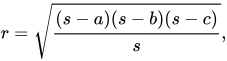
where is the semiperimeter (see Heron's formula).
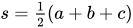
The tangency points of the incircle divide the sides into segments of lengths from , from , and from (see Tangent lines to a circle).[8]


Distances to the vertices
Denote the incenter of as .
The distance from vertex to the incenter is:

Derivation of the formula stated above
Use the Law of sines in the triangle .

We get . We have that .


It follows that .

The equality with the second expression is obtained the same way.
The distances from the incenter to the vertices combined with the lengths of the triangle sides obey the equation[9]

Additionally,[10]

where and are the triangle's circumradius and inradius respectively.

Other properties
The collection of triangle centers may be given the structure of a group under coordinate-wise multiplication of trilinear coordinates; in this group, the incenter forms the identity element.[6]
Incircle and its radius properties
Distances between vertex and nearest touchpoints
The distances from a vertex to the two nearest touchpoints are equal; for example:[11]

Other properties
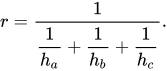
If the altitudes from sides of lengths , , and are , , and , then the inradius is one third the harmonic mean of these altitudes; that is,[12]


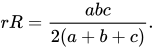
The product of the incircle radius and the circumcircle radius of a triangle with sides , , and is[13]
Some relations among the sides, incircle radius, and circumcircle radius are:[14]

Any line through a triangle that splits both the triangle's area and its perimeter in half goes through the triangle's incenter (the center of its incircle). There are either one, two, or three of these for any given triangle.[15]
The incircle radius is no greater than one-ninth the sum of the altitudes.[16]: 289
The squared distance from the incenter to the circumcenter is given by[17]: 232

![{\displaystyle {\overline {OI}}^{2}=R(R-2r)={\frac {a\,b\,c\,}{a+b+c}}\left[{\frac {a\,b\,c\,}{(a+b-c)\,(a-b+c)\,(-a+b+c)}}-1\right]}](https://wikimedia.org/api/rest_v1/media/math/render/svg/bb15cf80e70231de35ac2c6a332123c6e5ab377a)
and the distance from the incenter to the center of the nine point circle is[17]: 232


The incenter lies in the medial triangle (whose vertices are the midpoints of the sides).[17]: 233, Lemma 1
Relation to area of the triangle
The radius of the incircle is related to the area of the triangle.[18] The ratio of the area of the incircle to the area of the triangle is less than or equal to , with equality holding only for equilateral triangles.[19]

Suppose has an incircle with radius and center . Let be the length of , the length of , and the length of .
Now, the incircle is tangent to at some point , and so is right. Thus, the radius is an altitude of .


Therefore, has base length and height , and so has area .


Similarly, has area and has area .


Since these three triangles decompose , we see that the area is:


and

where is the area of and is its semiperimeter.

For an alternative formula, consider . This is a right-angled triangle with one side equal to and the other side equal to . The same is true for . The large triangle is composed of six such triangles and the total area is:



Gergonne triangle and point

The Gergonne triangle (of ) is defined by connecting the three touchpoints of the incircle on the three sides. The touchpoint opposite is denoted , etc.
This Gergonne triangle, , is also known as the contact triangle or intouch triangle of . Its area is

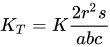
where , , and are the area, radius of the incircle, and semiperimeter of the original triangle, and , , and are the side lengths of the original triangle. This is the same area as that of the extouch triangle.[20]


The three lines , , and intersect in a single point called the Gergonne point, denoted as (or triangle centerX7). The Gergonne point lies in the open orthocentroidal disk punctured at its own center, and can be any point therein.[21]


The Gergonne point of a triangle has a number of properties, including that it is the symmedian point of the Gergonne triangle.[22]
Trilinear coordinates for the vertices of the intouch triangle are given by
![{\displaystyle {\begin{array}{ccccccc}T_{A}&=&0&:&\sec ^{2}{\frac {B}{2}}&:&\sec ^{2}{\frac {C}{2}}\\[2pt]T_{B}&=&\sec ^{2}{\frac {A}{2}}&:&0&:&\sec ^{2}{\frac {C}{2}}\\[2pt]T_{C}&=&\sec ^{2}{\frac {A}{2}}&:&\sec ^{2}{\frac {B}{2}}&:&0.\end{array}}}](https://wikimedia.org/api/rest_v1/media/math/render/svg/9eb7b01b64eee3aa88c531ac3c509a1297330fb5)
Trilinear coordinates for the Gergonne point are given by

or, equivalently, by the law of cosines,

Excircles and excenters
An excircle or escribed circle[2] of the triangle is a circle lying outside the triangle, tangent to one of its sides, and tangent to the extensions of the other two. Every triangle has three distinct excircles, each tangent to one of the triangle's sides.[3]
The center of an excircle is the intersection of the internal bisector of one angle (at vertex , for example) and the external bisectors of the other two. The center of this excircle is called the excenter relative to the vertex , or the excenter of .[3] Because the internal bisector of an angle is perpendicular to its external bisector, it follows that the center of the incircle together with the three excircle centers form an orthocentric system.[5]
Trilinear coordinates of excenters
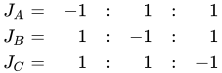
While the incenter of has trilinear coordinates, the excenters have trilinears

Exradii
The radii of the excircles are called the exradii.
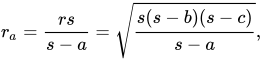
The exradius of the excircle opposite (so touching , centered at ) is[23][24]


- where
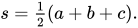
See Heron's formula.
Derivation of exradii formula
Source:[23]
Let the excircle at side touch at side extended at , and let this excircle's radius be and its center be . Then is an altitude of , so has area . By a similar argument, has area and has area . Thus the area of triangle is


- .

So, by symmetry, denoting as the radius of the incircle,
- .

By the Law of Cosines, we have
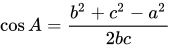
Combining this with the identity , we have


But , and so
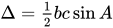
![{\displaystyle {\begin{aligned}\Delta &={\tfrac {1}{4}}{\sqrt {-a^{4}-b^{4}-c^{4}+2a^{2}b^{2}+2b^{2}c^{2}+2a^{2}c^{2}}}\\[5mu]&={\tfrac {1}{4}}{\sqrt {(a+b+c)(-a+b+c)(a-b+c)(a+b-c)}}\\[5mu]&={\sqrt {s(s-a)(s-b)(s-c)}},\end{aligned}}}](https://wikimedia.org/api/rest_v1/media/math/render/svg/e17e05c79be64264f2af1be5ecf1d02950827252)
which is Heron's formula.
Combining this with , we have


Similarly, gives
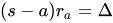
![{\displaystyle {\begin{aligned}&r_{a}^{2}={\frac {s(s-b)(s-c)}{s-a}}\\[4pt]&\implies r_{a}={\sqrt {\frac {s(s-b)(s-c)}{s-a}}}.\end{aligned}}}](https://wikimedia.org/api/rest_v1/media/math/render/svg/ba686fd7b853925eb08592fc095e9bf4b0113bb9)
Other properties
From the formulas above one can see that the excircles are always larger than the incircle and that the largest excircle is the one tangent to the longest side and the smallest excircle is tangent to the shortest side. Further, combining these formulas yields:[25]
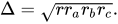
Other excircle properties
The circular hull of the excircles is internally tangent to each of the excircles and is thus an Apollonius circle.[26] The radius of this Apollonius circle is where is the incircle radius and is the semiperimeter of the triangle.[27]

The following relations hold among the inradius , the circumradius , the semiperimeter , and the excircle radii , , :[14]


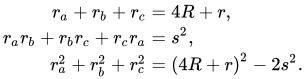
The circle through the centers of the three excircles has radius .[14]

If is the orthocenter of , then[14]


Nagel triangle and Nagel point

The Nagel triangle or extouch triangle of is denoted by the vertices , , and that are the three points where the excircles touch the reference and where is opposite of , etc. This is also known as the extouch triangle of . The circumcircle of the extouch is called the Mandart circle (cf. Mandart inellipse).
The three line segments , and are called the splitters of the triangle; they each bisect the perimeter of the triangle,



The splitters intersect in a single point, the triangle's Nagel point (or triangle centerX8).

Trilinear coordinates for the vertices of the extouch triangle are given by
![{\displaystyle {\begin{array}{ccccccc}T_{A}&=&0&:&\csc ^{2}{\frac {B}{2}}&:&\csc ^{2}{\frac {C}{2}}\\[2pt]T_{B}&=&\csc ^{2}{\frac {A}{2}}&:&0&:&\csc ^{2}{\frac {C}{2}}\\[2pt]T_{C}&=&\csc ^{2}{\frac {A}{2}}&:&\csc ^{2}{\frac {B}{2}}&:&0\end{array}}}](https://wikimedia.org/api/rest_v1/media/math/render/svg/0e8d6799e9e4d5b1aea79376040b10da869f6dcb)
Trilinear coordinates for the Nagel point are given by

or, equivalently, by the Law of Sines,

Barycentric coordinates for the Nagel point are therefore

or equivalently

The Nagel point is the isotomic conjugate of the Gergonne point.
Related constructions
Nine-point circle and Feuerbach point

In geometry, the nine-point circle is a circle that can be constructed for any given triangle. It is so named because it passes through nine significant concyclic points defined from the triangle. These nine points are:[28][29]
- The midpoint of each side of the triangle
- The foot of each altitude
- The midpoint of the line segment from each vertex of the triangle to the orthocenter (where the three altitudes meet; these line segments lie on their respective altitudes).
In 1822, Karl Feuerbach discovered that any triangle's nine-point circle is externally tangent to that triangle's three excircles and internally tangent to its incircle; this result is known as Feuerbach's theorem. He proved that:[30]
- ... the circle which passes through the feet of the altitudes of a triangle is tangent to all four circles which in turn are tangent to the three sides of the triangle ... (Feuerbach 1822)
The triangle center at which the incircle and the nine-point circle touch is called the Feuerbach point.
The incircle may be described as the pedal circle of the incenter. The locus of points whose pedal circles are tangent to the nine-point circle is known as the McCay cubic.
Incentral and excentral triangles
The points of intersection of the interior angle bisectors of with the segments , , and are the vertices of the incentral triangle. Trilinear coordinates for the vertices of the incentral triangle are given by


![{\displaystyle {\begin{array}{ccccccc}A'&=&0&:&1&:&1\\[2pt]B'&=&1&:&0&:&1\\[2pt]C'&=&1&:&1&:&0\end{array}}}](https://wikimedia.org/api/rest_v1/media/math/render/svg/3487b5cc7e4da69320fd2b2eba8694f84f687ceb)
The excentral triangle of a reference triangle has vertices at the centers of the reference triangle's excircles. Its sides are on the external angle bisectors of the reference triangle (see figure at top of page). Trilinear coordinates for the vertices of the excentral triangle are given by
![{\displaystyle {\begin{array}{ccrcrcr}A'&=&-1&:&1&:&1\\[2pt]B'&=&1&:&-1&:&1\\[2pt]C'&=&1&:&1&:&-1\end{array}}}](https://wikimedia.org/api/rest_v1/media/math/render/svg/a64e38d71f55286a611e6ba91d8f7b53ad1c582f)
Equations for four circles
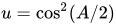
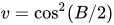
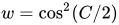
Let be a variable point in trilinear coordinates, and let , , . The four circles described above are given equivalently by either of the two given equations:[31]: 210–215

- Incircle:
- -excircle:
- -excircle:
- -excircle:
![{\displaystyle {\begin{aligned}u^{2}x^{2}+v^{2}y^{2}+w^{2}z^{2}-2vwyz-2wuzx-2uvxy&=0\\[4pt]{\textstyle \pm {\sqrt {x}}\cos {\tfrac {A}{2}}\pm {\sqrt {y{\vphantom {t}}}}\cos {\tfrac {B}{2}}\pm {\sqrt {z}}\cos {\tfrac {C}{2}}}&=0\end{aligned}}}](https://wikimedia.org/api/rest_v1/media/math/render/svg/f2920e55669ed2026e6f5d95a18597f2ffe1a260)
![{\displaystyle {\begin{aligned}u^{2}x^{2}+v^{2}y^{2}+w^{2}z^{2}-2vwyz+2wuzx+2uvxy&=0\\[4pt]{\textstyle \pm {\sqrt {-x}}\cos {\tfrac {A}{2}}\pm {\sqrt {y{\vphantom {t}}}}\cos {\tfrac {B}{2}}\pm {\sqrt {z}}\cos {\tfrac {C}{2}}}&=0\end{aligned}}}](https://wikimedia.org/api/rest_v1/media/math/render/svg/2d03601071be1531bd0bbbe1ed9d44f8c8bba2b1)
![{\displaystyle {\begin{aligned}u^{2}x^{2}+v^{2}y^{2}+w^{2}z^{2}+2vwyz-2wuzx+2uvxy&=0\\[4pt]{\textstyle \pm {\sqrt {x}}\cos {\tfrac {A}{2}}\pm {\sqrt {-y{\vphantom {t}}}}\cos {\tfrac {B}{2}}\pm {\sqrt {z}}\cos {\tfrac {C}{2}}}&=0\end{aligned}}}](https://wikimedia.org/api/rest_v1/media/math/render/svg/5c44c4ca2ef6fee4eca0fa7e8a92d3e400f4266b)
![{\displaystyle {\begin{aligned}u^{2}x^{2}+v^{2}y^{2}+w^{2}z^{2}+2vwyz+2wuzx-2uvxy&=0\\[4pt]{\textstyle \pm {\sqrt {x}}\cos {\tfrac {A}{2}}\pm {\sqrt {y{\vphantom {t}}}}\cos {\tfrac {B}{2}}\pm {\sqrt {-z}}\cos {\tfrac {C}{2}}}&=0\end{aligned}}}](https://wikimedia.org/api/rest_v1/media/math/render/svg/e28aa20f8675ce4680149c36f52266ceca04eeff)
Euler's theorem
Euler's theorem states that in a triangle:

where and are the circumradius and inradius respectively, and is the distance between the circumcenter and the incenter.

For excircles the equation is similar:

where is the radius of one of the excircles, and is the distance between the circumcenter and that excircle's center.[32][33][34]


Generalization to other polygons
Some (but not all) quadrilaterals have an incircle. These are called tangential quadrilaterals. Among their many properties, perhaps the most important is that their two pairs of opposite sides have equal sums. This is called the Pitot theorem.[35]
More generally, a polygon with any number of sides that has an inscribed circle (that is, one that is tangent to each side) is called a tangential polygon.
Generalization to topological triangles
If topological triangles are considered, it is still possible to define an inscribed circle. It is no longer described as tangent to all sides, since the topological triangle might not be differentiable everywhere. Rather, it is defined as a circle whose center has the same minimal distance to each side. It has been proven that all topological triangles have an inscribed circle.[36]
See also
- Circumcenter – Circle that passes through the vertices of a trianglePages displaying short descriptions of redirect targets
- Circumcircle – Circle that passes through the vertices of a triangle
- Circumconic and inconic – Conic section that passes through the vertices of a triangle or is tangent to its sides
- Circumgon – Geometric figure which circumscribes a circle
- Ex-tangential quadrilateral – Convex 4-sided polygon whose sidelines are all tangent to an outside circle
- Harcourt's theorem – Area of a triangle from its sides and vertex distances to any line tangent to its incircle
- Incenter–excenter lemma – Theorem about inscribed and circumscribed circles
- Inscribed sphere – Sphere tangent to every face of a polyhedron
- Power of a point – Relative distance of a point from a circle
- Steiner inellipse – Unique ellipse tangent to all 3 midpoints of a given triangle's sides
- Tangential quadrilateral – Polygon whose four sides all touch a circle
- Triangle conic
Notes
- ^Kay (1969, p. 140)
- ^ abAltshiller-Court (1925, p. 74)
- ^ abcdeAltshiller-Court (1925, p. 73)
- ^Kay (1969, p. 117)
- ^ abJohnson 1929, p. 182.
- ^ abEncyclopedia of Triangle CentersArchived 2012-04-19 at the Wayback Machine, accessed 2014-10-28.
- ^Kay (1969, p. 201)
- ^Chu, Thomas, The Pentagon, Spring 2005, p. 45, problem 584.
- ^Allaire, Patricia R.; Zhou, Junmin; Yao, Haishen (March 2012), "Proving a nineteenth century ellipse identity", Mathematical Gazette, 96: 161–165, doi:10.1017/S0025557200004277, S2CID 124176398.
- ^Altshiller-Court, Nathan (1980), College Geometry, Dover Publications. #84, p. 121.
- ^Mathematical Gazette, July 2003, 323-324.
- ^Kay (1969, p. 203)
- ^Johnson 1929, p. 189, #298(d).
- ^ abcdBell, Amy. ""Hansen's right triangle theorem, its converse and a generalization", Forum Geometricorum 6, 2006, 335–342"(PDF). Archived from the original(PDF) on 2021-08-31. Retrieved 2012-05-05.
- ^Kodokostas, Dimitrios, "Triangle Equalizers", Mathematics Magazine 83, April 2010, pp. 141-146.
- ^Posamentier, Alfred S., and Lehmann, Ingmar. The Secrets of Triangles, Prometheus Books, 2012.
- ^ abcFranzsen, William N. (2011). "The distance from the incenter to the Euler line"(PDF). Forum Geometricorum. 11: 231–236. MR 2877263. Archived from the original(PDF) on 2020-12-05. Retrieved 2012-05-09..
- ^Coxeter, H.S.M. "Introduction to Geometry 2nd ed. Wiley, 1961.
- ^Minda, D., and Phelps, S., "Triangles, ellipses, and cubic polynomials", American Mathematical Monthly 115, October 2008, 679-689: Theorem 4.1.
- ^ Weisstein, Eric W. "Contact Triangle." From MathWorld--A Wolfram Web Resource. https://mathworld.wolfram.com/ContactTriangle.html
- ^Christopher J. Bradley and Geoff C. Smith, "The locations of triangle centers", Forum Geometricorum 6 (2006), 57–70. http://forumgeom.fau.edu/FG2006volume6/FG200607index.htmlArchived 2016-03-04 at the Wayback Machine
- ^Dekov, Deko (2009). "Computer-generated Mathematics : The Gergonne Point"(PDF). Journal of Computer-generated Euclidean Geometry. 1: 1–14. Archived from the original(PDF) on 2010-11-05.
- ^ abAltshiller-Court (1925, p. 79)
- ^Kay (1969, p. 202)
- ^Baker, Marcus, "A collection of formulae for the area of a plane triangle", Annals of Mathematics, part 1 in vol. 1(6), January 1885, 134-138. (See also part 2 in vol. 2(1), September 1885, 11-18.)
- ^"Grinberg, Darij, and Yiu, Paul, "The Apollonius Circle as a Tucker Circle", Forum Geometricorum 2, 2002: pp. 175-182"(PDF). Archived from the original(PDF) on 2023-06-25. Retrieved 2012-05-02.
- ^"Stevanovi´c, Milorad R., "The Apollonius circle and related triangle centers", Forum Geometricorum 3, 2003, 187-195"(PDF). Archived from the original(PDF) on 2022-10-06. Retrieved 2012-05-03.
- ^Altshiller-Court (1925, pp. 103–110)
- ^Kay (1969, pp. 18, 245)
- ^Feuerbach, Karl Wilhelm; Buzengeiger, Carl Heribert Ignatz (1822), Eigenschaften einiger merkwürdigen Punkte des geradlinigen Dreiecks und mehrerer durch sie bestimmten Linien und Figuren. Eine analytisch-trigonometrische Abhandlung (in German) (Monograph ed.), Nürnberg: Wiessner.
- ^Whitworth, William Allen. Trilinear Coordinates and Other Methods of Modern Analytical Geometry of Two Dimensions, Forgotten Books, 2012 (orig. Deighton, Bell, and Co., 1866). https://www.forgottenbooks.com/en/search?q=%22Trilinear+coordinates%22
- ^Nelson, Roger, "Euler's triangle inequality via proof without words", Mathematics Magazine 81(1), February 2008, 58-61.
- ^Johnson 1929, p. 187.
- ^"Emelyanov, Lev, and Emelyanova, Tatiana. "Euler's formula and Poncelet's porism", Forum Geometricorum 1, 2001: pp. 137–140"(PDF). Archived from the original(PDF) on 2023-01-17. Retrieved 2012-05-02.
- ^Josefsson (2011, See in particular pp. 65–66.)
- ^Al-Ajrawi, Ezzaddin (20 October 2024). "Inscribing Spheres in Topologically Embedded Simplices". The American Mathematical Monthly. 131 (9): 806–813. doi:10.1080/00029890.2024.2380233. ISSN 0002-9890.
References
- Altshiller-Court, Nathan (1925), College Geometry: An Introduction to the Modern Geometry of the Triangle and the Circle (2nd ed.), New York: Barnes & Noble, LCCN 52013504
- Johnson, Roger A. (1929), "X. Inscribed and Escribed Circles", Modern Geometry, Houghton Mifflin, pp. 182–194
- Josefsson, Martin (2011), "More characterizations of tangential quadrilaterals"(PDF), Forum Geometricorum, 11: 65–82, MR 2877281, archived from the original(PDF) on 2016-03-04, retrieved 2023-03-14
- Kay, David C. (1969), College Geometry, New York: Holt, Rinehart, and Winston, LCCN 69012075
- Kimberling, Clark (1998). "Triangle Centers and Central Triangles". Congressus Numerantium (129): i–xxv, 1–295.
- Kiss, Sándor (2006). "The Orthic-of-Intouch and Intouch-of-Orthic Triangles". Forum Geometricorum (6): 171–177.
External links
- Derivation of formula for radius of incircle of a triangle, MATHalino
- Weisstein, Eric W."Incircle". MathWorld.
Interactive
- Triangle incenter; Triangle incircle; Incircle of a regular polygon (with interactive animations)
- Constructing a triangle's incenter / incircle with compass and straightedge An interactive animated demonstration
- Equal Incircles Theorem at cut-the-knot
- Five Incircles Theorem at cut-the-knot
- Pairs of Incircles in a Quadrilateral at cut-the-knot
- An interactive Java applet for the incenter
