Khvarenah


| Part of a series on |
| Zoroastrianism |
|---|
 |
 Religion portal Religion portal |
Khvarenah,[a] in New PersianFarr, is a mystical radiant force emanating from men chosen by God that confers upon them both the right to rule and the cosmic capacity to do so justly.
Farr is understood as a real presence: an invisible yet palpable aura of righteousness that legitimizes rule, enables victory, and proves divine favor. A king possesses the Farr when his rule aligns with asha (cosmic truth/order); he loses it the moment druj ('the Lie', more generally, pride, cruelty, or falsehood) enter his heart.[1] It is one of the most ancient concepts in Iranian civilization, attested long before the establishment of the First Persian Empire;
The Khvarenah of the Kiani,Khvarenah that divinities and mortals alike should strive for.
— Yasht 19, Avesta; holy scripture of Zoroastrianism
The idea continues to dominate Iranian debates about just leadership up to the present day. While the 1979 Revolution nominally positioned itself against absolute monarchy, supporters of Khomeini "drew upon the concept of Farr. The Ayatollah specifically relied on the Iranian penchant for a supreme monarch endowed with a divine right to rule when he converted Iran’s Islamic clerics into a new monarchical dynasty, with absolute power."[2]
Etymology and related terms
Avestan khvarenah is probably[3] derived from Proto-Avestan *hvar "to shine", nominalized with the -nah suffix. Proto-Avestan *hvar is in turn related to Old Indic svar with the same meaning, and together descending from Proto-Indo-Iranian *súHr̥ "to shine", ultimately from Proto-Indo-European*sóhr "to shine". Other proposals suggest a linguistic relationship with Avestan xᵛar- "to eat".
Of the numerous Iranian languages in which the word is attested, the initial xᵛ- is evident only as Avestan khvar(e)nah and as Zoroastrian Middle Persiankhwarrah, from which New Persiankhorra then derives. In other Iranian dialects the word has an f- form, for instance as Median and Old Persianfarnah-, from which Middle- and New Persian farr(ah) and adjectival farrokh derive. For many decades, the f- form was believed to represent a specific Median sound-law change of proto-Iranian xᵛ- to f-. The hypothesis has since been shown to be untenable, and the proto-Iranian form is today reconstructed as *hu̯,[4] preserved in Avestan as xᵛ- and dissimilated as f- in other Iranian dialects.
Pre-Christian Georgian kings of the Pharnavazid dynasty were divinely assigned kxwarrah and its loss usually led to the monarch's imminent death or overthrow in Georgian kingship. Many of the monarchs had names based on this etymological root like Pharnavaz, Pharnajom and Pharasmanes.[5] The word was borrowed into the Georgian language as p'ar[n].[6][7]
In the Iranian languages of the Middle Period, the word is also attested as Bactrianfar(r)o, Khotanesepharra, Parthianfarh, Sogdianf(a)rn, and Osseticfarnæ and farn, though in these languages the word does not necessarily signify "glory" or "fortune": In Buddhism, Sogdian farn and Khotanese pharra signified a "position of a Buddha," that is, with "dignity" or "high position." This meaning subsequently passed into Tocharian. In Manicheanism, Sogdian frn signified "luck" and was a designator of the "first luminary". Manichean Parthian farh again signifies "glory." In Scytho-Sarmatian and Alan culture, Digor-Osseticfarnæ and Iron-Osseticfarn signified "peace, happiness, abundance, fortune."
The term also appears as a borrowing in Armenianpʿarkʿ, but with a greater range of meaning than in Iranian languages.
In scripture
Bisyllabic khvarenah is only attested once in the Gathas, the oldest hymns of Zoroastrianism and considered to have been composed by the prophet himself. The one instance of Gathic khvarenah occurs in Yasna 51.18, where the word appears to mean royal glory. The primary source of information on khvarenah comes from the Yashts, the younger Avesta's collection of 21 hymns dedicated to individual divinities.
Two distinct forms of khvarenah are discernible in Yasht 19:[8]
- kavam khvarenah (kauuaēm xᵛarənah), the fortune of the kavis, the Kayanian kings
- akhvaretem khvarenah (axᵛarətəm xᵛarənah), glory that both divinities and mortals should strive for.
Similarly Yasht 18, although nominally dedicated to Arshtat, is a short 9-verse ode to a third variant of khvarenah; the Iraniankhvarenah (airiianəm xᵛarənah) that is created by Ahura Mazda and that is "full of milk and pastures," vanquishes the daevas and the Un-Iranians.
Yasht 19, which is nominally dedicated to Zam "Earth", further typifies khvarenah as a yazata,[9] that is, itself "worthy of worship." The same hymn includes a list of divinities and mortals who perform their duties due to the power of khvarenah. Among these are the mythological Kayanian kings – the kavis (kauuis) – who are rulers through the grace of, and empowered by, khvarenah.
Khvarenah is however also glory held by divinities: Ahura Mazda has it (19.9-13), the Amesha Spentas have it (19.14-20), the other yazatas as well (19.21-24). Yima loses it thrice, in turn to Mithra, Thraetaona and Keresaspa. Khvarenah assumes the shape of a bird when leaving Yima. (19.35-36, 19.82)
According to Yasht 13.14, the waters flow, the plants spring forth, and the winds blow through the khvarenah of the Fravashis. In Yasna 68.11, the waters of Aredvi Sura are invoked to bestow radiance and glory. Khvarenah is also associated with the waters in other texts; with the world-sea Vourukasha in Yasht 19.51 and 19.56-57; with the Helmand river in Yasht 19.66ff. It is also identified with Haoma, together with which it plays a seminal role in the legend of the birth of Zoroaster. In these passages, khvarenah has a seminal and germinal implication, being both fiery fluid and living seed.
In Yasna 60.2, the family priest is seen to request joy and blessings for the righteous, good nature, truth, prosperity, power, and glory for the house in which he offers prayers. The hymn to Mithra speaks of the divinity as the "dispenser of khvarenah" (Yasht 10.16, 10.128, 10.141). Other texts describe Mithra as "most endowed with glory" (Yasht 19.35, Vendidad 19.15).
In Yasht 19.46, Akem Manah, the demon of "evil purpose" attempts (but fails) to seize khvarenah. The Iranian khvarenah and Dahman, the hypostasis of prayer, render Bushyasta - the demoness of "sloth" – powerless (Yasht 10.97, 13.4).
At the final renovation of the world, the royal glory will follow the Saoshyants (Yasht 19.89).
In tradition
In the 9th-12th century texts of Zoroastrian tradition khvarenah (→ Middle Persiankhwarrah) is a spiritual force that exists before the creation of the tan-gohr, the mortal body (Bundahishn II.7ff, Zadspram 3.75). In these later texts, the glory appears to be acquirable through learning and knowledge (Bundahishn II.9ff).
Khwarrah continues to be associated with astral bodies (Dadistan-i Denig I.25, I.35-36), but its primary function lies in its role as the divine glory of kings, a continuation of the Avestan notion of the kavam khvarenah. New in tradition is an identification of khwarrah with religion, as in "the great khwarrah-bestowing force of the pure religion" (Dadistan-i Denig I.36)
The Karnamag-i Artaxshir-i Papakan, a collection of hagiographic legends related to Ardashir, the founder of the Sasanian Empire, includes (4.11.16 and 4.11.22-23) a tale in which Ardashir – who at that point in the story is still a vassal of the Arsacid Parthians – escapes from the court of the last Arsacid king, Ardavan. In the story, Ardashir makes off with much Ardavan's treasure, as well as Ardavan's favourite concubine, and is being chased by Ardavan and his troops. On the road, Ardavan and his contingent are overtaken by an enormous ram, which is also following Ardashir. Ardavan's religious advisors explain that the ram is the manifestation of the khwarrah of the ancient Iranian kings, which is leaving Ardavan and the Parthians in favor of a new emperor.
The representation of khwarrah as a ram reappears on Sasanian seals and as an ornament in Sasanian architecture. Khwarrah also appears in Sassanian crowns as a bird with a pearl in its beak. Depictions of khwarrah as a bird are allusions to the Avestan myth of Yasht 19.35-36, 19.82 in which khvarenah takes the shape of a bird as it leaves Yima (MP: Jamshid), a metamorphosis similar to that of the yazata of victory, Verethragna.[10] The crown as a repository of khwarrah is also attested in the Paikuli inscription of Narseh, which describes the punishment meted out to an individual who has been "driven by Ahriman and the devs" to steal khwarrah by placing the crown on the head of a false ruler.[11] Another ubiquitous motif in Sassanian art is the symbol of a boar, which is a representation of the protection of the yazataVerethragna (MP: Wahram) given to rulers that hold khwarrah.
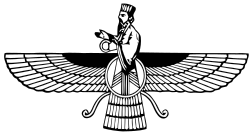
The ring of kingship that appears in Sassanian investiture reliefs is often identified as representing khwarrah.[12] This is also the case for the ring held by the bearded figure in the Achaemenid winged sun-disk symbol that is traditionally considered to represent a fravashi (MP: fravahr). The Achaemenid winged sun-disk has in its entirety also been occasionally been interpreted as a representation of khvarenah.[12]
That khwarrah – in addition to its significance as "royal fortune" – also signified "fortune" in a general sense is demonstrated by the use of an Aramaic ideogram GDE in the Middle Persian texts of the Sasanian and post-Sasanian periods.[13] The custom of using this Aramic ideogram to represent khvarenah is probably inherited from Achaemenid times.[13]
Syncretic influences
"The fundamental motif of Iranian kingship, a hereditary dynastic charisma [...], which, could however be lost, was at the root of ideas that were widespread in the Hellenistic and Roman periods."[13] For example, as the tyche basileos, fortuna regia, the saving grace (luck) of fortune of a king; and probably also the royal farrah in the tyche of the various Hellenistic rulers of the Seleucid and Arsacid periods as well as of the Kushan kings.[13]
Because the concepts of khvarenah/khwarrah and Aramaic gd(y) circulated in the same areas and have many characteristics in common, it is possible that the Mesopotamian concept influenced the Zoroastrian one.[10] On the other hand, khvarenah may also be a facet of Zoroastrianism's Indo-Iranian cultural inheritance since khvarenah appears to have a parallel in Indic tejas, in which kingship is likewise associated with the bright splendor and power of light and fire.[10]
The concept of the royal khwarrah survived the 7th century downfall of the Sasanian Empire, and remained a central motif (for instance as the farr-e elahi) in the culture, philosophy and epics of Islamic Iran.[13]
In culture
- The 1995 Ossetian film "ФАРН" (en:Farn) produced for North Ossetian Television by Murat Dzhusoyty.[14]
See also
External links
Notes
References
- Citations
- ^Skjærvø, Prods Oktor. "JAMŠID i. Myth of Jamšid". Encyclopaedia Iranica. Retrieved 4 December 2025.
In Yašt 19.30-34, the wanderings of the Fortune of the kauuis are described and, in particular, how it left Yima in the shape of the Vārəγna bird when he uttered a "deceiving word" (druj/draogəm vācim).
- ^Mackenthun, Tamara C. (2009). Continuity in Iranian Leadership Legitimization: Farr-i Izadi, Shi'ism, and Vilayet-i Faqih(PDF). Boise State University. Retrieved 4 December 2025.
{{cite book}}: CS1 maint: location missing publisher (link) - ^Gnoli 1999, p. 313.
- ^Gnoli 1996, p. 171.
- ^Rapp, S. H. Jr. (2016) The Sasanian World Through Georgian Eyes, Caucasia and the Iranian Commonwealth in Late Antique Georgian Literature, Sam Houston State University, US, Routledge, ISBN 978-1-4724-2552-2; location: 6731
- ^Canepa, Matthew P. (2018). The Iranian Expanse: Transforming Royal Identity through Architecture, Landscape, and the Built Environment, 550 BCE–642 CE. University of California Press. p. 114. ISBN 978-0-520-96436-5.
- ^Rapp, Stephen H. Jr (2014). The Sasanian World through Georgian Eyes: Caucasia and the Iranian Commonwealth in Late Antique Georgian Literature. Routledge. pp. 151, 228. ISBN 978-1-4724-2552-2.
- ^Lubotsky 1998, p. 480.
- ^Boyce 1975, pp. 66–68.
- ^ abcGnoli 1999, p. 316.
- ^de Jong 2004, p. 364.
- ^ abcf.Gnoli 1999, p. 316.
- ^ abcdeGnoli 1999, p. 315.
- ^"ФАРН (1995)", www.kino-teatr.ru
- Bibliography
- Boyce, Mary (1975), History of Zoroastrianism, vol. 1, Leiden: Brill.
- de Jong, Albert (2004), "Sub Specie Maiestatis: Reflections on Sasanian Court Rituals", in Stausberg, Michael (ed.), Zoroastrian Rituals in Context, Numen 102, Leiden: Brill, pp. 345–365.
- Gnoli, Gherardo (1996), "Über das iranische *hu̯arnah-: lautliche, morphologische und etymologische Probleme. Zum Stand der Forschung", Altorientalische Forschungen, 23: 171–180, doi:10.1524/aofo.1996.23.1.171, S2CID 163727744.
- Gnoli, Gherardo (1999), "Farr(ah)", Encyclopaedia Iranica, vol. 9, Costa Mesa: Mazda, pp. 312–316, archived from the original on 2008-05-27, retrieved 2007-08-04.
- Lubotsky, Alexander (1998), "Avestan xᵛarənah-: the etymology and concept", in Meid, W. (ed.), Sprache und Kultur. Akten der X. Fachtagung der Indogermanischen Gesellschaft Innsbruck, 22.-28. September 1996, Innsbruck: IBS, pp. 479–488.
