Parinda (transl. Bird) is a 1989 Indian Hindi-language crime thriller film directed, produced and distributed by Vidhu Vinod Chopra. The film stars Jackie Shroff, Anil Kapoor, Nana Patekar and Madhuri Dixit. The story and scenario were written by Chopra, while Shiv Kumar Subramaniam and Imtiyaz Husain wrote the screenplay and dialogues, respectively. R. D. Burman composed the music and Khurshid Hallauri wrote the lyrics. Binod Pradhan served as the film's cinematographer and Renu Saluja was its editor.Parinda's story is loosely inspired by Marlon Brando starrer On the Waterfront. Parinda follows Kishan (Shroff), who works for the underworld chieftain Anna (Patekar). Kishan's brother Karan (Kapoor) returns home after completing his studies in the United States. The two brothers are caught on different sides of a gang war after Karan decides to avenge his friend's death by Anna. (Full article...)
Image 6
Greatest extent of the Chalukya Empire
The Chalukya dynasty (Kannada:[tʃaːlukjɐ]) was a Classical Indian dynasty that ruled large parts of southern and central India between the 6th and the 12th centuries. During this period, they ruled as three related yet individual dynasties. The earliest dynasty, known as the "Badami Chalukyas", ruled from Vatapi (modern Badami) from the middle of the 6th century. The Badami Chalukyas began to assert their independence at the decline of the Kadamba kingdom of Banavasi and rapidly rose to prominence during the reign of Pulakeshin II. After the death of Pulakeshin II, the Eastern Chalukyas became an independent kingdom in the eastern Deccan. They ruled from Vengi until about the 11th century. In the western Deccan, the rise of the Rashtrakutas in the middle of the 8th century eclipsed the Chalukyas of Badami before being revived by their descendants, the Western Chalukyas, in the late 10th century. These Western Chalukyas ruled from Kalyani (modern Basavakalyan) until the end of the 12th century.The rule of the Chalukyas marks an important milestone in the history of South India and a golden age in the history of Karnataka. The political atmosphere in South India shifted from smaller kingdoms to large empires with the ascendancy of Badami Chalukyas. A Southern India-based kingdom took control and consolidated the entire region between the Kaveri and the Narmada rivers. The rise of this empire saw the birth of efficient administration, overseas trade and commerce and the development of new style of architecture called "Chalukyan architecture". Kannada literature, which had enjoyed royal support in the 9th century Rashtrakuta court found eager patronage from the Western Chalukyas in the Jain and Brahminical traditions. The 11th century saw the patronage of Telugu literature under the Eastern Chalukyas. (Full article...)
Territory of the Western Chalukyas (c. 1100 CE) in India (modern boundaries shown) and the empire's capital, Kalyani, in the modern Bidar district, Karnataka state, IndiaA large body of Western Chalukya literature in the Kannada language was produced during the reign of the Western Chalukya Empire (973–1200 CE) in what is now southern India. This dynasty, which ruled most of the western Deccan in South India, is sometimes called the Kalyani Chalukya dynasty after its royal capital at Kalyani (now Basavakalyan), and sometimes called the Later Chalukya dynasty for its theoretical relationship to the 6th-century Chalukya dynasty of Badami. For a brief period (1162–1183), the Kalachuris of Kalyani, a dynasty of kings who had earlier migrated to the Karnataka region from central India and served as vassals for several generations, exploited the growing weakness of their overlords and annexed the Kalyani. Around 1183, the last Chalukya scion, Someshvara IV, overthrew the Kalachuris to regain control of the royal city. But his efforts were in vain, as other prominent Chalukya vassals in the Deccan, the Hoysalas, the Kakatiyas and the Seunas destroyed the remnants of the Chalukya power.Kannada literature from this period is usually categorised into the linguistic phase called Old-Kannada. It constituted the bulk of the Chalukya court's textual production and pertained mostly to writings relating to the socio-religious development of the Jain faith. The earliest well-known writers belonging to the Shaiva faith are also from this period. Under the patronage of Kalachuri King Bijjala II, whose prime minister was the well-known Kannada poet and social reformerBasavanna, a native form of poetic literature called Vachana literature (lit "utterance", "saying" or "sentence") proliferated. The beginnings of the Vachana poetic tradition in the Kannada-speaking region trace back to the early 11th century. Kannada literature written in the champumetre, composed of prose and verse, was popularised by the Chalukyan court poets. However, with the advent of the Veerashaiva (lit, "brave devotees of the god Shiva") religious movement in the mid-12th century, poets favoured the native tripadi (three-line verse composed of eleven ganas or prosodic units), hadugabba (song-poem) and free verse metres for their poems. (Full article...)
Image 9
Nyctibatrachus major, the Malabar night frog, large wrinkled frog, or Boulenger's narrow-eyed frog, is a species of frog in the familyNyctibatrachidae, commonly known as the robust frogs. It was described in 1882 by the zoologist George Albert Boulenger, and is the type species of the genusNyctibatrachus. It is a large frog for its genus, with an adult snout–vent length of 31.5–52.0 mm (1.24–2.05 in) for males and 43.7–54.2 mm (1.72–2.13 in) for females. It is mainly brownish to greyish in colour, with a dark greyish-brown upperside, a greyish-white underside, and light grey sides. It also has a variety of grey or brown markings. When preserved in ethanol, it is mostly greyish-brown to grey, with whitish sides. Sexes can be told apart by the presence of the femoral glands (bulbous glands near the inner thigh) in males.The species is endemic to the Western Ghats mountain range of India, where it is found in Kerala, Tamil Nadu, and Karnataka. Adults inhabit fast-moving forest streams at elevations of up to 900 m (3,000 ft) and have highly specific habitat requirements. Adults are mostly found in or near water and are nocturnal; subadults can be found during both the night and day. Its diet mainly consists of other frogs and insect larvae. Over a period of several days or weeks, females lay multiple small clutches of eggs on leaves and rocks overhanging water; tadpoles drop into the water below on hatching. The species is currently classified as being endangered on the IUCN Red List owing to its small and severely fragmented range and ongoing habitat degradation. Threats to the species include habitat loss, increased human presence near the streams it inhabits, and possibly nitrate pollution caused by fertiliser overuse. (Full article...)
Margaret Alice MurrayFSA ScotFRAI (13 July 1863 – 13 November 1963) was an Anglo-Indian Egyptologist, archaeologist, anthropologist, historian, and folklorist. The first woman to be appointed as a lecturer in archaeology in the United Kingdom, she worked at University College London (UCL) from 1898 to 1935. She was president of the Folklore Society from 1953 to 1955, and published widely.Born to a wealthy middle-class English family in Calcutta, British India, Murray divided her youth between India, Britain, and Germany, training as both a nurse and a social worker. Moving to London, in 1894 she began studying Egyptology at UCL, developing a friendship with department head Flinders Petrie, who encouraged her early academic publications and appointed her junior lecturer in 1898. In 1902–1903, she took part in Petrie's excavations at Abydos, Egypt, there discovering the Osireion temple, and the following season investigated the Saqqara cemetery, both of which established her reputation in Egyptology. Supplementing her UCL wage by giving public classes and lectures at the British Museum and Manchester Museum, it was at the latter in 1908 that she led the unwrapping of Khnum-nakht, one of the mummies recovered from the Tomb of two Brothers – the first time that a woman had publicly unwrapped a mummy. Recognising that British Egyptomania reflected the existence of widespread public interest in Ancient Egypt, Murray wrote several books on Egyptology targeted at a general audience. (Full article...)
Image 12
Chandralekha (also spelt Chandraleka) is a 1948 Indian historical and adventure film produced and directed by S. S. Vasan of Gemini Studios. Starring T. R. Rajakumari, M. K. Radha and Ranjan, the film follows two brothers (Veerasimhan and Sasankan) who fight over ruling their father's kingdom and marrying a village dancer, Chandralekha.Development began during the early 1940s when, after two successive box-office hits, Vasan announced that his next film would be entitled Chandralekha. However, when he launched an advertising campaign for the film he only had the name of the heroine from a storyline he had rejected. Veppathur Kittoo (one of Vasan's storyboard artists) developed a story based on a chapter of George W. M. Reynolds' novel, Robert Macaire: or, The French bandit in England. Original director T. G. Raghavachari left the film more than halfway through because of disagreements with Vasan, who took over in his directorial debut. (Full article...)
Image 13
Gemini (/dʒɛminɪ/) is a 2002 Indian Tamil-language crime action film written and directed by Saran with Pon Elango as assistant director. This film was produced by AVM Productions. The film stars Vikram in the main lead role, while Kiran Rathod, Murali, Kalabhavan Mani, Vinu Chakravarthy, Manorama and Thennavan portray significant roles. Based on gang wars in Chennai, the film delves into the lives of outlaws and the roles the police and society play in their rehabilitation and acceptance.In early 2001, rival gangsters "Vellai" Ravi and Chera reformed themselves with the patronage of a police officer. Saran was inspired by this incident and scripted a story based on it. Production began shortly afterwards in December the same year and was completed by March 2002. The film was shot mainly at the AVM Studios in Chennai, while two song sequences were filmed in Switzerland. The film had cinematography by A. Venkatesh and editing by Suresh Urs while the soundtrack was scored by Bharadwaj. (Full article...)
Keechaka Vadham (transl. The Extermination of Keechaka) is an Indiansilent film produced, directed, filmed and edited by R. Nataraja Mudaliar. The first film to have been made in South India, it was shot in five weeks at Nataraja Mudaliar's production house, India Film Company. As the members of the cast were Tamils, Keechaka Vadham is considered to be the first Tamil film. No print of it is known to have survived, making it a lost film.The screenplay, written by C. Rangavadivelu, is based on an episode from the Virata Parva segment of the Hindu epicMahabharata, focusing on Keechaka's attempts to woo Draupadi. The film stars Raju Mudaliar and Jeevarathnam as the central characters. (Full article...)
In Hindu mythology, Ahalya (Sanskrit: अहल्या, IAST: Ahalyā) also spelt as Ahilya, is the wife of the sage Gautama Maharishi. Many Hindu scriptures describe her legend of seduction by the king of the godsIndra, her husband's curse for her infidelity, and her liberation from the curse by the god Rama.Created by the god Brahma as the most beautiful woman, Ahalya was married to the much older Gautama. In the earliest full narrative, when Indra comes disguised as her husband, Ahalya sees through his disguise but nevertheless accepts his advances. Later sources often absolve her of all guilt, describing how she falls prey to Indra's trickery. In all narratives, Ahalya and Indra are cursed by Gautama. The curse varies from text to text, but almost all versions describe Rama as the eventual agent of her liberation and redemption. Although early texts describe how Ahalya must atone by undergoing severe penance while remaining invisible to the world and how she is purified by offering Rama hospitality, in the popular retelling developed over time, Ahalya is cursed to become a stone and regains her human form after she is brushed by Rama's foot. (Full article...)
Ganesha or Ganesh (Sanskrit: गणेश, IAST: Gaṇeśa, IPA:[ɡɐˈɳeːɕɐ]), also known as Ganapati, Vinayaka and Pillaiyar, is one of the best-known and most revered and worshipped deities in the Hindu pantheon and is the Supreme God in the Ganapatya sect. His depictions are found throughout India. Hindu denominations worship him regardless of affiliations. Ganesha also holds the Title of "Pratham Pujya" (the god to be worshipped initially before the worship of any other Deity). Devotion to Ganesha is widely diffused and extends to Jains and Buddhists and beyond India.Although Ganesha has many attributes, he is readily identified by his elephant head and four arms. He is widely revered, more specifically, as the remover of obstacles and bringer of good luck; the patron of arts and sciences; and the deva of logic, intellect, and wisdom. As the god of beginnings, he is honoured at the start of rites and ceremonies. Ganesha is also invoked during writing sessions as a patron of letters and learning. Several texts relate anecdotes associated with his birth and exploits. (Full article...)
Image 20
Cyclone 04B at peak intensity near landfall
The 2000 Sri Lanka cyclone (IMD designation: BOB 06 JTWC designation: 04B) was the strongest tropical cyclone to strike Sri Lanka since 1978. The fourth tropical storm and the second severe cyclonic storm of the 2000 North Indian Ocean cyclone season, it developed from an area of disturbed weather on December 25, 2000. It moved westward, and quickly strengthened under favorable conditions to reach top wind speeds of 75 mph (121 km/h). The cyclone hit eastern Sri Lanka at peak strength, then weakened slightly while crossing the island before making landfall over southern India on December 28. The storm degenerated into a remnant low later that day, before merging with another trough on the next day.The storm was the first cyclone over Sri Lanka with winds of at least hurricane strength since a cyclone of 1978 hit the island in the 1978 season, as well as the first tropical storm to hit the island since 1992. The storm was also the first December tropical cyclone of hurricane intensity in the Bay of Bengal since 1996. It produced heavy rainfall and strong winds, damaging or destroying tens of thousands of houses and leaving up to 500,000 homeless. At least nine people died as a result of the cyclone. (Full article...)
Image 21
Collins on an 1899 postcard
Arthur Edward Jeune Collins (18 August 1885 – 11 November 1914) was an English cricketer and soldier. He held, for 116 years, the record of highest score in cricket: as a 13-year-old schoolboy, he scored 628 not out over four afternoons in June 1899. Collins's record-making innings drew a large crowd and increasing media interest; spectators at the Old Cliftonian match being played nearby were drawn away to watch the junior school house cricket match in which Collins was playing. Despite this achievement, Collins never played first-class cricket. Collins's 628 not out stood as the record score until January 2016 when an Indian boy, Pranav Dhanawade, scored 1009 in a single innings.Collins joined the British Army in 1902 and studied at the Royal Military Academy, Woolwich, before becoming an officer in the Royal Engineers. He served in France during the First World War, where he was killed in action in 1914 during the First Battle of Ypres. Collins had been mentioned in despatches and also represented the Royal Military Academy at cricket and rugby union. (Full article...)
Image 22
Kapadia in 2018
Dimple Kapadia (born 8 June 1957) is an Indian actress predominantly appearing in Hindi films. Born and raised in Mumbai by wealthy parents, she aspired to become an actress from a young age and received her first opportunity through her father's efforts to launch her in the film industry. She was discovered at age 14 by the filmmaker Raj Kapoor, who cast her in the title role of his teen romance Bobby (1973), which opened to major commercial success and gained her wide public recognition. Shortly before the film's release in 1973, she married the actor Rajesh Khanna and quit acting. Their daughters, Twinkle and Rinke Khanna, both briefly worked as actresses in their youth. Kapadia returned to films in 1984, two years after her separation from Khanna. Her comeback film Saagar, which was released a year later, revived her career. Both Bobby and Saagar won her Filmfare Awards for Best Actress. Through her work over the next decade, she established herself as one of Hindi cinema's leading actresses.While her initial roles often relied on her perceived beauty and sex appeal, Kapadia was keen to challenge herself and expand her range. She was among the first actresses who starred in women-centred Hindi action films but found greater favour with critics when she took on more dramatic roles in both mainstream and neorealist parallel cinema. Appearing in films ranging from marital dramas to literary adaptations, she played troubled women sometimes deemed reflective of her personal experience, and received acclaim for her performances in Kaash (1987), Drishti (1990), Lekin... (1991), and Rudaali (1993). For her role as a professional mourner in Rudaali, she won the National Film Award for Best Actress and a Filmfare Critics Award. She also had supporting roles in the crime dramas Prahaar (1991), Angaar (1992), Gardish (1993) and Krantiveer (1994), the latter securing her another Filmfare Award. (Full article...)
Image 23
Kapoor in 2017
Sonam Kapoor Ahuja (pronounced[soːnəmkəˈpuːr]; born 9 June 1985) is an Indian actress who works in Hindi films. She has received several awards, including a National Film Award and a Filmfare Award. Kapoor appeared in Forbes India'sCelebrity 100 list from 2012 to 2016.The daughter of actor Anil Kapoor, Sonam began her career as an assistant director on filmmaker Sanjay Leela Bhansali's 2005 film Black. She made her acting debut in Bhansali's romantic drama Saawariya (2007), a box office flop, and had her first commercial success with the romantic comedy I Hate Luv Storys (2010). This was followed by a series of commercial failures and repetitive roles, which garnered her negative reviews. The 2013 box office hit Raanjhanaa marked a turning point in Kapoor's career, garnering her praise and Best Actress nominations at several award ceremonies. (Full article...)
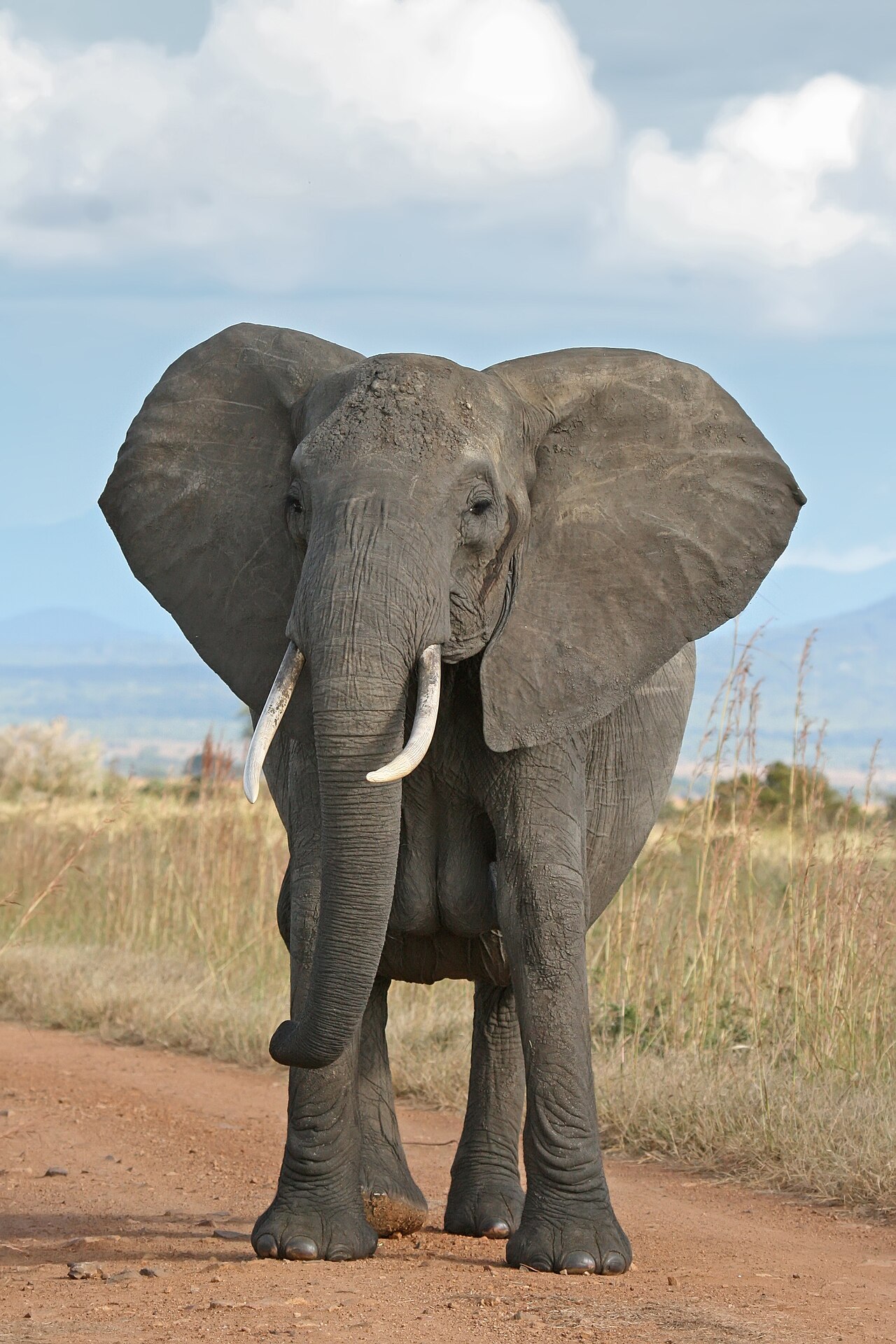
Elephants are the largest living land animals. Three living species are currently recognised: the African bush elephant (Loxodonta africana), the African forest elephant (L. cyclotis), and the Asian elephant (Elephas maximus). They are the only surviving members of the familyElephantidae and the orderProboscidea; extinct relatives include mammoths and mastodons. Distinctive features of elephants include a long proboscis called a trunk, tusks, large ear flaps, pillar-like legs, and tough but sensitive grey skin. The trunk is prehensile, bringing food and water to the mouth and grasping objects. Tusks, which are derived from the incisor teeth, serve both as weapons and as tools for moving objects and digging. The large ear flaps assist in maintaining a constant body temperature as well as in communication. African elephants have larger ears and concave backs, whereas Asian elephants have smaller ears and convex or level backs.Elephants are scattered throughout sub-Saharan Africa, South Asia, and Southeast Asia and are found in different habitats, including savannahs, forests, deserts, and marshes. They are herbivorous, and they stay near water when it is accessible. They are considered to be keystone species, due to their impact on their environments. Elephants have a fission–fusion society, in which multiple family groups come together to socialise. Females (cows) tend to live in family groups, which can consist of one female with her calves or several related females with offspring. The leader of a female group, usually the oldest cow, is known as the matriarch. (Full article...)
Image 25
Indian roller, Gujarat
The Indian roller (Coracias benghalensis) is a bird of the family Coraciidae. It is 30–34 cm (12–13 in) long with a wingspan of 65–74 cm (26–29 in) and weighs 166–176 g (5.9–6.2 oz). The face and throat are pinkish, the head and back are brown, with blue on the rump and contrasting light and dark blue on the wings and tail. The bright blue markings on the wing are prominent in flight. The sexes are similar in appearance. Two subspecies are recognised.The Indian roller occurs widely from West Asia to the Indian subcontinent. Often found perched on roadside trees and wires, it is common in open grassland and scrub forest habitats, and has adapted well to human-modified landscapes. It mainly feeds on insects, especially beetles. The species is best known for the aerobatic displays of males during the breeding season. Adult males and females form pair bonds and raise the young together. The female lays 3–5 eggs in a cavity or crevice, which is lined with a thin mat of straw or feathers. The roller is the state bird of three Indian states. It is listed as a species of least concern on the IUCN Red List. (Full article...)
Murugan, also known as Kartikeya, is the Hinduwar god, worshiped particularly by Tamil Hindus. Murugan has a peacock as a mount and is often depicted with six heads and twelve arms holding a variety of weapons. His consorts, pictured here, are Valli and Deivayanai.
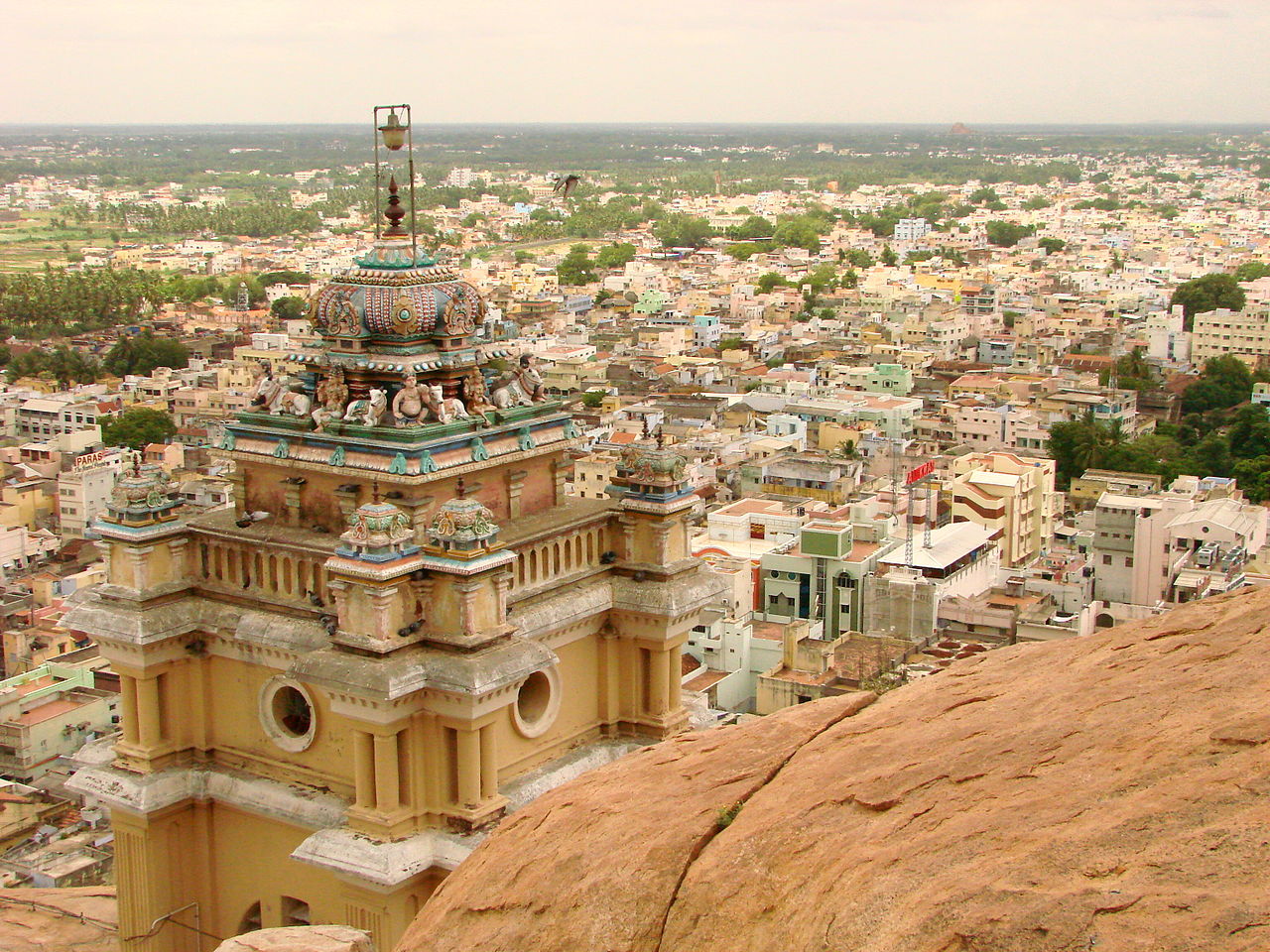
The Dharmaraya Swamy Temple is one of the oldest temples in Bangalore, India. It is thought to be more than 800 years old and is built in the Dravidian style, with a gopuram, an ornate monumental entrance tower. Gods worshipped here include Dharmaraya, Krishna, Arjuna, Draupadi and Bhima. The Karaga festival starts from the temple each year; the festival is dedicated to Draupadi, the most important female character in the Hindu epic, the Mahabharata. Starting at midnight, a priest dressed as a woman carries an earthen pot filled with water and adorned with decorations several feet high on his head in procession through the town, preceded by hundreds of bare-chested, dhoti-clad, turbaned Veerakumaras bearing unsheathed swords.
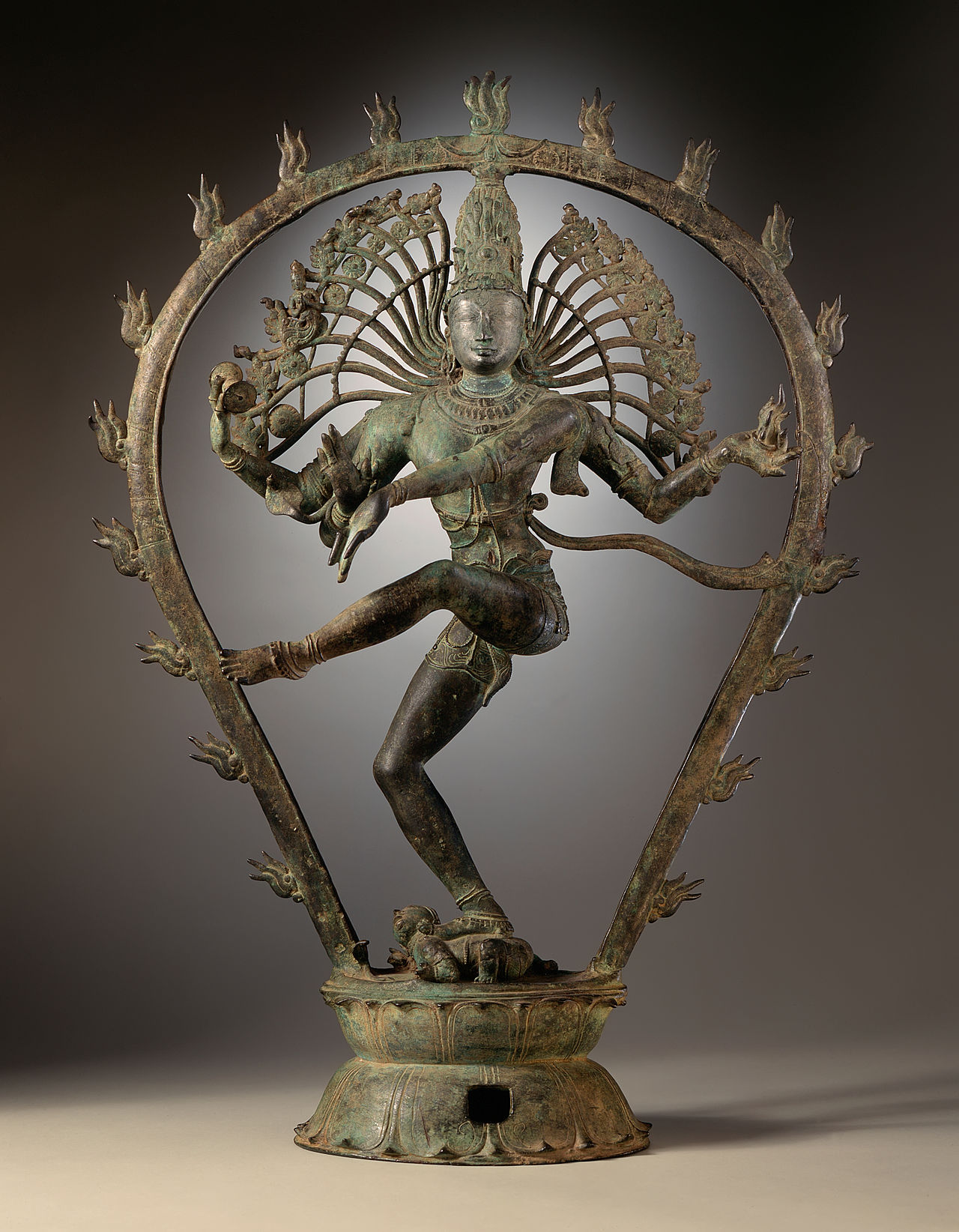
A statue of the Hindu god Shiva as Nataraja, the Lord of Dance. In this form, Shiva performs his divine dance to destroy a weary universe and make preparations for the god Brahma to start the process of creation. A Telugu and Tamil concept, Shiva was first depicted as Nataraja in the famous Chola bronzes and sculptures of Chidambaram. The form is present in most Shiva temples in South India, and is the main deity in Chidambaram Temple, the foremost Shaivist temple.
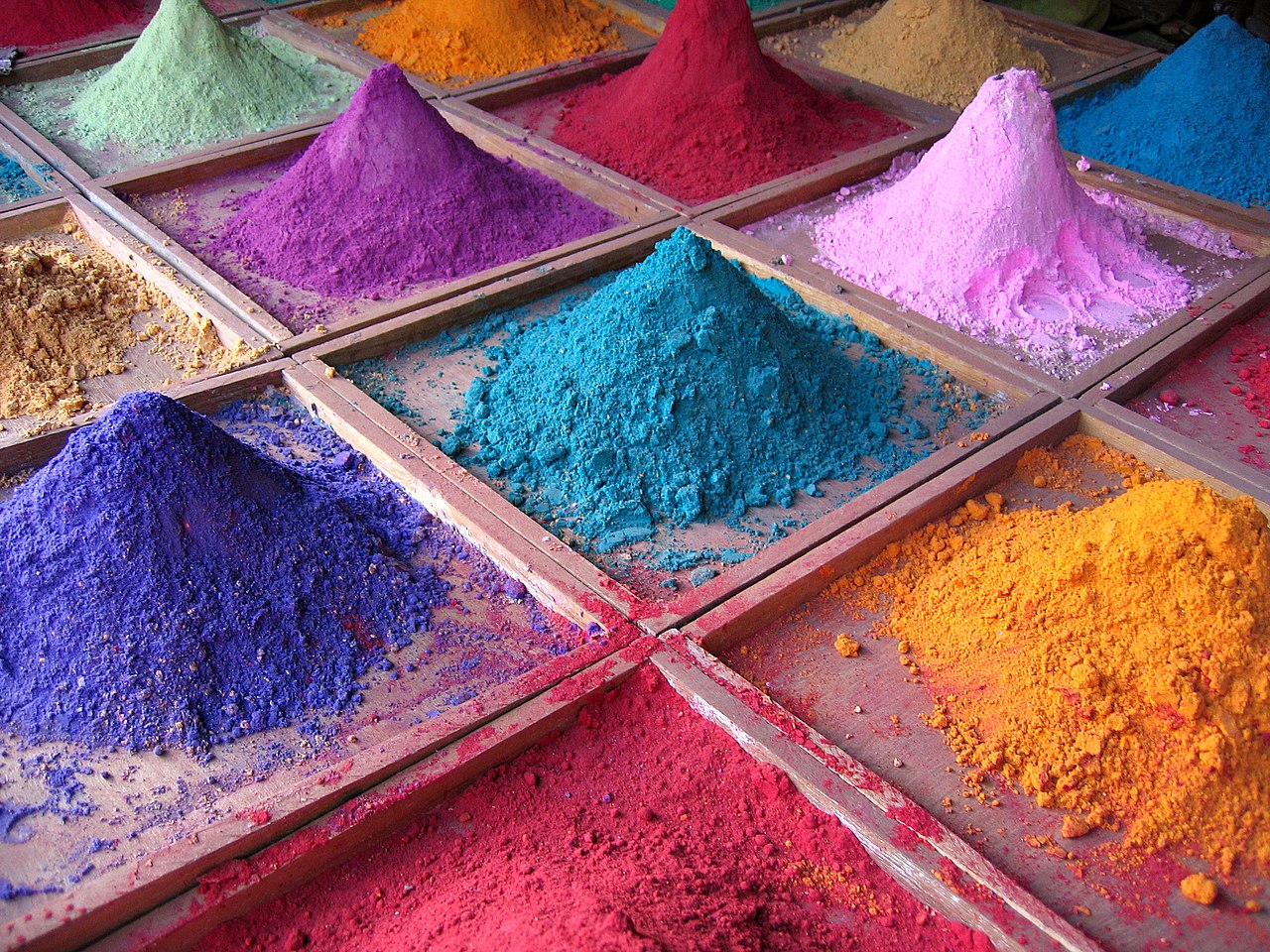
Pigments for sale at a market stall in Goa, India. Many pigments used in manufacturing and the visual arts are dry colourants, ground into a fine powder. This powder is then added to a vehicle or matrix, a relatively neutral or colorless material that acts as a binder, before it is applied. Unlike a dye, a pigment generally is insoluble.
The round ribbontail ray (Taeniura meyeni) is a species of stingray in the family Dasyatidae, found throughout the nearshore waters of the tropical Indo-Pacific region. Reaching 1.8 m (6 ft) across, this large ray is characterized by a thick, rounded pectoral fin disc covered by small tubercles on top, and a relatively short tail bearing a single venomous spine. The ray is well-camouflaged when lying on the seabed; it is largely nocturnal, and preys on molluscs, crustaceans and bony fish. Mature females bear litters of up to seven pups, which are fed during gestation on "uterine milk", a product secreted by the walls of the oviduct. This round ribbontail ray was photographed in Lakshadweep, India.
The Rudra Mahalaya Temple is an ancient temple complex at Siddhpur in the Patan district of Gujarat, India. The temple was completed in 1140 by Jayasimha Siddharaja, but in 1296, Alauddin Khalji sent an army under Ulugh Khan and Nusrat Khan, who dismantled the structure. In 1414 or 1415, the temple was further destroyed and the western part was converted into a congregational mosque by Muslim ruler Ahmad Shah I of the Muzaffarid dynasty. Apart from the mosque, the surviving fragments consist of two porches, a torana (ornamental gateway) and a few pillars.
An Indian merchant holding green chickpeas (Cicer arietinum). One of the earliest cultivated legumes, chickpeas are ingredients in a number of dishes around the world. India is the largest producer of this nutrient-dense food, accounting for 64% of global production in 2016.
A potter at work in Jaura, Madhya Pradesh, India. Pottery, defined by ASTM International as "all fired ceramic wares that contain clay when formed, except technical, structural, and refractory products", originated during the Neolithic period.
Al-Ameen College of Pharmacy is a pharmacy college in Bangalore, India. Established in 1983, it is under the purview of the Al-Ameen Educational Society.
Pomegranate juice is a beverage made from the fruit of the pomegranate. It is used in cooking both as a fresh juice and as a concentrated syrup. The fruit originated in the region extending from Iran to northern India and has been cultivated since ancient times. The fruit has a hard outer husk and a spongy mesocarp in which the seeds in their fleshy seedcoats are embedded. Pomegranate juice can be sweet or sour, but most fruits are moderate in taste. The juice has long been a popular drink in Europe and the Middle East, and is now widely distributed in the United States and Canada.
Leptosia nina, known as the psyche, is a species of butterfly in the family Pieridae (the sulphurs, yellows and whites), found in the Indian subcontinent, southeastern Asia, and Australia. It has a small wingspan of 2.5 to 5 cm (1 to 2 in). The upper side of the otherwise white forewing has a large, somewhat pear-shaped, black spot; this spot is also present on the underside which is scattered with greenish dots and speckles, sometimes arranged in bands. This L. nina butterfly was photographed in Kerala, India.
注目リスト –
これは、Wikipedia コミュニティが英語版 Wikipedia のベスト リストであるとみなしている注目リストです。
The Padma Vibhushan is the second highest civilian award of the Republic of India. Instituted on 2 January 1954, the award is given for the "exceptional and distinguished service", without distinction of race, occupation, position, or sex. The Padma Vibhushan award recipients are announced every year on Republic Day and registered in The Gazette of India—a publication released weekly by the Department of Publication, Ministry of Urban Development used for official government notices. The conferral of the award is not considered official without its publication in the Gazette. Recipients whose awards have been revoked or restored, both of which require the authority of the President, are also registered in the Gazette and are required to surrender their medals when their names are struck from the register. As of 2020, none of the conferments of Padma Vibhushan have been revoked or restored. The recommendations are received from all the state and the union territory governments, the Ministries of the Government, the Bharat Ratna and previous Padma Vibhushan award recipients, the Institutes of Excellence, the Ministers, the Chief Ministers and the Governors of State, and the Members of Parliament including private individuals. The recommendations received during 1 May and 15 September of every year are submitted to the Padma Awards Committee, constituted by the Prime Minister. The committee recommendations are later submitted to the Prime Minister and the President for the further approval.When instituted in 1954, the Padma Vibhushan was classified as "Pahla Varg" (Class I) under the three-tier Padma Vibhushan awards; preceded by the Bharat Ratna, the highest civilian award, and followed by "Dusra Varg" (Class II), and "Tisra Varg" (Class III). On 15 January 1955, the Padma Vibhushan was reclassified into three different awards; the Padma Vibhushan, the highest of the three, followed by the Padma Bhushan and the Padma Shri. The criteria includes "exceptional and distinguished service in any field including service rendered by Government servants" but excluding those working with the Public sector undertakings with the exception of doctors and scientists. The 1954 statutes did not allow posthumous awards but this was subsequently modified in the January 1955 statute. The award, along with other personal civil honours, was briefly suspended twice in its history; for the first time in July 1977 when Morarji Desai was sworn in as the fourth Prime Minister. The suspension was rescinded on 25 January 1980, after Indira Gandhi became the Prime Minister. The civilian awards were suspended again in mid-1992, when two Public-Interest Litigations were filed in the High Courts questioning the civilian awards being "Titles" per an interpretation of Article 18 (1) of the Constitution. The awards were reintroduced by the Supreme Court in December 1995, following the conclusion of the litigation. (Full article...)
Image 3
Matondkar in 2010Urmila Matondkar is an Indian actress known for her work in Hindi films. She has appeared in over 60 films. She has been praised by the critics for her acting and dancing skills. She made her screen debut as a child artist in B.R. Chopra's Karm (1977), and later appeared in Shekhar Kapur's highly acclaimed Masoom (1983). In 1991, she acted in the critically acclaimed film Dacait.After making her debut as the heroine in 1989 Malayalam thriller Chanakyan, Urmila began a full-time acting career, with a leading role in the 1991 action Narsimha. She rose to prominence with Ram Gopal Varma's blockbusterRangeela (1995). Her portrayal of an aspiring actress, Mili Joshi, opposite Aamir Khan received praise from critics, and garnered her first nomination for the Filmfare Award for Best Actress. (Full article...)
Image 4
Since Brabourne hosted its first international match in 1948, 35 Test centuries and 2 ODI centuries have been scored at the ground.Brabourne Stadium is a cricket ground in Mumbai, India. It is the home of the Cricket Club of India and has played host to Ranji Trophy matches (including seventeen finals) and Indian Premier League matches, as well as being a Test, One Day International and Twenty20 International (T20) venue. It has a capacity of 20,000 spectators. The ground has hosted eighteen Test matches, the first in 1948 when India played the West Indies. It has also staged nine One Day International matches, the first of which was in 1989 when Australia lost to Pakistan by 66 runs. One T20 International has been played at the ground when India beat Australia by 7 wickets in 2007 (first T20 International to be played in India). Of the nine One Day Internationals played at the stadium, five matches (including the final) were staged during the ICC Champions Trophy in 2006.The first Test century (100 or more runs in a single innings) scored at the ground was in 1948 by the West Indian Allan Rae in the first innings of the first Test match played at Brabourne Stadium. The first Indian to score a century at the Brabourne was Rusi Modi in the third innings of the same match. In total, 35 Test centuries have been scored at the ground in 18 Test matches. Virender Sehwag's 293, scored against Sri Lanka in 2009, is the highest Test innings achieved at the ground. The highest Test score by an overseas player is 194 by the West Indian Everton Weekes in 1948. Vijay Hazare has scored the most Test centuries at the ground with four. (Full article...)
Kapoor in 2022Ranbir Kapoor is an Indian actor known for his work in Hindi-language films. He worked as an assistant director on the films Aa Ab Laut Chalen (1999) and Black (2005), before making his acting debut in Sanjay Leela Bhansali's romantic drama Saawariya (2007). It earned Kapoor the Filmfare Award for Best Male Debut. He established himself in 2009 with leading roles in three films—the coming-of-age drama Wake Up Sid, the comedy Ajab Prem Ki Ghazab Kahani and the drama Rocket Singh: Salesman of the Year. He won the Filmfare Critics Award for Best Actor for his combined work in these three films. In 2010, Kapoor played a character based on Arjuna and Michael Corleone in the commercially successful political thriller Raajneeti.From 2011 to 2013, Kapoor's releases were among the highest-grossing Hindi films of their respective years. In Imtiaz Ali's musical Rockstar (2011), he played an aspiring singer, and in Anurag Basu's comedy-drama Barfi! (2012), he starred as a joyful deaf and mute man. His performance in both films was critically acclaimed and he earned two consecutive Best Actor awards at Filmfare and the former also earned him a Filmfare Critics Award for Best Actor. The romantic comedy Yeh Jawaani Hai Deewani (2013) further established him as a star. (Full article...)
Image 8
Rabindranath Tagore was the first Indian and also the first non-European and the first Asian to be awarded with the Nobel Prize. He received the prize for Literature in 1913.The Nobel Prize is a set of annual international awards bestowed on "those who conferred the greatest benefit on humankind" in the fields of Physics, Chemistry, Physiology or Medicine, Literature, Peace and Economic Sciences, instituted by Alfred Nobel's last will, which specified that a part of his fortune be used to create the prizes. Each laureate (recipient) receives a gold medal, a diploma and a sum of money, which is decided annually by the Nobel Foundation. The Royal Swedish Academy of Sciences awards the Nobel Prize in Physics, the Nobel Prize in Chemistry and the Sveriges Riksbank Prize in Economic Sciences in Memory of Alfred Nobel; the Nobel Assembly at the Karolinska Institute awards the Nobel Prize in Physiology or Medicine; the Swedish Academy awards the Nobel Prize in Literature; and the Norwegian Nobel Committee awards the Nobel Peace Prize. They are widely recognised as one of the most prestigious honours awarded in the aforementioned fields.First instituted in 1901, the Nobel Prize has been awarded to a total of 989 individuals (930 men and 59 women) and 30 organisations as of 2022. Among the recipients, 12 are Indians of which 5 are Indian citizens and 7 are of Indian ancestry or residency. Rabindranath Tagore was the first Indian citizen to be awarded and also the first non-European and the first Asian to be awarded in 1913. Mother Teresa is the only woman among the list of recipients. Sri Aurobindo, the Indian poet, philosopher, nationalist and developer of Integral yoga, was nominated unsuccessfully for the Nobel Prize in Literature in 1943 and for the Nobel Peace Prize in 1950. (Full article...)
Image 9
Enthiran (transl. Robot) is a 2010 Indian Tamil-languagescience fiction film directed by S. Shankar and produced by Kalanithi Maran. Shankar wrote the screenplay and co-wrote the dialogues with Sujatha and Madhan Karky. The film stars Rajinikanth and Aishwarya Rai with Danny Denzongpa, Santhanam, and Karunas playing supporting roles. The musical score was composed by A. R. Rahman while the cinematography, visual effects, editing, and art direction were handled by R. Rathnavelu, V. Srinivas Mohan, Anthony, and Sabu Cyril respectively. The film's story revolves around a scientist's struggle to control his creation, an android robot whose software is upgraded to give it the ability to comprehend and generate human emotions. The plan backfires when the robot falls in love with the scientist's fiancée and is further manipulated by a rival scientist to bring destruction to all who stand in its way. The film was dubbed into Hindi as Robot.Produced on an estimated budget of ₹1.32 billion, Enthiran was released on 1 October 2010 and yielded a revenue of ₹1.79 billion according to a report by the Sun TV Network. The film garnered awards and nominations in several categories, with particular praise for its cinematography, visual effects, art direction, costume design, and Rajinikanth's performance. The film has won 25 awards from 38 nominations. (Full article...)
Image 10
Harbhajan Singh has the third-highest number of Test wickets by an off spinner, behind Sri Lanka'sMuttiah Muralitharan and India's Ravichandran Ashwin in test match cricket.In cricket, a five-wicket haul (also known as a "fifer") refers to a bowler taking five or more wickets in a single innings. This is regarded as a notable achievement, and as of October 2024, only 54 bowlers have taken 15 or more five-wicket hauls at international level in their cricketing careers. A right-arm off break bowler, Harbhajan Singh has taken 417 wickets in Test, 269 wickets in One Day International (ODI) and 25 wickets in Twenty20 International (T20I) matches for India. He has the second-highest number of five-wicket hauls (28) in international cricket—next to Anil Kumble—among Indian cricketers and the eleventh among overall.Harbhajan made his Test debut against Australia in 1998. His first five-wicket haul came against the same team during the second Test of the 2000–01 series at Eden Gardens. His six wickets for 73 runs in the second innings of the match raised his tally to thirteen wickets in the match; his performance was instrumental in India winning the match after being forced to follow-on. In the third Test of the series, he claimed fifteen wickets for 217 runs, including career-best figures of eight wickets for 84 runs. The majority of his five-wicket hauls in Test cricket—seven out of his twenty-five—have come against Australia. (Full article...)
Image 11
Priyanka Chopra won several awards, including the National and Filmfare awards for Best Actress for her performance in FashionFashion is a 2008 Indian drama film directed by Madhur Bhandarkar and produced by UTV Motion Pictures. The film features Priyanka Chopra in the lead role, with Kangana Ranaut, Mugdha Godse, Arbaaz Khan and Arjan Bajwa in supporting roles as well as several professional fashion models playing themselves. Bhandarkar co-wrote the film with Ajay Monga and Anuraadha Tewari. Deven Murdeshwar edited the film while the cinematography was provided by Mahesh Limaye. Salim–Sulaiman composed the musical score, with lyrics written by Irfan Siddiqui and Sandeep Nath. The film focuses on the transformation of Meghna Mathur, an aspiring fashion model played by Chopra, from a small-town girl to a supermodel in the Indian fashion industry.Produced on a budget of ₹180 million (US$2.1 million), Fashion was released on 29 October 2008 to critical acclaim and box-office success. It grossed ₹600 million (US$7.1 million) and was noted for being commercially successful despite being a women-centric film with no male lead. Fashion received various awards and nominations, with praise for its direction, the performance of the cast, screenplay, editing, musical score, and costume design. (Full article...)
Members of the Indian cricket team before a Women's Cricket World Cup game in SydneyA One Day International (ODI) is an international cricket match between two teams, each having ODI status, as determined by the International Cricket Council. The women's variant of the game is similar to the men's version, with minor modifications to umpiring and pitch requirements. The first women's ODI was played in 1973, between England and Australia. The Indian women's team played their first ever ODI match in 1978, against England, after the Women's Cricket Association of India was formed. The Women's Cricket Association of India was merged with the Board of Control for Cricket in India in 2006 as part of the International Cricket Council's initiative to develop women's cricket.Since the team was formed, 151 women have represented India in ODI cricket. This list includes all players who have played at least one ODI match and is arranged in the order of debut appearance. Where more than one player won their first cap in the same match, those players are listed alphabetically by last name at the time of debut. (Full article...)
Image 14
Bachchan in 2013Abhishek Bachchan is an Indian actor and film producer known for his work in Hindi films. He made his acting debut opposite Kareena Kapoor in J. P. Dutta's war drama Refugee (2000), where his portrayal of the titular unnamed refugee earned a nomination for the Filmfare Best Male Debut Award. However, his subsequent films failed at the box office°, including Bas Itna Sa Khwaab Hai (2001), and Shararat (2002). His career prospects improved in 2004, when he played a gangster in Mani Ratnam's political drama Yuva and a police officer in Sanjay Gadhvi's action thriller Dhoom. The former won him his first Filmfare Award for Best Supporting Actor, and the latter became one of the highest-grossing films of the year and his first commercial success.In 2005, Bachchan teamed up with his father twice in Ram Gopal Varma's thriller Sarkar and the crime comedy Bunty Aur Babli. The latter was the second highest-grossing film of the year, and his performance in Sarkar earned him a second Filmfare Award for Best Supporting Actor. That same year, he appeared in the Bengali film Antarmahal (2005). 2006 proved to be key for Bachchan, as he received his third consecutive Filmfare Award for Best Supporting Actor for his performance in Karan Johar's musical romantic drama Kabhi Alvida Naa Kehna (2006), and reprised his role in the action sequel Dhoom 2 (2006), which became the highest-grossing Bollywood film to that point. Bachchan next starred alongside Aishwarya Rai in Ratnam's critically and commercially successful drama Guru (2007), a biopic inspired by the life of businessman Dhirubhai Ambani. His title role in the film was positively received. (Full article...)
Barfi! is a 2012 Indianromanticcomedy-drama film written and directed by Anurag Basu and produced by UTV Motion Pictures. The film features Ranbir Kapoor, Priyanka Chopra, and Ileana D'Cruz in the lead roles, with Saurabh Shukla, Ashish Vidyarthi, and Roopa Ganguly playing supporting roles. The screenplay which incorporates a nonlinear narrative was co-written by Basu with his wife Tani. Pritam Chakraborty composed the musical and background score while Akiv Ali edited the film, with the cinematography provided by Ravi Varman. Set between 1972 and 2012, the film narrates the story of the title character from Darjeeling and his relationships with two women, Shruti and the autistic Jhilmil.Made on a budget of approximately ₹410 million (US$4.8 million), Barfi! opened worldwide on 14 September 2012 to widespread critical acclaim. It was a major commercial success, grossing ₹1.88 billion (US$22 million) at the box office. Barfi! has received various awards and nominations, with praise for its direction, the cast's performances, cinematography, screenplay, musical score, costume and production design. As of June 2015, the film has won 70 awards. (Full article...)
Image 20
Bowlers have taken fifty-three five-wicket hauls in Tests and two five-wicket hauls in One Day International matches played at Chepauk.M. A. Chidambaram Stadium (MAC), also known as the Chepauk Stadium or simply Chepauk due its location in the city's locality of Chepauk, is a sports ground in Chennai, India that has hosted international cricket matches along with provincial games. Named after M. A. Chidambaram, former President of Board of Control for Cricket in India (BCCI), the venue was formerly known as the Madras Cricket Club ground. It has a capacity of 38,000 spectators for international matches. It is the home ground of the Tamil Nadu cricket team and the Indian Premier League team Chennai Super Kings. The first Test at this venue took place in 1934, between India and England. As of February 2021, it has hosted a further 33 Test matches. Chepauk has also staged 22 One Day International (ODI) matches, the first of which was in 1987 when Australia defeated India in a group-match during the 1987 World Cup.In cricket, a five-wicket haul (also known as a "five-for" or "fifer") refers to a bowler taking five or more wickets in a single innings. This is regarded as a notable achievement. The first bowler to take a five-wicket haul in a Test match at Chepauk was Amar Singh for India against England in 1934; he finished the innings with bowling figures of 7 wickets for 86 runs. Australia's Ashley Mallett became the first to take two five-wicket hauls in the same match at Chepauk, when he took 5 for 91 and 5 for 53 in the second and fourth innings of the fifth Test of Australia's 1969–70 tour of India. Narendra Hirwani is the most recent cricketer and the first Indian to take two five-wicket hauls on debut. He took 8 for 61 and 8 for 75 against the West Indies during the fourth Test of the 1987–88 series between the teams, which was held at this ground, and finished the match with bowling figures of 16 for 136. These are also the best match-figures by any bowler on Test debut. The best figures in Test cricket at Chepauk are 8 for 55, taken by India's Vinoo Mankad against England in 1952. Axar Patel took the most recent five-wicket haul at Chepauk, with figures of 5 for 60 against England in their 2020–21 tour of India. As of September 2024, 33 bowlers have taken 53 Test match five-wicket hauls at this ground. (Full article...)
The President of the Indian National Congress is the chief executive of the Indian National Congress (INC), one of the principal political parties in India, founded by retired British civil servant Allan Octavian Hume. Constitutionally, the president is elected by an electoral college composed of members drawn from the Pradesh Congress Committees and members of the All India Congress Committee (AICC). In the event of any emergency because of any cause such as the death or resignation of the president elected as above, the most senior general secretary discharges the routine functions of the president until the Working Committee appoints a provisional president pending the election of a regular president by the AICC. The president of the party has effectively been the party's national leader, head of the party's organisation, head of the Working Committee, the chief spokesman, and all chief Congress committees.After the party's foundation in December 1885, Womesh Chandra Banerjee became its first president. From 1885 to 1933, the presidency had a term of one year only. From 1933 onwards, there was no such fixed term for the president. During Jawaharlal Nehru's premiership, he rarely held the Presidency of INC, even though he was always head of the Parliamentary Party. Despite being a party with a structure, Congress under Indira Gandhi did not hold any organisational elections after 1978. In 1978, Gandhi split from the INC and formed a new opposition party, popularly called Congress (I), which the national election commission declared to be the real Indian National Congress for the 1980 general election. Gandhi institutionalised the practice of having the same person as the Congress president and the prime minister of India after the formation of Congress (I). Her successors Rajiv Gandhi and P. V. Narasimha Rao also continued that practice. Nonetheless, in 2004, when the Congress was voted back into power, Manmohan Singh became the first and only prime minister not to be the president of the party since establishment of the practice of the president holding both positions. (Full article...)
Image 23
Aadukalam (transl. Arena) is a 2011 Indian Tamil-language drama film written and directed by Vetrimaaran and produced by S. Kathiresan. Vetrimaaran co-wrote the dialogues with Vikram Sugumaran. The film stars Dhanush and Taapsee Pannu with Kishore, V. I. S. Jayapalan, Naren, and Murugadoss playing supporting roles. The musical score was composed by G. V. Prakash Kumar while the cinematography and editing were respectively handled by Velraj and Kishore Te. The film's story revolves around Karuppu who is the understudy of an experienced cockfighter, Pettaikaran. When Karuppu wins in a cockfight against Pettaikaran's rival Rathnasamy, Pettaikaran, who is initially happy, becomes jealous of Karuppu's newfound popularity and plots his downfall.Produced on a budget of ₹150-200 million, Aadukalam was released on 14 January 2011 and grossed ₹300 million according to a February 2011 report by The Economic Times. The film garnered awards and nominations in several categories, with particular praise for its direction, screenplay, Dhanush's performance, music, cinematography, and editing. The film has won 33 awards from 52 nominations. (Full article...)
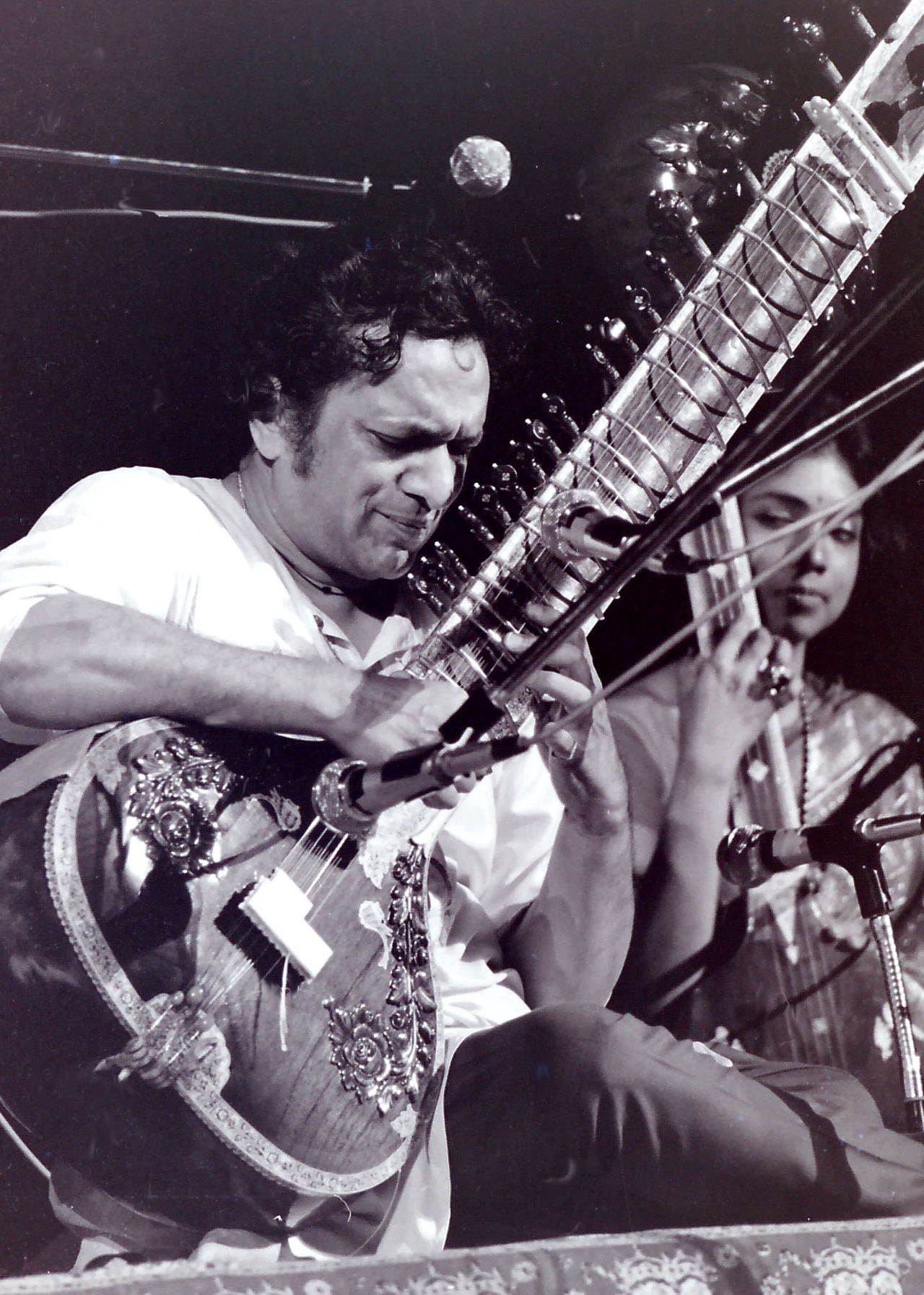
Pandit Ravi Shankar (Bengali pronunciation:[ˈrobiˈʃɔŋkor]; born Robindro Shaunkor Chowdhury, sometimes spelled as Ravindra Shankar Chowdhury; 7 April 1920 – 11 December 2012) was an Indian sitarist and composer. A sitar virtuoso, he became the world's best-known exponent of Indian classical music in the second half of the 20th century, and influenced many musicians in India and throughout the world. Shankar was awarded India's highest civilian honour, the Bharat Ratna, in 1999. He is also the father of American singer Norah Jones and British-American musician and sitar player Anoushka Shankar.Shankar was born to a Bengali family in India, and spent his youth as a dancer touring India and Europe with the dance group of his brother Uday Shankar. At age 18, he gave up dancing to pursue a career in music, studying the sitar for seven years under court musician Allauddin Khan. After finishing his studies in 1944, Shankar worked as a composer, creating the music for the Apu Trilogy by Satyajit Ray, and was music director of All India Radio, New Delhi, from 1949 to 1956. (Full article...)
Image 3
George VernonIn the 1889–90 cricket season, an English team managed by George Vernon and captained by Lord Hawke toured Ceylon and India. It was a pioneering tour being the first visit by an English team to India and the second to Ceylon, following the stopover by Ivo Bligh's team to Australia in 1882–83. Vernon's team, known as G. F. Vernon's XI, was entirely composed of players with amateur status and, in the absence of professionals, none of its matches have been recognised as first-class. In all, they played thirteen matches from 28 November 1889 to 1 March 1890, starting with two games in Ceylon before moving on to Calcutta where the Indian part of the tour began in late December.Of the thirteen matches, Vernon's XI won ten (six by over an innings) and drew two. They were defeated only once, by the Parsis in a match which had great significance for the native communities living under the rule of the British Raj. The matches were all played under the Laws of Cricket which prevailed in England at the time, including the compulsory follow-on and the recently introduced 5-ball over. The tour was a success and it made a significant contribution to the growth and development of cricket in the sub-continent. (Full article...)
Image 4
Pair of ruddy shelducks
The ruddy shelduck (Tadorna ferruginea) is a bird species in the familyAnatidae. It is a distinctive waterfowl, 58 to 70 cm (23 to 28 in) in length with a wingspan of 110 to 135 cm (43 to 53 in). It has orange-brown body plumage with a paler head, while the tail and the flight feathers in the wings are black, contrasting with the white wing-coverts. It is a migratory bird, wintering in the Indian subcontinent and breeding in southeastern Europe and central Asia, though there are small resident populations in North Africa. It has a loud honking call.The ruddy shelduck mostly inhabits inland water-bodies such as lakes, reservoirs and rivers. The male and female form a lasting pair bond and the nest may be well away from water, in a crevice or hole in a cliff, tree or similar site. A clutch of about eight eggs is laid and is incubated solely by the female for about four weeks. The young are cared for by both parents and fledge about eight weeks after hatching. (Full article...)
Image 5
The Bharat Ratna (Hindi pronunciation:[bʱaːɾət̪ɾət̪n̪(ᵊ)]; lit.'Gem of India') is the highest civilian award of the Republic of India. Instituted on 2 January 1954, the award is conferred in recognition of "exceptional service/performance of the highest order", without distinction of race, occupation, position or gender. The award was originally limited to achievements in the arts, literature, science, and public services, but the Government of India expanded the criteria to include "any field of human endeavor" in December 2011. The recipients receive a Sanad (certificate) signed by the president and a peepal leaf-shaped medallion. Bharat Ratna recipients rank seventh in the Indian order of precedence.The first recipients of the Bharat Ratna were: the former governor-general of the Union of IndiaC. Rajagopalachari, the former president of the Republic of IndiaSarvepalli Radhakrishnan; and the Indian physicist C. V. Raman, who were honoured in 1954. Since then, the award has been bestowed upon 53 individuals, including 18 who were awarded posthumously. The original statutes did not provide for posthumous awards but were amended in January 1966 to permit them to honor former prime minister Lal Bahadur Shastri, the first individual to be honored posthumously. In 2014, cricketer Sachin Tendulkar, then aged 40, became the youngest recipient, while social reformer Dhondo Keshav Karve was the oldest recipient when he was awarded on his 100th birthday. Though usually conferred on India-born citizens, the award has been conferred on one naturalized citizen, Mother Teresa, and on two non-Indians: Abdul Ghaffar Khan (born in British India and later a citizen of Pakistan) and Nelson Mandela, a citizen of South Africa. (Full article...)
Image 6
Taruni Sachdev (14 May 1998 – 14 May 2012) was an Indian child actress. She made her film debut in 2004 with Vellinakshatram, which endeared her to Malayalam audiences. The same year, she appeared in Sathyam and she act the lead role in 2009. She also appeared in over 50 advertisements for various companies. Her last film was a Tamil film Vetri Selvan (2014), which was released two years after her death. She died in the 2012 Agni Air Dornier 228 crash near Jomsom Airport in Nepal. Her mother also died in the crash. (Full article...)
Image 7
Shri Kali Temple, Burma, a Hindu temple with Dravidian architecture in YangonBurmese Indians are a group of people of Indian origin who live in Myanmar (Burma). The term 'Burmese Indian' refers to a broad range of people from South Asia, most notably from present-day countries such as India and Bangladesh. While Indians have lived in Burma for many centuries, most of the ancestors of the current Burmese Indian community emigrated to Burma from the start of British rule in the mid-19th century to the separation of British Burma from British India in 1937. During colonial times, ethnic Indians formed the backbone of the government and economy serving as soldiers, civil servants, merchants, moneylenders, mobile laborers and dock workers. A series of anti-Indian riots in the 1930s and mass emigration at the onset of the Japanese invasion of Burma in 1942 were followed in the 1960s by the forced migration of hundreds of thousands of ethnic Indians, exacerbated by internal conflict in Myanmar.Burmese Indians today are estimated to account for approximately 5% (about 2.0–2.5 million people) of the population of Burma and are concentrated largely in the two major cities (Yangon and Mandalay) and former colonial towns (Pyin U Lwin and Kalaw). They wield considerable influence and control over the Burmese economy and have a major socio-cultural presence within the country. Amongst the well-known Burmese Indians is S N Goenka, a leading practitioner and teacher of vipassanā meditation and Helen, a well-known Bollywood film actress who is also of Anglo-Burmese descent. (Full article...)
Image 8
General Lord Cornwallis receiving Tipu Sultan's sons as hostages, by Robert Home, c. 1793British General Charles Cornwallis, the Earl Cornwallis, was appointed in February 1786 to serve as both Commander-in-Chief of British India and Governor of the Presidency of Fort William, also known as the Bengal Presidency. He oversaw the consolidation of British control over much of peninsular India, setting the stage for the British Raj. He was also instrumental in enacting administrative and legal reforms that fundamentally altered civil administration and land management practices there. According to historian Jerry Dupont, Cornwallis was responsible for "laying the foundation for British rule throughout India and setting standards for the services, courts, and revenue collection that remained remarkably unaltered almost to the end of the British era."He was raised to the title of Marquess Cornwallis in 1792 as recognition for his performance in the Third Anglo-Mysore War, in which he extracted significant concessions from the Mysorean ruler, Tipu Sultan. Returned to England in 1793, he was engaged in administrative and diplomatic postings until 1798, when he was posted to the Kingdom of Ireland as Lord Lieutenant and Commander-in-Chief. In 1801, he was again posted to India. He arrived in July 1805 and died in October in Ghazipur. (Full article...)
Image 9
Oppam (transl. Along) is a 2016 Indian Malayalam-language neo-noircrime thriller film directed by Priyadarshan from a story by Govind Vijayan. The film, produced Antony Perumbavoor for Aashirvad Cinemas, stars Mohanlal, Samuthirakani and Nedumudi Venu in lead roles.The songs were composed by the group 4 Musics, while the score was composed by Ron Ethan Yohann. The cinematography and editing were handled by N. K. Ekambaram and M. S. Ayyappan Nair.Regular collaborators Mohanlal and Priyadarshan were expected to work on a film in 2015, but it was postponed before principal photography began until the following year. Priyadarshan decided to make another film with Mohanlal, and began looking at screenplays. They wanted a break from their usual comedy films. Priyadarshan agreed on a short story by Govind Vijayan which was suggested by Mohanlal. The director developed a plot and screenplay, which was on its final draft in February 2016. The film began principal photography in March and ended in June; it was filmed in Kochi, Ooty, Vagamon, Thiruvananthapuram, and Idukki. (Full article...)
Fort Dansborg (Danish: Dansborg), locally called Danish Fort, is a Danish fort located in the shores of Bay of Bengal in Tranquebar (Tharangambadi) in the Mayiladuthurai District, state of Tamil Nadu. Fort Dansborg was built in the land ceded by Thanjavur king Ragunatha Nayak in an agreement with Danish Admiral Ove Gjedde in 1620 and acted as the base for Danish settlement in the region during the early 17th century. The fort is the second largest Danish fort after Kronborg. The fort was sold to the British in 1845 and along with Tranquebar, the fort lost its significance as the town was not an active trading post for the British. After India's independence in 1947, the fort was used as an inspection bungalow by the state government until 1978 when its archaeology department took control of the fort. The fort is now used as a museum where the major artifacts of the fort and the Danish colonial empire in India are displayed.The fort was renovated twice in modern times, by the Tranquebar Association with the help of the Danish royal family and the state's archaeology department in 2001 and by the state's tourism department in 2011. (Full article...)
Image 12
Pushkar Lake or Pushkar Sarovar is located in the town of Pushkar near Ajmer city in Ajmer district of the Rajasthan state of western India. Pushkar Lake is a sacred lake for the Hindus. The Hindu scriptures describe it as "Tirtha-Guru" [Thirtha Raj]– the perceptor of pilgrimage sites related to a water-body and relate it to the mythology of Brahma, the creator-god in Hinduism, whose most prominent temple stands in Pushkar. The Pushkar Lake finds mention on coins as early as the 4th century BC.Pushkar Lake is surrounded by 52 bathing ghats (a series of steps leading to the lake), where pilgrims throng in large numbers to take a sacred bath, especially around Kartik Poornima (October–November) when the Pushkar Fair is held. A dip in the sacred lake is believed to cleanse sins and cure skin diseases. Over 500 Hindu temples are situated around the lake precincts. (Full article...)
Image 13
British troops lined up on the beach awaiting evacuation
The Dunkirk evacuation, codenamed Operation Dynamo and also known as the Miracle of Dunkirk, or just Dunkirk, was the evacuation of more than 338,000 Allied soldiers during the Second World War from the beaches and harbour of Dunkirk, in the north of France, between 26 May and 4 June 1940. The operation began after large numbers of Belgian, British, and French troops were cut off and surrounded by German troops during the six-week Battle of France.After Germanyinvaded Poland in September 1939, France and the British Empire declared war on Germany and imposed an economic blockade. The British Expeditionary Force (BEF) was sent to help defend France. After the Phoney War of October 1939 to April 1940, Germany invaded Belgium, the Netherlands, and France on 10 May 1940. Three panzer corps attacked through the Ardennes and drove northwest to the English Channel. By 21 May, German forces had trapped the BEF, the remains of the Belgian forces, and three French field armies along the northern coast of France. BEF commander GeneralViscount Gort immediately saw evacuation across the Channel as the best course of action, and began planning a withdrawal to Dunkirk, the closest good port. (Full article...)
Image 14
"Didi Tera Devar Deewana" (transl. Sister, your brother-in-law is crazy) is a 1994 Hindi-language filmi song performed by Lata Mangeshkar and S. P. Balasubrahmanyam for the soundtrack of the 1994 Indian musical romantic drama film Hum Aapke Hain Koun..!. The track was composed by Raamlaxman, while lyrics were written by Dev Kohli. Hum Aapke Hain Koun..! was written and directed by Sooraj R. Barjatya and produced under the banner of Rajshri Productions. The music video of "Didi Tera Devar Deewana" shows the film's ensemble cast and leads Madhuri Dixit and Salman Khan dancing at a baby shower ceremony.The song became very famous after its release, with it reaching various music charts and bagging the Filmfare Special Award for Mangeshkar. The purple jaded satin saree designed by Anna Singh and sported by Dixit in the video trended in the markets, being also merchandised. Dixit's dance and looks throughout the clip were met with highly positive reviews. After watching the song's video, artist M. F. Husain found his muse in Dixit and went on to paint a series of paintings on her. The song is also featured on the dance rhythm video game Just Dance 3 with the song credited as Kurio ko uddah le jana by Bollywood Rainbow. (Full article...)
Image 15
India competed at the 2022 Winter Olympics in Beijing, China, from 4 to 20 February 2022. The country's participation in Beijing marked its eleventh appearance at the Winter Olympics since its debut in 1964. The India team consisted of one male alpine skier, Arif Khan, who was the country's flag-bearer during the opening ceremony. He did not win a medal, and as of these Games, India had not earned a Winter Olympic medal. A volunteer served as the flag-bearer during the closing ceremony. (Full article...)
Image 16
Vishnu's Vaikuntha Chaturmukha form holding Gadadevi (right hand) and Chakrapurusha in his hands.Ayudhapurusha is the anthropomorphic depiction of a divine weapon in Hindu art. Ayudhapurushas are sometimes considered as partial incarnates of their divine owners.The sex of the personified weapon is determined by the gender of the weapon in the Sanskrit language. The suffix "purusha" (man) is added to masculine weapons and "devi" (goddess) to female ones. The weapons Shakti, Heti (a Hatchet-like weapon) and Gada (mace), especially Kaumodaki (the mace of Vishnu), Dhanus/Dhanushya ("bow") are women. Chakra, especially Vishnu's Sudarshana Chakra (discus of Vishnu), Shankha ("conch"), Padma (lotus), Ankusha (elephant goad), Pasha (noose), Trisula (trident), vajra (thunderbolt), Khadga (sword), Danda (a sceptre or club), Bana/Shara ("arrow") and Bhindi (sling) are depicted male. (Full article...)
The Ross Island Prison Headquarters, 1872Ross Island Penal Colony was a convict settlement that was established in 1858 in the remote Andaman Islands by the British colonial government in India, primarily to jail a large number of prisoners from the Indian Rebellion of 1857, also known as the Indian Mutiny. With the establishment of the penal colony at Ross Island, the British administration made it the administrative headquarters for the entire group of Andaman and Nicobar Islands and built bungalows and other facilities on the site. This colony was meant as "manageable models of colonial governance and rehabilitation". The Chief Commissioner's residence was located at the highest point on the island. Over time, several other islands including Chatham and Viper were used for the penal colony.The penal colony became infamous as "Kalapani" or "black water" for the brutalities inflicted by the British authorities on the political prisoners from India, and most of whom had died by 1860 due to illness and torture suffered during the initial stages of the clearance of the forest to establish the colony. In later years the colony experimented for a short time with civilizing the indigenous people of Andamans. The penal colony was used as an experimental station for various methods of torture and medical tests During World War II, the island was invaded by the Japanese army, forcing the British to evacuate. The administrative buildings were destroyed but the penal colony remained. After the Allied forces reoccupied the island the penal colony was disbanded on 7 October 1945. (Full article...)
Image 22
Gandhidham based WDG-4G twins at New Jalpaiguri Jn.
The Indian locomotive class WDG-4G (GE ES43ACmi) is a class of dual-cabin freight-hauling diesel–electric locomotive used by the Indian Railways (IR). The locomotive is designed by GE Transportation and is based on its Evolution Series, which are used in North America. The class is meant for freight hauling and replaces the older American Locomotive Company (ALCO)-designed locomotives, which have been the mainstay diesels of Indian Railways since 1962. Equipped with a 12-cylinderfully turbocharged GEVO engine, it is claimed to be 50% more environmentally friendly than its predecessors and is the first in the country to be compliant with level one of the emission norms set by the International Union of Railways (UIC-1). The locomotive has two cabs for easy reversal, both of which are air conditioned.The locomotive is part of a 13-year contract between Indian Railways and GE Transportation under which 700 such locomotives will be produced indigenously. Diesel Locomotive Factory, Marhowrah was set up by GE for the production and supply of these locomotives which is also seen as a boost to the Make in India initiative. The maintenance of the locomotive will be GE's responsibility which will also have to ensure that 95% of the fleet is ready at all times. For this, real time remote tracking and fault diagnostics has been implemented in the locomotive. (Full article...)
Chennai Express is a 2013 Indian action comedy film directed by Rohit Shetty and produced by UTV Motion Pictures and Red Chillies Entertainment. The film stars Shah Rukh Khan and Deepika Padukone with Nikitin Dheer and Sathyaraj in supporting roles. It revolves around Rahul Mithaiwala, a businessman who accidentally boards the eponymous train and journeys from Mumbai to Rameswaram with the daughter of an influential crime boss. The film, primarily in Hindi, contains significant Tamil dialogue due to its setting in Rameswaram.The first planned collaboration between Khan and Shetty was a remake of Angoor (1982). The script of Chennai Express, which was initially written as a backup project for Khan, was chosen instead. Conceived as a "commercial romance", the film was originally titled Ready Steady Po. Filming began in Mehboob Studio in October 2012 and was completed by May 2013. A large part of the film was set in Ooty, for which sets were constructed in Wai and also in Ramoji Film City. The soundtrack for Chennai Express was composed by Vishal–Shekhar, with the background score being composed by Amar Mohile. UTV Motion Pictures came on board as producer and distributor, marking its first active project with Khan after Swades (2004). (Full article...)


.svg)
 特集記事 –


.jpg/1280px-Priyanka_Chopra_at_Bulgary_launch,_2024_(cropped).jpg)


.png)




_wb_edit.jpg/1280px-Brahmaea_wallichii_insulata_(Brahmeid_Moth)_wb_edit.jpg)


.jpg/1280px-Pomegranate_Juice_(2019).jpg)


.jpg/1280px-Medal,_order_(AM_2014.7.12-17).jpg)


.jpg)


_2.jpg/1280px-Snehal_Pradhan_(10_March_2009,_Sydney)_2.jpg)


.jpg/1280px-Tamannaah_Bhatia_at_the_Aaj_Ki_Raat_launch_event_(cropped).jpg)




.jpg)


_wb_edit.jpg)


.jpg)


.jpg)


_2.jpg)


.jpg)


